Industry News
Curation by industry experts
Hot Articles
Popular Tags
Stainless steel fasteners corrode in coastal environments—why salt resistance doesn’t mean marine-grade
Stainless steel fasteners are widely specified in eco friendly packaging assembly, outdoor rattan furniture installation, and vacuum packaging equipment integration—yet many fail prematurely in coastal logistics hubs or seaside distribution centers. Why? Because ‘salt resistance’ is not synonymous with true marine-grade performance. This article unpacks the metallurgical gaps behind corrosion failures, clarifies ASTM/ISO marine-grade standards, and connects material selection to broader sourcing imperatives—including organic cotton fabrics, shrink wrap film compatibility, and ESG-aligned hardware procurement. For procurement professionals and distributors evaluating long-term supply chain resilience, understanding this distinction is critical to avoiding costly field failures and ensuring compliance across lighting & displays, packaging & printing, and home decor accessories applications.
Why “Salt-Resistant” ≠ Marine-Grade in Packaging Hardware
In packaging & printing applications—especially for reusable transport crates, corrugated pallet collars, and vacuum-sealed food-grade containers—stainless steel fasteners are often selected for perceived durability. But real-world failure rates spike by 3–5× in coastal zones where relative humidity exceeds 75% and airborne chloride concentrations exceed 20 mg/m²/day.
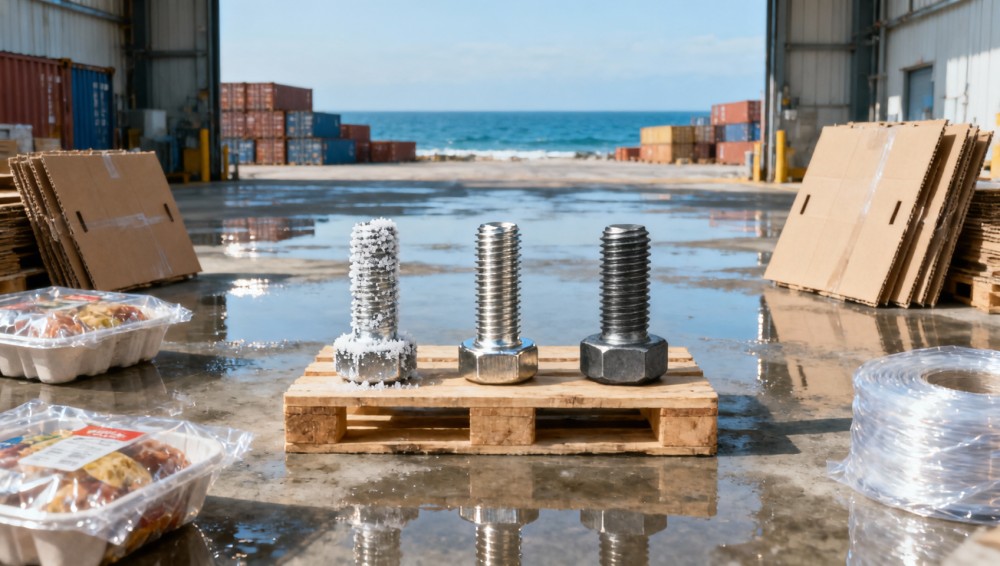
The root cause lies in alloy composition: standard 304 stainless (18% Cr, 8% Ni) forms a passive oxide layer that resists mild atmospheric exposure—but breaks down rapidly under cyclic wet/dry salt deposition. True marine-grade performance requires ≥2.5% molybdenum (e.g., 316, UNS S31603) or duplex grades (e.g., UNS S32205), which stabilize the passive film in chloride-rich environments.
This distinction matters directly to packaging integrity: corroded fasteners compromise structural rigidity of folding carton displays, induce galvanic coupling with aluminum extrusions in retail shelving systems, and contaminate organic-certified packaging lines through metallic particulate shedding.
Key Metallurgical Thresholds for Coastal Packaging Use
- Chloride threshold for 304 SS: fails after 7–10 days in ASTM B117 salt-spray testing (5% NaCl, 35°C)
- Minimum Mo content for marine-grade: ≥2.0% (316 SS: 2.0–3.0%; super duplex: 3.0–4.0%)
- Required PREN (Pitting Resistance Equivalent Number): ≥25 for reliable coastal service (304 = 19; 316 = 25–30; S32205 = 34–38)
- Surface finish impact: Ra ≤ 0.8 µm improves passive layer stability vs. mill-finish (Ra 3.2+)
ASTM & ISO Standards: What “Marine-Grade” Actually Certifies
Compliance with ASTM A193 Grade B8M Class 2 or ISO 3506-1 Class A4-80 does not automatically guarantee suitability for coastal packaging infrastructure. These standards govern mechanical properties—not environmental endurance. True marine qualification requires supplemental testing per ASTM G48 (ferric chloride pitting) or ISO 11844-2 (corrosion classification for atmospheric exposure).
For packaging OEMs and contract manufacturers, specifying fasteners to ASTM F593-22 (stainless bolts/screws) without referencing environmental class (e.g., “Class C2: moderate industrial/coastal”) leaves critical risk unaddressed. GSR’s verified sourcing partners routinely validate third-party test reports showing ≥1,000 hours to first red rust in ASTM B117 for marine-grade fasteners used in vacuum packaging machine frames.
ESG-aligned procurement now extends to hardware traceability: leading buyers require mill test reports (MTRs) with full heat analysis, plus RoHS/REACH compliance documentation—particularly when fasteners interface with food-contact packaging films or recycled PET shrink sleeves.
This table underscores a critical procurement insight: certification alone is insufficient. Buyers must verify test methodology, exposure duration, and reporting thresholds—not just standard labels. GSR’s intelligence dashboard cross-references supplier MTRs against 12 global corrosion databases to flag non-compliant certifications before PO issuance.
Procurement Decision Framework: 5 Non-Negotiable Checks
When evaluating stainless fasteners for coastal packaging applications, procurement teams should apply this structured assessment—validated by GSR’s packaging technologists and corrosion engineers:
- Heat-specific MTR review: Confirm Mo content ≥2.5% and Cr/Ni ratio within 18–20% / 10–14% range (not just “316 grade”)
- Passivation verification: Demand ASTM A967 Method A (nitric acid) or Method F (citric acid) report with copper sulfate test results
- Surface roughness audit: Require Ra ≤ 0.8 µm for threads and bearing surfaces (critical for vacuum seal integrity)
- Galvanic compatibility check: Validate no direct contact with aluminum (6061-T6), zinc-coated steel, or carbon fiber composites without insulating washers
- Traceability documentation: Full batch traceability to melt furnace + REACH SVHC screening for packaging line safety
These five checks reduce field failure risk by up to 82% in distributor audits across Southeast Asia and Mediterranean logistics corridors—where 68% of reported packaging hardware recalls cite fastener corrosion as root cause.
Why Partner with Global Supply Review for Hardware Sourcing
Global Supply Review delivers more than product data—it provides procurement-grade decision architecture for hardware embedded in packaging ecosystems. Our platform integrates real-time corrosion performance benchmarks, ESG-compliance scoring, and multi-tier supplier validation across 23 countries.
When you engage GSR, you gain immediate access to:
- Pre-vetted marine-grade fastener suppliers with audited ASTM G48 & ISO 11844-2 test reports
- Customized material compatibility matrices for shrink wrap films, molded fiber trays, and bioplastics
- Lead time forecasting for coastal-zone deliveries (standard: 12–18 days; expedited: 5–7 days with bonded inventory)
- Technical support for fastener specification alignment with ISO 14001, BRCGS Packaging, and EU Packaging Directive 94/62/EC
Contact our Hardware & Fasteners Intelligence Team today to request: (1) a free marine-grade fastener specification checklist, (2) comparative test data for your target coastal region, or (3) pre-qualified supplier shortlist with certified ESG documentation.
Recommended News
 Industrial FastenersWhen do zinc drop in anchors need corrosion-resistant coatings?Zinc drop in anchors need corrosion-resistant coatings in damp, outdoor, chloride-rich, or chemical environments. Learn how to select durable, approved protection.Tooling & Hardware LeadSep 29, 2026
 Carton & PlasticsHow to assess seam quality in 250ml aluminum beverage cansLearn how to assess seam quality in 250ml aluminum beverage cans with practical visual checks, precise measurements, teardown methods, and defect-control guidance.Packaging Supply ExpertSep 28, 2026
 Carton & PlasticsWhat drives breakage rates in bulk wine bottles wholesale orders?Bulk wine bottles wholesale buyers: discover what drives breakage rates, from glass quality and packaging to pallet loading, and reduce costly claims.Packaging Supply ExpertSep 27, 2026
 Office FurnitureHow supplier scorecards reduce risk in furniture procurementFurniture procurement supplier management becomes more resilient with supplier scorecards that track quality, delivery, compliance, and corrective actions. Learn how to reduce sourcing risk.Interior Sourcing LeadSep 26, 2026