Industry News
Curation by industry experts
Hot Articles
Popular Tags
When do smart lighting systems for hotels pay for themselves?
Smart lighting systems for hotels pay for themselves when cumulative electricity and maintenance savings, after recurring costs, recover the installed investment. That happens sooner where lighting stays on for long periods without being needed, electricity is expensive, and controls can be added with limited disruption. Payback becomes harder to justify where efficient LEDs, effective schedules, and existing occupancy controls have already removed much of the waste.
There is no defensible universal payback period. A proposal should earn approval through a calculation based on the property’s actual lighting load, operating patterns, installation costs, and ongoing fees. Guest convenience and design flexibility may support the purchase, but the financial case should stand on benefits the hotel can measure.
Separate the LED upgrade from the controls investment
A lighting proposal may combine new LED fixtures, occupancy sensors, dimming, scheduling, gateways, and management software. Its headline savings can look convincing while leaving an important question unanswered: how much comes from replacing inefficient lamps, and how much comes from making the lighting smarter?
If the hotel already plans to replace aging fixtures, compare the smart system with a suitable LED installation using basic controls. The additional investment in connected controls should be assessed against the additional savings it produces. Otherwise, a supplier can attribute savings from an ordinary fixture replacement to features that contribute relatively little.
Where existing LEDs still have useful life, include the cost of replacing them early. A controls retrofit that retains compatible fixtures may offer better economics than a complete replacement, although compatibility, dimming performance, and installation labor need to be included in that comparison.
Ask for separate prices for the essential lighting work and the optional control capabilities. This makes it possible to approve useful automation without buying a property-wide platform whose extra functions have no clear operating value.
Calculate payback from net savings
The basic calculation is:
Simple payback = net initial investment ÷ annual net operating savings.
Net initial investment includes the complete cost of getting the system into service, less confirmed incentives. Annual net operating savings include avoided electricity and supported maintenance savings, minus the new operating costs introduced by the system.
Installation costs should reflect an operating hotel. Accessing occupied rooms, protecting finishes, working around events, and returning to unavailable areas can change labor requirements. If work requires taking rooms out of service, assess the likely lost contribution from displaced bookings rather than automatically treating the full room rate as a project cost.
Use the payback target to test the quotation. Dividing the investment by the acceptable recovery period gives the annual net savings the project must deliver. If that required saving exceeds the property’s realistically avoidable lighting expenditure, the proposal needs a smaller scope or a lower price.
Simple payback assumes reasonably stable annual savings. Where installation is phased, subscriptions change, or replacements occur before recovery, use cumulative cash flow to identify when the investment is actually recovered.
Build the savings estimate around how each space operates
A hotel-wide savings percentage hides the differences that determine whether controls work financially. Guest rooms, corridors, meeting spaces, restaurants, and service areas have different schedules and different limits on how far lighting can be reduced.
Guest rooms: occupancy needs a careful definition
Room occupancy figures alone cannot establish lighting savings. A sold room may be empty during the day, while an unsold room may already have its lights switched off. The relevant question is how much lighting currently operates unnecessarily and how reliably the proposed controls can remove that consumption.
Compare the proposed system with existing key-card switches, housekeeping procedures, and guest behavior. A connected system may add useful control, but it should receive credit only for the waste it can remove beyond those existing practices.
Sensor performance also affects the result. Guests may be reading, sleeping, or sitting still. Controls that incorrectly interpret inactivity as vacancy can generate complaints and lead staff to disable automation. Door events, occupancy sensing, appropriate delays, and accessible manual controls need to work together under realistic room conditions.
Shared spaces: long operating hours can help
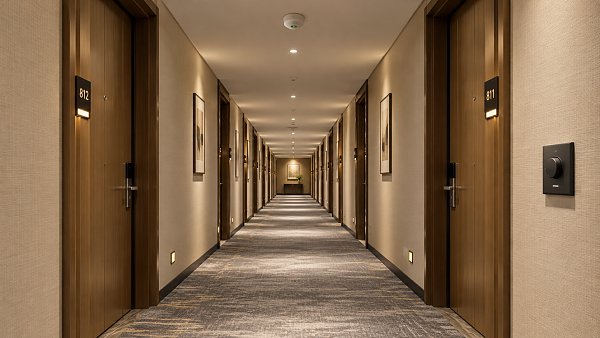
Corridors, stairwells, service passages, and back-of-house areas can offer worthwhile opportunities where lights remain at full output despite intermittent use. Savings may come from reducing output between visits rather than switching lights off.
Required illumination, emergency lighting arrangements, visibility, and guest comfort constrain the available reduction. The financial model must use the lighting levels the hotel can actually operate with. A calculation based on switching an entire corridor off has little value if the approved design requires continuous background illumination.
Meeting rooms and function spaces can benefit from scheduling when lighting remains on after events. Daylight-responsive dimming can help in suitable perimeter spaces, but it contributes little in interior areas or where shades usually remain closed. Decorative lighting may have tightly defined operating hours that leave limited additional savings.
Accept savings only when the mechanism is clear
Lighting electricity consumption depends on electrical power and operating time. Build the baseline from fixture quantities, actual power draw, and operating hours for each relevant area. For dimmed lighting, use supported power consumption at the intended settings; a control command does not necessarily translate directly into the same percentage reduction in electrical power.
Avoid adding overlapping savings claims. Occupancy control, scheduling, and daylight dimming may all reduce consumption during some of the same hours. Their individual estimates cannot simply be added together. Model the final operating pattern after the controls interact, and include power used by gateways and other continuously powered equipment.
Value avoided consumption using the tariff components that will actually fall. Fixed charges generally remain. Demand-charge savings require evidence that the lighting reduction lowers the billed peak; reduced electricity use at another time may have no effect on that charge.
Maintenance deserves similar discipline. Remote fault alerts can help staff locate problems, but they do not automatically reduce payroll. Time released for other duties is operational capacity unless overtime, contractor expenditure, or another cash cost genuinely falls. Record those two benefits separately.
Reduced lighting heat can affect heating and cooling demand, but the net result depends on climate, season, and HVAC operation. Keep that effect outside the core calculation unless the property has a suitable basis for estimating it. Claims about higher room rates, better reviews, or increased bookings should likewise remain outside the savings required to repay the investment.
Choose the least costly architecture that delivers the benefit
A basic timer, local occupancy sensor, or standalone dimmer may capture much of the available saving in a straightforward space. Connected controls become more useful when the hotel needs coordinated schedules, central adjustments, fault visibility, or integration across many rooms and zones.
Wireless controls can reduce some wiring work, particularly in finished buildings. Their installed cost still depends on site coverage, gateway placement, commissioning, and the power or battery requirements of individual devices. Wired controls may suit major refurbishment work where access is already available. Neither approach has an automatic financial advantage.
Integration with a property management system can support room-status-based operation, but it introduces interfaces, configuration work, and support responsibilities. The quotation should explain what happens when room status is delayed, a gateway fails, or internet access is lost. Local lighting operation must remain practical during those failures.
Procurement terms affect lifecycle cost as much as device selection. Establish which functions require a subscription, who can change settings, whether another service provider can maintain the installation, and what replacement parts will be available. A low purchase price can become expensive if routine changes require specialist visits or replacing compatible equipment becomes difficult.
Use a pilot to resolve the assumptions that matter
A useful pilot represents the conditions driving the investment. Select rooms or zones with different occupancy patterns, daylight exposure, layouts, and existing control arrangements. Testing only the easiest area can produce savings that do not translate across the property.
Measure lighting consumption before and after installation while recording relevant changes in occupancy, schedules, and operating practice. Whole-building electricity bills usually contain too many other influences to establish the performance of a small lighting trial. Circuit metering or suitable temporary measurement provides a clearer basis for comparison.
The pilot should also record installation time, commissioning effort, false vacancy events, guest complaints, staff overrides, and support requests. These determine whether the planned settings can remain in use. A system that saves electricity only while staff closely supervise it has a different operating cost from one that runs reliably.
Agree on acceptance criteria before the trial begins. They should address measured energy use, acceptable lighting behavior, manual control, recovery after interruptions, and the handover information needed by hotel staff. Use the findings to revise both the price and the forecast before expanding installation.
Approve the project against a downside case
A credible proposal should show what happens when performance falls short of the central forecast. Test lower avoidable operating hours, slower rollout, higher support costs, and continued manual overrides. Electricity-price assumptions should be visible so the decision does not quietly depend on future tariff increases.
For larger investments, review discounted cash flow over a realistic ownership period. Include subscription changes, expected component replacements, and any costs associated with changing platforms. Where the hotel is leased or managed, establish who funds the equipment and who receives the electricity savings; a project can benefit the property overall while giving the investing party a weak return.
Before approval, require a priced scope, a baseline by area, an explanation of how savings were calculated, clear recurring charges, and a commissioning and measurement plan. Make responsibility for integration, training, and post-installation adjustments explicit.
The strongest purchasing decision may be a phased one: install controls in spaces with demonstrated waste, verify the operating result, and expand where the economics hold. If the investment only meets its recovery target after counting speculative revenue or overlapping savings, reduce the scope before committing capital.
Recommended News
 Home DecorHow to choose a washable kitchen floor mat that stays in placeChoose a washable kitchen floor mat that stays put. Discover how to compare backing, floor compatibility, comfort, and cleaning care before you buy.Interior Sourcing LeadOct 30, 2026
 Policy & RegulationsChina Issues Disposable Underwear Standard FZ/T 64125-2026China’s disposable underwear standard FZ/T 64125-2026 takes effect November 1, 2026. Explore key safety and testing requirements to prepare your products and supplier reviews.Oct 29, 2026
 Smart LightingWhen do smart lighting systems for hotels pay for themselves?When do smart lighting systems for hotels pay for themselves? Learn how to calculate net savings, uncover hidden costs, and identify upgrades that deliver measurable returns before you invest.Commercial Tech EditorOct 29, 2026
 Eco PackagingUS Cities Push for EPR Legislation as Plastic Packaging Recycling Costs RiseEPR legislation is drawing support as US cities face rising plastic packaging recycling costs. Explore what this push could mean for producers, businesses and local recycling.Packaging Supply ExpertOct 28, 2026