Industry News
Curation by industry experts
Hot Articles
Popular Tags
HDPE T-Grip Sheet Extrusion Line for Sale: Buyer Inspection Points
Used extrusion lines can look attractive on paper and still become expensive mistakes after installation. For procurement teams evaluating an HDPE T-grip sheet line, the main question is not whether the line can run, but whether it can run the required product consistently, at a realistic output rate, with manageable maintenance risk. That is especially important when the line will be used for applications such as tunnel waterproofing, foundation lining, or other back-fixed geomembrane systems where sheet profile integrity matters as much as basic sheet thickness.
T-grip sheet is not a standard flat sheet product. The anchoring ribs must bond correctly to the base sheet, maintain geometry across width, and survive downstream handling and installation. A line that produces ordinary PE sheet acceptably may still struggle with rib definition, gauge stability, edge control, or cooling balance when switched to T-grip production. Buyer inspection therefore needs to go beyond a general machine condition check.
Start with the product requirement, not the machine nameplate
Before inspecting any equipment, procurement should define the commercial and technical target clearly. Many disputes around used lines begin because the buyer only asked for “HDPE sheet extrusion” and the seller only proved that resin could be melted and formed. For T-grip sheet, the target should include:
- Sheet width range and usable trim width
- Base sheet thickness range
- Rib height, rib spacing, and profile tolerance
- Target output with the intended HDPE grade
- Surface quality expectations on both sides
- Required winding, stacking, or cutting format
- Downstream application demands such as weldability, anchoring performance, or dimensional stability
These points shape the inspection checklist. A line sized for general PP or PE sheet may have enough motor power, yet still be unsuitable if the die design, calibrating section, haul-off control, or winding system cannot hold the T-profile accurately. Buyers looking at a hdpe t-grip sheet extrusion line for sale should read the listing as a starting point, then match every line component against their actual product specification and resin behavior.
The extrusion section: where hidden risk usually starts
The extruder is often judged by screw diameter and installed power, but procurement should inspect a broader set of conditions. HDPE processing places demands on plasticizing stability, temperature control, and pressure consistency. On a used line, wear inside the barrel and screw can reduce output efficiency and increase melt variation long before the machine appears “broken.”
Screw and barrel wear
Ask for maintenance history, rebuild records, and evidence of past material use. A line that has run heavily filled compounds or abrasive formulations may have higher wear than one used mainly for standard polyolefins. In practical terms, wear can show up as unstable back pressure, lower output at normal amperage, poor melt homogeneity, or excessive temperature rise. If inspection includes a test run, compare melt pressure behavior during steady production rather than relying only on peak output claims.
Heating and cooling zones
Check whether all barrel zones, adapters, and die heating circuits respond correctly and reach setpoint without long drift. On older lines, failing thermocouples, weak heaters, or unreliable cooling control can create local overheating. That may not stop production immediately, but it can distort rib formation, increase gels, or widen thickness variation over long runs.
Drive system and controls
Look at motor condition, gearbox noise, inverter or drive generation, and control panel serviceability. Procurement teams often focus on whether the line is currently operational, yet long-term spare parts availability matters more. If the control platform is obsolete, even a minor failure after delivery can delay commissioning for weeks.
Die and T-profile forming capability deserve the closest inspection
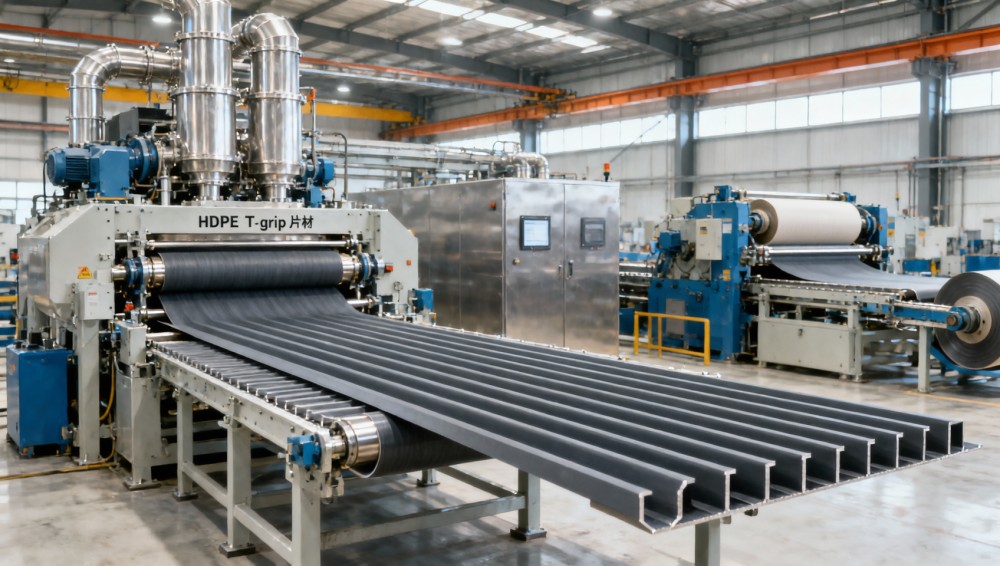
For this type of product, the die is rarely a minor detail. It is the heart of value creation. Buyers should confirm whether the die was originally designed for T-grip sheet or merely adapted from a flat sheet setup. Retrofitted tooling can work, but only if profile geometry, internal flow distribution, and deck thickness control are proven under production conditions.
Die lip condition and profile uniformity
Inspect for scratches, corrosion, repairs, and uneven bolt response across the width. Even small die lip damage may print into the sheet surface or create flow imbalance around the ribs. If possible, measure sample sheet dimensions from left, center, and right positions. Rib height variation across width is often more revealing than a general visual check.
Internal flow path and changeover practicality
If the line has interchangeable tooling for flat sheet and T-grip sheet, ask how long the changeover takes and what alignment work is normally required afterward. A flexible line sounds attractive, but if each product switch demands prolonged setup, significant purge waste, and skilled die tuning, the commercial value may be lower than expected.
Melt pump and screen changer configuration
Some used lines include these components, others do not. Their value depends on the buyer’s material plan and quality target. For HDPE sheet with tight dimensional requirements, a stable melt stream can improve profile consistency. However, adding complexity also adds maintenance points. The right question is whether the current configuration supports your resin cleanliness level and output target without frequent interruptions.
Calibrating, cooling, and haul-off systems often determine real product quality
Many buyers spend most of the inspection time at the extruder and die, then underestimate the downstream section. For T-grip sheet, cooling symmetry and controlled pulling are critical. If the profile cools unevenly, the sheet can warp, ribs can lean, and width control may drift.
Cooling table and support arrangement
Check roller condition, table flatness, cooling efficiency, and the ability to support profiled sheet without crushing rib geometry. Ask whether the line was running HDPE recently or another polymer with different shrink behavior. HDPE usually needs careful management of cooling and pull tension to avoid memory effects and dimensional distortion.
Haul-off traction and synchronization
Inspect belt or roller surface wear, pressure adjustment, and synchronization with extruder output. Inconsistent haul-off speed leads directly to thickness fluctuation and profile instability. During a trial, watch whether the operator compensates constantly with speed changes. If stable output requires too much manual correction, the line may be difficult to run consistently in a normal factory environment.
Cutting and winding suitability
Some T-grip sheet is rolled, while other production setups may rely on cut lengths or custom handling. The downstream equipment must suit the sheet stiffness, thickness, and rib geometry. A winder built for smooth sheet can mark or deform profiled material if nip pressure and guiding are poorly controlled. Procurement should not assume the existing finishing section is automatically compatible.
Material compatibility is more than “it can process PE”
Suppliers sometimes describe a used line in broad terms, especially if it has processed multiple thermoplastics. That is not enough for a buyer planning long production runs in HDPE. Resin grade, melt flow characteristics, additive package, and recycled content ratio all affect behavior in the line.
If the project involves virgin HDPE for demanding waterproofing applications, the buyer should ask for a test using a resin grade close to the intended production material. If the business model relies on blended or reprocessed content, inspect how the line handles contamination risk, filtration needs, and output stability. A line that runs clean virgin material smoothly may behave very differently with variable feedstock.
This is also the point where a second review of any hdpe t-grip sheet extrusion line for sale listing becomes useful. General sheet line descriptions may indicate broad polymer capability, but procurement still needs proof of stable HDPE profile production under conditions close to the planned product mix.
Ask for documents that reduce commissioning uncertainty
A used line purchase becomes risky when equipment arrives with incomplete technical records. Missing drawings and undocumented modifications can turn small maintenance jobs into major delays. Buyers should request, where available:
- Machine layout and foundation requirements
- Electrical drawings and PLC/drive documentation
- Die drawings or profile specifications
- Motor, heater, gearbox, and control component lists
- Maintenance and overhaul records
- Operating manuals and startup procedures
- Evidence of recent running condition
Document quality often says as much about project risk as the machine’s visual condition. A line in average cosmetic condition but with complete technical files may be easier to restart than a cleaner-looking machine with undocumented retrofits.
Trial runs should be structured like acceptance tests
If a trial run is possible, procurement should not treat it as a simple demonstration. Prepare a short acceptance protocol before visiting the site. The purpose is to test repeatability, not just to see molten plastic coming out of the die.
Try to keep retained samples from different stages of the run. Even without lab testing on site, side-by-side comparison can expose drift that is easy to miss when observing one sheet at a time.
Check the economics behind the purchase price
A low acquisition cost can hide expensive follow-up work. Procurement should separate the machine price from the “ready-to-produce” cost. Common additions include die refurbishment, new heaters, rollers, control upgrades, shipping frames, dismantling, installation labor, local power adaptation, and commissioning support.
Another overlooked cost is startup scrap. Older sheet lines may require longer stabilization after restart, especially when moved and reassembled. If your business depends on short production runs or frequent product changes, a line with lower nominal capacity but better repeatability may deliver stronger operating economics than a larger but less stable setup.
Factory integration can change the decision
Even a technically sound line may not fit the buyer’s plant without expensive modifications. Review utility demand, floor space, line height, crane access, resin feeding arrangement, chill water capacity, and ventilation needs. Also confirm whether your maintenance team can support the mechanical and control architecture already installed on the line.
This matters particularly for imported used equipment. Voltage, safety circuits, guarding philosophy, and control language may require adaptation. None of these issues automatically disqualify a purchase, but they should be budgeted and scheduled before the order is approved.
Questions that reveal whether the seller understands the line
The quality of seller answers can help procurement judge risk. Useful questions include:
- What exact products was the line making most recently?
- Which die belongs to the offered configuration, and are all matching components included?
- What parts were replaced in the last major maintenance cycle?
- What production issues occurred most often in recent operation?
- What utilities and auxiliary equipment are required for a normal run?
- Which control or drive components are hardest to source today?
Specific, technically consistent answers usually indicate that the equipment history is traceable. Vague responses are a signal to inspect more deeply, not necessarily to reject the line immediately.
The practical buying view
For procurement teams, the best inspection approach is to judge the line as a production system rather than a collection of parts. The extruder, die, cooling section, haul-off, and finishing equipment all affect whether T-grip geometry can be produced reliably in HDPE. A machine can be mechanically serviceable and still fail commercially if profile consistency, documentation, or integration cost is weak.
The strongest purchase decisions usually come from a simple discipline: define the target product, inspect the line against that target, document the gaps, and price the missing work honestly. That method gives a clearer answer than any general statement about capacity or condition, especially when evaluating a used HDPE T-grip sheet extrusion line for sale.
Recommended News
 Office FurnitureWhen does a custom executive office desk justify its higher cost?Discover when a custom executive office desk is worth the investment—from tailored layouts and integrated technology to durable materials and long-term value.Interior Sourcing LeadSep 22, 2026
 Office FurnitureWhich high back ergonomic office chairs fit all-day desk work?High back ergonomic office chairs for all-day desk work: compare lumbar support, seat depth, armrests, recline, and materials to find a better fit.Interior Sourcing LeadSep 21, 2026
 Commercial LEDWhen does a 200W linear high bay provide enough light for a warehouse?Discover when a 200W linear high bay delivers sufficient warehouse lighting, with practical guidance on lumens, mounting height, aisle layout, and uniformity.Commercial Tech EditorSep 20, 2026
 Home DecorWhat to check before ordering wholesale nesting side tables in EuropeWholesale nesting side tables Europe: assess materials, stability, compliance, packaging, landed cost, and supplier reliability before ordering with confidence.Interior Sourcing LeadSep 19, 2026