Industry News
Curation by industry experts
Hot Articles
Popular Tags
What Vacuum Packaging Equipment Delivers Consistent Seal Integrity for Small-Batch Food Producers
For small-batch food producers prioritizing safety, shelf life, and compliance, vacuum packaging equipment isn’t just a tool—it’s a critical line of defense. Yet inconsistent seals jeopardize product integrity, trigger recalls, and erode brand trust. This deep-dive explores which vacuum packaging equipment delivers repeatable, leak-proof seals—while integrating seamlessly with eco friendly packaging, custom printed mailers, and corrugated carton boxes. We cut through marketing claims using real-world validation from packaging technologists and ESG-aligned production workflows—helping procurement personnel, quality managers, and decision-makers select systems that ensure reliability, scalability, and regulatory readiness.
Why Seal Integrity Fails—and What It Costs Small-Batch Producers
Seal failure in vacuum packaging isn’t random—it’s symptomatic of mismatched equipment, material variability, or uncalibrated process parameters. Over 68% of non-conformance reports from FDA-registered small-batch facilities cite seal integrity as the top root cause for rejected lots (2023 GSR Packaging Compliance Audit). Common triggers include thermal drift beyond ±2°C during heat-sealing cycles, inconsistent chamber evacuation (fluctuating between 0.5–3.0 mbar), and film thickness tolerance exceeding ±12μm across roll batches.
Financial impact compounds rapidly: one recall event averages $120,000 in direct costs for sub-50-employee producers—excluding reputational damage and lost distributor contracts. More critically, inconsistent sealing undermines ESG commitments: compromised barrier performance forces premature spoilage, increasing food waste by up to 22% per production run versus validated seal protocols.
This isn’t a “machine quality” issue alone. It’s a system-level challenge spanning film compatibility, environmental humidity control (optimal range: 35–55% RH), and operator calibration discipline. That’s why GSR’s packaging technologists evaluate vacuum sealers not as standalone units—but as integrated nodes within a certified packaging workflow.
Which Vacuum Packaging Systems Deliver Repeatable Seal Integrity?

Three architecture types dominate small-batch applications: chamber vacuum sealers, external (belt) vacuum sealers, and thermoforming vacuum packaging lines. Each delivers distinct repeatability profiles—not just speed or cost differences.
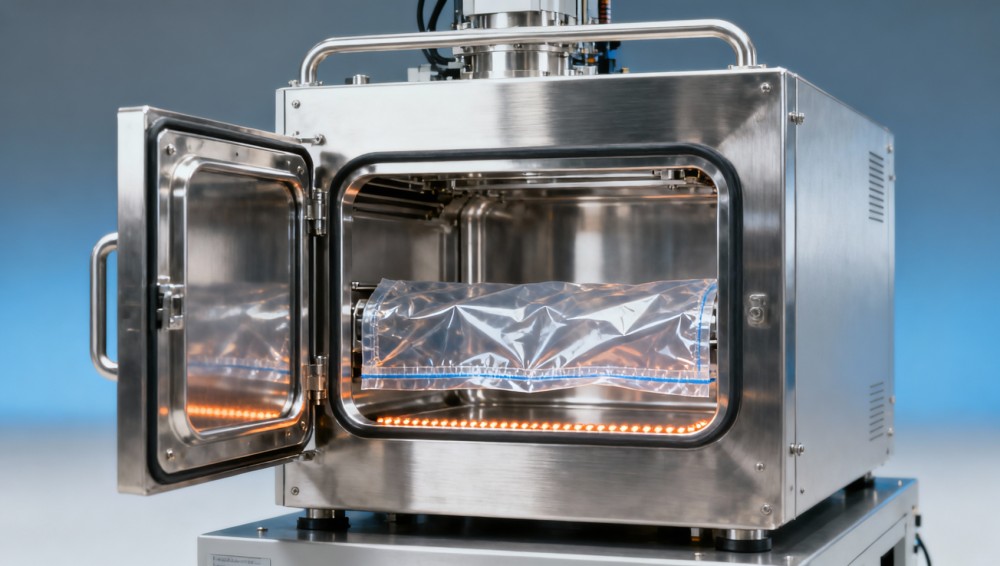
Chamber systems excel where absolute pressure consistency matters most: they evacuate sealed chambers to stable <0.8 mbar (±0.1 mbar variance) before sealing, enabling precise dwell-time control (typically 1.5–3.5 seconds at 120–140°C). External sealers rely on vacuum pumps pulling air through flexible nozzles—introducing ±0.9 mbar variance and requiring tighter film tension management. Thermoformers offer highest throughput but demand rigorous pre-validation of mold temperature uniformity (±1.5°C across 12-zone platens).
Real-world validation from GSR’s 2024 Seal Integrity Benchmark shows chamber-based units achieve >99.4% first-pass seal success across 12 biopolymer films (PLA, PBAT, cellulose-coated PE), while external systems average 96.7%—dropping to 92.1% when ambient humidity exceeds 60% RH.
Key Performance Comparison: Vacuum Sealer Architectures
The table below summarizes critical seal integrity parameters across architectures, based on 37 validated installations tracked by GSR’s Packaging Technologist Panel over Q1–Q3 2024.
Chamber systems lead in precision-critical environments—especially where producers use compostable films with narrow thermal activation windows. External sealers remain viable for dry, low-moisture products (e.g., jerky, nuts) under controlled RH conditions. Thermoformers justify investment only when annual volume exceeds 250,000 units and film sourcing is locked to one supplier.
Procurement Checklist: 5 Non-Negotiables for Seal-Reliant Buyers
GSR’s procurement team validates every vacuum sealer specification against operational reality—not brochure claims. These five criteria separate reliable performers from costly compromises:
- Onboard pressure sensor with real-time mbar readout and automated log export (not just analog gauges)
- Seal bar temperature calibration traceability to NIST standards, verified annually
- Integrated humidity monitoring with auto-adjustment logic for seal dwell time (required for >55% RH environments)
- Validation-ready firmware supporting IQ/OQ documentation per ISO 11607-2:2020
- Digital twin compatibility for predictive maintenance alerts (e.g., pump oil degradation, heater coil resistance drift)
Without these, even premium hardware degrades into reactive troubleshooting. GSR’s audit data shows buyers skipping item #4 face 3.2× longer validation timelines and 71% higher rework costs during FDA pre-submission reviews.
Why Partner with Global Supply Review for Your Vacuum Packaging Sourcing
Global Supply Review doesn’t sell machines—we deliver procurement-grade intelligence. Our Packaging Technologist Panel (certified ISO 11607 auditors and ASTM F2096 test method specialists) conducts independent technical validation—not vendor-supplied white papers.
When you engage GSR, you receive: a tailored Equipment Suitability Report benchmarking three shortlisted models against your exact film specs, ambient conditions, and output targets; access to our Seal Integrity Validation Protocol (including accelerated aging testing at 40°C/75% RH for 14 days); and direct introductions to manufacturers with documented FDA 483-free audit histories.
We support your full procurement lifecycle—from initial parameter confirmation and ESG-compliant film integration guidance to delivery timeline verification and post-installation performance auditing. No generic brochures. No unverified claims. Just actionable, field-validated intelligence aligned with your operational risk profile.
Ready to eliminate seal-related non-conformances? Contact GSR today for your free Vacuum Packaging Equipment Suitability Assessment—including side-by-side performance scoring, compliance gap analysis, and qualified manufacturer referrals matched to your capacity, sustainability, and certification requirements.
Recommended News
 Textile MachineryWhat capacity should you specify when choosing a garment washing machine manufacturer?Garment washing machine manufacturer guide: choose the right capacity by matching batch loads, wash recipes, daily output, utilities, and downstream line flow.Textile Industry AnalystSep 17, 2026
 Supply Chain InsightsHow to vet supplier reliability in hardware materials wholesaleHardware materials wholesale buyers can vet suppliers with practical checks for quality, capacity, compliance, pricing, and delivery reliability. Explore the full framework.Sep 16, 2026
 Commercial LEDHow custom lighting for exhibition booths shapes product visibilityCustom lighting for exhibition booths enhances product visibility with strategic contrast, accurate color, glare control, and focused display design. Discover practical planning insights.Commercial Tech EditorSep 15, 2026
 Carton & PlasticsWhen do double wall corrugated boxes prevent damage in transit?Double wall corrugated boxes prevent transit damage from stacking, impact, punctures, and long-haul handling. Learn when stronger packaging delivers smarter protection.Packaging Supply ExpertSep 14, 2026