Industry News
Curation by industry experts
Hot Articles
Popular Tags
EU EPR Q3 Enforcement Raises Entry Bar for Compostable Bridal Gift Boxes
On September 1, 2026, a clearer compliance threshold emerged for paper-based packaging shipped to the EU under the PPWR-linked EPR regime: from the third quarter of 2026, the producer responsibility system will be mandatorily enforced across all member states, and paper packaging such as bridal gift boxes that is marketed as “compostable” must use EN13432-certified materials and complete EPR registration through an EU authorized representative. For exporters involved in wedding photography packaging, custom albums, invitations, and other eco packaging products, this is worth close attention because the rule change affects not only product claims, but also customs clearance, market access, and delivery timing.
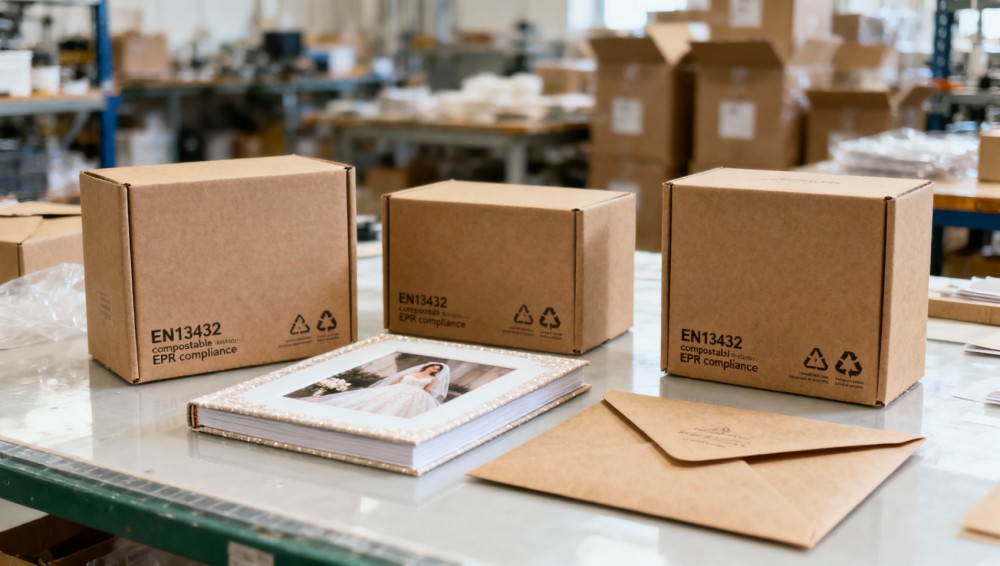
What the rule now requires for EU-bound paper packaging
The confirmed change is that the EPR producer responsibility system linked to the EU Packaging and Packaging Waste Regulation (PPWR) will become mandatory in all member states starting in the third quarter of 2026.
For paper packaging exported to the EU, including bridal gift boxes, any product presented as “compostable” must use materials certified under EN13432.
The confirmed requirement also states that overseas manufacturers must complete EPR registration through an EU authorized representative.
According to the information provided, non-compliant products may be refused customs clearance or face high fines.
The rule directly affects Chinese exporters of wedding photography accessory boxes, custom albums, invitations, and similar eco packaging products by influencing their eligibility to enter the market and their delivery schedules.
Where the pressure is likely to appear first in the supply chain
Export packaging suppliers may face a stricter market-entry check
From an industry perspective, exporters of bridal gift boxes, invitation packaging, and related paper-based presentation products are likely to feel the impact first because the change ties product claims to both material certification and producer registration. What deserves closer attention is that compliance may no longer be limited to packaging design or sales language; it may also affect whether goods can move through customs without disruption.
Material sourcing decisions may become more documentation-driven
Analysis shows that companies buying paperboard or other packaging inputs for products marketed as compostable should pay closer attention to whether supporting certification aligns with EN13432. The practical impact is likely to fall on procurement review, supplier qualification, and the consistency of technical and claim-related documents used in export orders.
Manufacturing and order delivery may need tighter coordination
For converters and manufacturers serving overseas buyers, the main issue is not only production itself but whether compliance preparation is completed early enough to avoid shipment delays. Observably, when a rule links customs outcomes to both material status and producer registration, production planning, order confirmation, and dispatch timing all become more sensitive to documentation readiness.
Compliance and testing service providers may see earlier client demand
Certification-related firms, testing service providers, and trade compliance support companies may be drawn into customer workflows earlier, because exporters will likely need clearer confirmation on compostable claims, supporting certificates, and EPR registration arrangements before shipment. The key point is not a guaranteed surge in service demand, but a likely shift in when such verification is needed in the order cycle.
What companies should review before shipments are affected
Check whether “compostable” claims are fully supportable
Analysis shows that companies using compostable positioning for paper packaging should review whether the claim is backed by EN13432-certified materials. If the supporting basis is unclear, the compliance risk may extend beyond product labeling to customs and market access.
Confirm who handles producer registration in the EU
What deserves closer attention is the registration path for overseas manufacturers. Based on the information provided, EPR registration must be completed through an EU authorized representative, so exporters should review whether this responsibility has been clearly assigned and documented in their export arrangements.
Prepare technical and trade documents with delivery timing in mind
Observably, companies shipping wedding-related eco packaging to the EU should pay closer attention to how certification records, registration materials, product descriptions, and shipment documents align with one another. The input does not provide detailed enforcement procedures, so it is more appropriate at this stage to treat document consistency as a priority area for ongoing review rather than assume a single uniform practice.
Watch for changes in customer requirements and procurement language
From an industry perspective, buyers may begin adjusting purchase specifications, onboarding requirements, or tender language in response to the enforcement timeline. Companies should therefore monitor whether customers start requesting clearer proof of EN13432 alignment, EPR registration status, or related compliance materials before confirming orders.
Why this looks more like an enforcement signal than a distant policy discussion
Analysis shows that this development is more appropriately understood as an execution-level signal rather than a general policy background item. The information provided points to a mandatory timeline, specific conditions for compostable claims, and explicit consequences for non-compliance, which together suggest that affected exporters should treat the issue as an operational compliance matter.
At the same time, observably, some practical details still require continued monitoring. The input does not provide further official wording on implementation procedures, documentation review standards, or market-by-market enforcement practice, so industry participants should avoid assuming that every operational detail is already settled.
How the market is likely to read this development now
At this stage, it is more appropriate to understand the update as a concrete tightening of entry requirements for certain EU-bound paper packaging products, especially where compostable claims are used. The immediate significance is not that every exporter will face the same outcome, but that compliance readiness is becoming more directly connected to customs clearance, buyer acceptance, and shipment timing.
A rational reading is that affected businesses should treat this as a near-term trade and compliance checkpoint, while continuing to watch how certification interpretation, registration practice, customer documentation requests, and market feedback develop as enforcement moves forward.
Basis of this article and what still needs verification
This article is generated from the user-provided news title, event date, and event summary. Typical source types relevant to developments of this kind may include official regulatory notices, releases from supervisory authorities, customs or trade administration information, industry association updates, standards organization documents, and reporting from authoritative trade media.
No specific official source link was provided in the input, so the exact official reference still requires further verification. What remains important to monitor includes subsequent implementation details, certification interpretation, enforcement practice, buyer procurement document changes, industry feedback, and how exporters are carrying out compliance preparation in practice.
Recommended News
 Carton & PlasticsWhen do double wall corrugated boxes prevent damage in transit?Double wall corrugated boxes prevent transit damage from stacking, impact, punctures, and long-haul handling. Learn when stronger packaging delivers smarter protection.Packaging Supply ExpertSep 14, 2026
 Carton & PlasticsHow to assess a flat bottom pouch supplier’s quality controlsFlat bottom pouch supplier quality controls: assess materials, seal integrity, traceability, change management, and release processes to reduce packaging risk.Packaging Supply ExpertSep 13, 2026
 Office FurnitureHow to compare wholesale commercial carpet tiles by installed costCommercial carpet tiles wholesale: compare installed costs, freight, waste, subfloor prep, labor, and lifecycle value to make smarter procurement decisions.Interior Sourcing LeadSep 12, 2026
 Carton & PlasticsWhen is 200 gsm kraft liner board strong enough for shipping cartons?Kraft liner board gsm 200: learn when it delivers reliable carton strength, how flute, stacking, moisture, and box size affect performance.Packaging Supply ExpertSep 11, 2026