Industry News
Curation by industry experts
Hot Articles
Popular Tags
How Can Garment Manufacturing Meet ESG Requirements?
As global buyers tighten sustainability, labor, and transparency standards, garment suppliers must convert ESG commitments into measurable operating practices that withstand audits, sourcing reviews, and commercial scrutiny.
How to ensure garment manufacturing meets ESG requirements? The answer is not a single certificate, recycled fabric claim, or annual sustainability statement from corporate headquarters.
Manufacturers need traceable inputs, safe chemical controls, fair work systems, reliable environmental data, responsible governance, and evidence that extends beyond their own factory gates.
Start With a Buyer-Ready ESG Risk Assessment
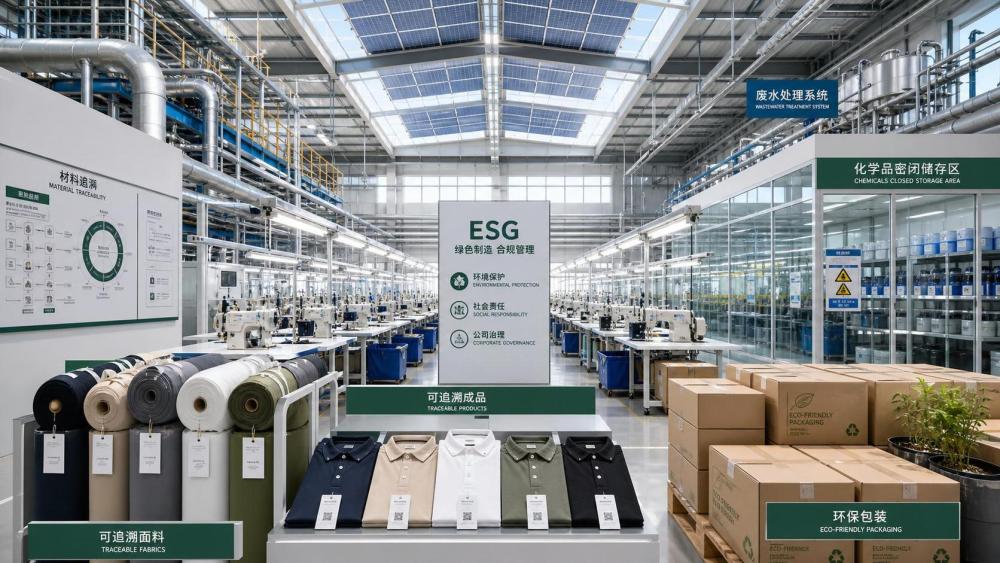
For procurement leaders, the immediate concern is whether a supplier can meet contractual requirements without creating hidden compliance, delivery, reputational, or regulatory risks later.
Manufacturers should begin by mapping current practices against customer codes of conduct, applicable laws, product regulations, and recognized frameworks such as GRI, SASB, or relevant sector standards.
A practical assessment separates policy from proof. Written commitments matter, but buyers increasingly ask for records, worker interviews, supplier lists, utility data, test reports, and corrective-action evidence.
Rank findings by severity, legal exposure, buyer importance, and implementation effort. Excessive working hours, wastewater failures, wage violations, and forced-labor indicators should receive immediate attention.
Management should assign each material risk to a named owner, establish deadlines, define evidence requirements, and review progress through a formal cross-functional governance process.
This approach prevents ESG from becoming an isolated sustainability project. It connects sourcing, production, human resources, finance, quality assurance, compliance, and senior leadership around shared operational priorities.
For buyers, a factory that understands its gaps and can document corrective action is often more credible than one presenting broad claims without measurable controls.
Build Material Traceability From Fiber to Finished Garment
Material traceability is central to garment ESG compliance because environmental claims, chemical risk, deforestation concerns, and forced-labor exposure frequently begin before fabric reaches the sewing line.
Manufacturers should maintain a chain-of-custody record covering fiber origin, spinning, knitting or weaving, dyeing, finishing, trims, packaging, transport, and final assembly.
Each purchase order should connect to approved material specifications, supplier declarations, transaction certificates where applicable, test results, and lot-level receiving records.
Traceability must be operational rather than decorative. Teams need to identify which batch entered which production order and which customer shipment contained that finished product.
For cotton, man-made cellulosics, leather, wool, recycled polyester, and other higher-risk materials, buyers may request deeper evidence on origin, certification scope, and supplier controls.
Claims such as organic, recycled, responsibly sourced, or lower impact should never exceed available documentation. Unsupported marketing language can create greenwashing exposure for both supplier and buyer.
Digital traceability platforms can improve record access, but technology does not replace supplier verification. Data quality still depends on disciplined onboarding, document checks, and periodic risk-based validation.
Control Chemicals, Water, and Waste at Process Level
Chemical management is often the most technical ESG requirement in apparel, particularly where dyeing, printing, washing, coating, laminating, or finishing occurs within the supply network.
Factories should maintain an up-to-date restricted substances list aligned with customer specifications, destination-market laws, and relevant textile chemical programs used by major brands.
Every chemical container requires accurate labeling, safety documentation, controlled storage, inventory tracking, and approval before use. Expired, unidentified, or decanted chemicals create avoidable audit failures.
Suppliers should assess formulations before purchase, not after a failed laboratory test. Preventive review reduces rejected production, emergency substitutions, delayed shipments, and worker exposure.
Water-intensive facilities need metering at meaningful process points, wastewater testing, treatment-system maintenance, discharge records, and escalation procedures when performance deviates from permit limits.
Waste programs should distinguish between hazardous waste, textile offcuts, sludge, packaging waste, and recyclable materials. Measuring waste by type reveals where prevention will produce commercial savings.
Buyers should ask for trends, not only snapshots. Monthly consumption, discharge, test, and waste data show whether environmental controls are embedded in production management.
Make Labor Compliance Verifiable in Daily Operations
Social compliance remains a decisive sourcing issue because a technically capable factory can still expose buyers to serious risk through wage, hour, safety, discrimination, or recruitment practices.
First, manufacturers must confirm that contracts, payroll, timekeeping, benefits, and disciplinary procedures comply with local law and applicable customer requirements for every worker category.
Records should include permanent, temporary, migrant, agency, apprentice, and subcontracted workers. Excluding vulnerable groups from documentation is a common cause of misleading compliance results.
Working-hour management requires production planning, accurate time records, voluntary overtime controls, rest-day monitoring, and a process for escalating capacity pressures before violations become routine.
Wage compliance should examine base pay, overtime premiums, deductions, incentives, social insurance, and final settlement. Payroll records must reconcile with attendance data and worker testimony.
Effective grievance systems offer confidential channels, non-retaliation protection, investigation timelines, and documented resolution. Workers must understand how to use them without depending on line supervisors.
Health and safety controls need more than inspection checklists. Emergency exits, fire systems, machine guards, ergonomics, personal protective equipment, and training require regular testing and worker participation.
Reduce Carbon and Energy Costs With a Measurable Plan
Environmental expectations increasingly include greenhouse-gas data, especially for energy-intensive textile processing. However, credible emissions management begins with accurate energy measurement and production normalization.
Factories should track electricity, fuels, steam, refrigerants, and renewable-energy purchases separately. Consumption data becomes meaningful when compared against production volume, process type, and operating hours.
Start with efficiency measures that improve both ESG performance and operating margins, including boiler maintenance, compressed-air leak repair, LED upgrades, heat recovery, and motor optimization.
For sewing facilities, electricity efficiency may dominate. For wet processing, thermal energy, water heating, and wastewater treatment often represent larger emissions and cost opportunities.
Renewable electricity agreements or on-site solar can support buyer targets, but suppliers should calculate claims carefully and retain contracts, invoices, generation records, and methodology documentation.
Set a baseline year, establish intensity targets, and review results monthly. Absolute emissions may rise with volume, so buyers also need a clear explanation of efficiency progress.
A credible decarbonization roadmap identifies projects, investment needs, payback periods, responsible managers, expected reductions, and practical constraints such as grid access or leased-building limitations.
Strengthen Governance, Supplier Controls, and Data Integrity
Governance determines whether ESG commitments survive production pressure. Without clear authority, reliable records, and escalation routes, policies frequently weaken when costs, deadlines, or capacity become difficult.
Senior management should approve an ESG policy, but operational leaders must own implementation. Board-level or executive review creates accountability for serious risks and resource decisions.
Supplier onboarding should include screening for legal status, labor practices, environmental permits, sanctions, country risks, material origin, and subcontracting capacity before commercial approval.
Approved vendors need written expectations, periodic reassessment, and corrective-action requirements. A supplier list that remains unchanged for years despite weak performance is not credible governance.
Unauthorized subcontracting deserves particular attention because it can bypass labor, safety, quality, traceability, and chemical controls. Production planning must reveal when approved capacity is insufficient.
Data integrity requires version control, source documents, reviewer checks, and retention rules. ESG metrics should be traceable to invoices, meters, payroll systems, laboratory reports, or inspection logs.
Internal audits should test actual practice through floor observations and worker engagement, rather than simply checking whether documents exist in a compliance office.
Prepare for Audits Without Managing Only for the Audit
Buyer audits can identify important gaps, but a factory built solely around audit day preparation will struggle when customers request unannounced visits, data reviews, or deeper supply-chain evidence.
Create a centralized evidence library for permits, certificates, policies, training records, corrective actions, environmental data, payroll files, risk assessments, and supplier documentation.
Document control should protect confidential worker and commercial information while allowing designated staff to retrieve current records quickly. Outdated policies and conflicting spreadsheets undermine trust.
Before an audit, conduct a realistic internal review using facility walk-throughs, record sampling, management interviews, and anonymous worker conversations. Treat discrepancies as operational signals, not embarrassments.
Corrective action plans should state the root cause, specific remedy, accountable owner, required resources, completion date, and verification method. “Train workers” alone is rarely sufficient.
When a serious issue is found, transparent disclosure and timely remediation generally protect buyer relationships better than concealment. Buyers need confidence that risks will be managed responsibly.
Audit performance should feed management review and capital planning. Repeated findings in the same area usually indicate a weak system, insufficient ownership, or an unrealistic production model.
Report ESG Performance in a Way Buyers Can Use
Good ESG reporting helps sourcing teams compare suppliers, validate claims, and identify improvement opportunities. It should be concise, evidence-based, consistent, and proportionate to the manufacturer’s scale.
Report material information first: energy, emissions, water, wastewater, waste, injury rates, workforce composition, turnover, training, audit findings, certifications, and corrective-action status.
Include reporting boundaries and calculation methods. Buyers need to know whether figures cover one factory, several sites, owned operations, contractor facilities, or only selected processes.
Use year-on-year comparisons and explain meaningful changes. A reduction may result from efficiency improvements, lower production volume, changed reporting methods, or a facility closure.
Do not publish precise sustainability targets without implementation plans. Stakeholders increasingly distinguish between ambition and execution, particularly when public claims influence sourcing or consumer marketing decisions.
For smaller suppliers, a disciplined monthly dashboard may be more useful than a polished report. The key is reliable data, management review, and a documented improvement cycle.
Procurement teams should request evidence that matches the risk. Requiring every supplier to produce complex reports can divert resources from the practical improvements buyers actually need.
Turn ESG Compliance Into a Sourcing Advantage
Meeting ESG requirements should be viewed as a commercial capability, not merely a cost of doing business. Strong systems reduce disruptions, strengthen buyer confidence, and support long-term supplier relationships.
Manufacturers that can provide traceable materials, responsible production data, verified labor practices, and credible corrective actions are better positioned for higher-value and more stable programs.
Buyers should evaluate capability through evidence, trend data, management ownership, and supply-chain visibility. Certifications remain useful, but they should support, not replace, operational due diligence.
The practical answer to how to ensure garment manufacturing meets ESG requirements is disciplined execution across materials, people, environment, governance, and transparent reporting throughout the supply chain.
Recommended News
 Policy & RegulationsEU Apparel Exports Face PFHxA Limits and New PPWR Packaging RulesEU apparel exports face PFHxA limits and PPWR packaging rules. Explore key compliance checks to protect bridalwear shipments, manage unsold stock and reduce delivery risks.Oct 21, 2026
 Outdoor FurnitureIs a rattan wicker patio sofa suitable for an uncovered patio?Is a rattan wicker patio sofa right for your uncovered patio? Discover which materials, frames, and cushions withstand outdoor exposure—and what to check before you buy.Interior Sourcing LeadOct 21, 2026
 Eco PackagingHigher Fees Urged for Hard-to-Recycle Plastics Under California’s EPR PlanCalifornia’s EPR plan faces calls for higher fees on hard-to-recycle plastics. Explore potential packaging cost impacts and how to prepare while adoption remains unconfirmed.Packaging Supply ExpertOct 20, 2026
 Commercial LEDHow much should you pay per T8 LED tube when buying in bulk?Compare T8 LED tube price quotes for bulk orders and uncover hidden installation, freight, and warranty costs. Learn how to choose compliant tubes at the best total value.Commercial Tech EditorOct 20, 2026