Industry News
Curation by industry experts
Hot Articles
Popular Tags
When do bulk embroidered hoodies offer better value than printed ones?
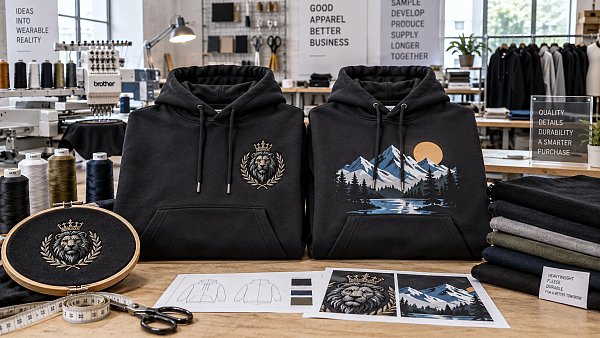
Bulk embroidered hoodies offer better value than printed ones when the garments are expected to be worn repeatedly, represent a long-term brand asset, or need to look credible in customer-facing and operational settings. The unit price may be higher, particularly for small quantities or large stitch areas, but the decision should not be made on decoration cost alone. A hoodie that remains presentable after frequent washing, is retained by staff, and continues to display the brand clearly can produce a lower effective cost over its usable life.
Printing remains the stronger option for some orders: detailed illustrations, large back graphics, short campaigns, event merchandise, and designs with several colours or tonal transitions. The practical question is not whether embroidery is “better.” It is whether its durability, appearance, and production profile match the intended use of the order.
Value depends on wear life, not just the quoted unit price
A basic comparison often starts with the decoration line on a supplier quote: embroidery costs more than a simple one-colour print, so printing appears cheaper. That comparison is incomplete. Procurement teams should compare the total value of a wearable asset over the period it will actually be used.
Embroidery creates a raised, stitched logo that is integrated into the fabric surface. On a suitable hoodie, a well-produced chest logo can tolerate regular laundering and everyday abrasion without the cracking, peeling, or fading associated with some printed finishes. That makes it particularly useful for uniforms, field teams, warehouse staff, trade crews, dealer networks, campus programs, and corporate merchandise intended for ongoing use.
The value case strengthens when the same hoodie is issued for a long period. Replacing prematurely worn branded garments creates costs beyond the replacement unit: repeat artwork setup, purchasing administration, stock management, size allocation, inbound freight, and the inconsistency of a mixed-generation uniform program. A more durable decoration can reduce those avoidable cycles.
That does not mean every embroidered garment lasts longer in practice. Hoodie construction, fabric weight, wash instructions, thread quality, stitch density, backing selection, and the way the garment is worn all affect the outcome. Embroidery is a durable method, not a guarantee that an unsuitable base garment becomes a durable uniform.
When bulk embroidered hoodies make commercial sense
Embroidery is usually the more valuable choice where the logo is compact, stable, and expected to stay unchanged across multiple buying cycles. A left-chest logo, small sleeve mark, or discreet brand identifier is a natural fit. These placements reinforce a professional appearance without making the garment feel like temporary promotional apparel.
It also works well where perception matters. In client-facing services, hospitality support, facilities management, technical installation, premium retail, and business events, an embroidered logo often reads as more established than a basic print. The benefit is not simply aesthetic. When employees are expected to wear the garment in public or around customers, a more polished finish can support consistency in how the business is represented.
Order volume matters in a different way. Embroidery generally requires digitising the artwork into a stitch file. That setup work is easier to justify when the design will be reordered, used across several garment styles, or applied to a substantial run. It may be harder to justify for a one-off internal event with a short lifespan. Buyers should ask whether the digitisation charge is a one-time asset retained for future orders, and whether the supplier can reuse it without alteration.
The design can reverse the cost decision
Buyers sometimes assume embroidery pricing is driven only by the logo’s physical dimensions. Stitch count is often more important. A small solid-fill design can require far more thread and machine time than a slightly larger outline logo. Dense areas, multiple colours, fine outlines, and complex text increase production complexity. A supplier should be able to explain whether the quote is based on estimated stitch count, size, location, or a fixed decoration tier.
Thread is also a poor medium for certain artwork. Fine lines can disappear, tiny lettering can become illegible, and gradients cannot be recreated as smooth tonal changes. Attempting to force a marketing graphic into embroidery often produces an expensive result that is less recognisable than a clean print would have been.
A sensible procurement step is to separate the brand system into use cases. Keep the full campaign artwork for printing, but create a simplified embroidery mark: perhaps a symbol, monogram, or compact wordmark with sufficient spacing. This is not a compromise in brand control; it is adapting the artwork to the production method. The best embroidered logos are designed to be stitched, rather than merely converted from a screen graphic.
Large embroidery has hidden costs
A large stitched design on the chest or back can make the hoodie less comfortable because the embroidered area becomes dense and less flexible. Backing material may be visible or noticeable inside the garment. The design can also pull or pucker lighter fleece fabrics, especially if the garment is not hooped and stabilised properly during production.
For prominent artwork, printing usually offers a better balance of visual impact, comfort, and cost. A hybrid specification can work well: embroidery for the left-chest corporate mark and print for a large event graphic or campaign message on the back. This approach should be sampled carefully because decoration order and placement affect the final appearance.
Choose the hoodie before choosing the decoration
Decoration method cannot be assessed in isolation from the blank garment. A lightweight hoodie may be appropriate for a seasonal promotion but may not provide enough structure for dense embroidery. A heavier, stable fleece generally supports a chest logo more cleanly, although fabric composition and surface finish still matter.
Ask suppliers for the garment specification, not only a lifestyle image. Useful points include fabric composition, fabric weight, fit, available sizes, colour continuity, shrinkage expectations, care label instructions, and whether the chosen style has previously been embroidered. Hood drawcords, pockets, seams, zippers, and kangaroo-pocket placement can limit available decoration areas. A logo that works on a flat sample may sit awkwardly on a finished garment if it conflicts with a seam or pocket opening.
Dark fabrics create another decision point. Embroidery remains visually strong on dark hoodies when thread colours provide sufficient contrast. Printed designs may require an underbase or additional production steps to maintain brightness on dark fabric, which can narrow the apparent price advantage. The exact outcome depends on the print process and artwork, so compare decorated samples rather than relying on a generic per-unit assumption.
Production planning matters as much as the method
Embroidery is performed garment by garment. That can create a production bottleneck when an order includes several placements, unusually dense artwork, multiple garment colours, or a large size breakdown. Printing can also have setup and throughput constraints, but its economics often improve when the same artwork is repeated at scale.
For a procurement order, the right comparison is a like-for-like request for quotation. Provide the same hoodie specification, colour range, size curve, logo artwork, placements, packaging requirement, delivery destination, and target delivery date to every supplier. Ask each supplier to distinguish between:
- blank garment cost;
- artwork preparation or digitisation cost;
- decoration cost by placement;
- sampling cost and sample lead time;
- packing, labelling, and size sorting;
- production lead time and shipment terms.
This avoids a frequent sourcing error: selecting a lower headline price that excludes the work needed to deliver issue-ready garments. For distributed teams, individual bagging, size labels, employee names, or department allocation can be more operationally valuable than a marginal reduction in decoration cost.
It is also worth clarifying artwork ownership and change control. If the logo is likely to change after a rebrand, or if multiple local teams use different brand marks, the reusable value of an embroidery file may be lower. If the logo will remain stable, retaining the approved digitised file, thread references, placement coordinates, and sample approval record supports consistency across future orders and suppliers.
Do not approve from a digital mock-up alone
Mock-ups establish intent, not production quality. A physical pre-production sample is particularly important for embroidered hoodies because it reveals issues that are difficult to judge on screen: puckering, thread shine, letter clarity, backing feel, placement relative to seams, and how the logo behaves when the garment is worn.
Review the sample under normal viewing conditions and after it has been worn, stretched, and laundered according to its care instructions. The goal is not laboratory testing. It is to ensure the chosen decoration looks appropriate for its actual setting and remains legible when the hoodie is not laid flat on a table.
For a large program, define approval criteria before production begins. Specify the approved logo version, placement measurement from a repeatable reference point, acceptable thread colours, backing requirements where relevant, and treatment of substitutions. A supplier needs practical tolerances; “match the mock-up” alone leaves too much room for interpretation.
Cost mistakes that make embroidery look better or worse than it is
The first mistake is treating embroidery as automatically premium and therefore automatically worth the premium. A dense, oversized logo on an inexpensive hoodie may be uncomfortable and visually awkward. The second is treating printing as disposable. A suitable print process on a good garment can be entirely appropriate for regular wear, especially when the artwork itself is the main message.
Another mistake is applying the same decoration method to every audience. Staff uniforms, trade-show giveaways, online merchandise, internal recognition gifts, and campaign apparel have different wear patterns and success measures. A single standard may simplify buying, but it can raise the total program cost if it is used where it adds no functional or brand benefit.
Finally, do not compare only the supplier’s standard artwork image. Request the decoration size in physical measurements and confirm whether it changes by garment size. A fixed logo can look balanced on a medium hoodie but undersized on extended sizes or too dominant on smaller sizes. This affects wearer acceptance, which in turn affects whether the garments are actually used.
A practical buying decision
Bulk embroidered hoodies are usually the stronger value choice when the design is a compact logo, the hoodie will be worn over an extended period, and the finished garment needs to project a consistent professional standard. They are especially effective for repeat uniform programs and premium merchandise where retention and repeat wear matter.
Choose printing when the artwork needs detail, covers a large area, supports a short-lived campaign, or must stay within a tight initial budget. For mixed needs, use embroidery selectively on durable, customer-facing garments and reserve print for graphic-led promotional pieces.
Before placing the order, confirm three things: that the artwork has been adapted for the chosen process, that the hoodie construction supports the decoration, and that a physical sample meets the standard expected after real use. Those checks provide a more reliable basis for value than any generic claim that embroidery or printing is inherently cheaper.
Recommended News
 Garment MfgWhen do bulk embroidered hoodies offer better value than printed ones?Bulk embroidered hoodies deliver lasting value for uniforms and premium branding. Compare durability, design, comfort, and cost to choose the right decoration.Textile Industry AnalystOct 11, 2026
 Carton & PlasticsHow to compare packaging automation suppliers for line integrationPackaging automation supplier comparison guide: evaluate line integration, controls, safety, testing, lifecycle costs, and support to select a proven partner.Packaging Supply ExpertOct 10, 2026
 Home DecorWhich decor exhibition in the USA best fits a home decor sourcing trip?Decor exhibition USA guide: compare High Point Market, Las Vegas Market, NY NOW, and HD Expo to choose the best event for your home decor sourcing trip.Interior Sourcing LeadOct 08, 2026
 Fabrics & YarnsWhat drives textile procurement cost beyond the quoted fabric price?Textile procurement cost goes far beyond the quoted fabric price. Discover how freight, quality, MOQ, compliance, payment terms, and supplier reliability shape total sourcing cost.Textile Industry AnalystOct 07, 2026