Industry News
Curation by industry experts
Hot Articles
Popular Tags
How to verify a metal furniture factory's production capacity
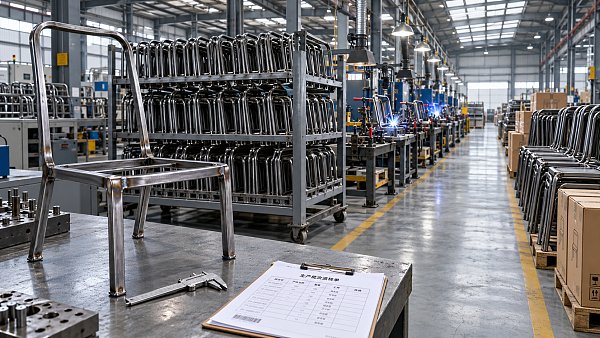
A metal furniture factory’s capacity claim is credible only when it can connect three things: recent output of comparable products, available time at the processes your order requires, and a production schedule that accounts for existing commitments. Machine counts and annual output figures can help establish scale, but they cannot establish whether your order will ship on time.
For procurement teams, the practical question is specific: can this factory produce the required quantity, to the agreed specification, within the available production window? Answering it requires checking the product mix, tracing production records, examining bottlenecks, and testing the proposed schedule against actual operating conditions.
Define the order before assessing the capacity claim
Start by asking what the supplier means by “units per month.” A factory producing simple welded stools may report a high unit count that says little about its ability to manufacture cabinets with drawers, hinges, locks, and multiple coating colors. Even products that look similar can require different amounts of cutting, welding, finishing, and assembly time.
Give the supplier a defined basis for its capacity estimate: drawings, dimensions, material specifications, quantities by model, finish requirements, packaging instructions, and the required shipment date. Identify details that could change the manufacturing route, including stainless steel finishing, visible weld requirements, flat-pack construction, or unusually large components.
Ask the factory to separate three figures:
- Demonstrated output: what it has recently completed and released through quality inspection for comparable products.
- Planned output: what it expects to achieve under stated assumptions about shifts, staffing, equipment availability, and product mix.
- Available capacity: the portion of that output it can allocate to your order after existing commitments.
A supplier may have substantial demonstrated output and very little available capacity during your delivery window. Another may have idle machines but lack the welders, fixtures, or assembly workers needed to use them. Keep these distinctions visible throughout the assessment.
Also establish where the factory’s responsibility ends. Cutting, laser processing, plating, powder coating, or component assembly may be subcontracted. Outsourcing can support a workable production plan, provided the supplier can show the external processor’s allocation, transport requirements, quality controls, and turnaround assumptions.
Request records that can be reconciled
Ask for recent production evidence covering several consecutive weeks, including a busy period if available. A single strong day or a selected shipment does not reveal how consistently a factory performs. The records should identify product families, quantities, operating hours, and the dates work entered and left major processes.
Customer names and commercial information can be redacted. What matters is preserving enough detail to connect an order to its production history and shipment. If confidentiality prevents sharing copies, an auditor can review records on site and report the relevant findings.
A useful evidence package includes:
- Production plans and actual completion records for comparable products.
- Shift rosters, attendance records, and staffing by process.
- Downtime, maintenance, rejection, and rework records for critical operations.
- The current order backlog and the production time already allocated to it.
- Finished-goods release, packing, and dispatch records that support reported output.
Trace a small selection of completed orders through the records. If a report lists finished chairs, establish whether these were welded frames, coated components, assembled chairs, or packed units approved for shipment. Counting intermediate parts as finished furniture can make capacity appear much larger than the deliverable output.
Check the relationship between the records. A reported increase in output should have a plausible explanation, such as longer operating hours, additional staffing, a simpler product mix, or improved equipment availability. If production reports show steady output while coating records show repeated stoppages, investigate where inventory accumulated and whether finished-goods figures include previously produced stock.
Quality losses belong in the calculation. Ask how much production passed inspection without repair and how much required welding corrections, recoating, replacement parts, or packaging rework. Repair work consumes the same resources needed for new orders, sometimes at the process already limiting throughput.
Historical on-time delivery performance can support the assessment, but the definition matters. Compare completion against the originally agreed date as well as any revised date, and distinguish full shipment from partial shipment. A delivery record becomes less informative if due dates are repeatedly moved before performance is measured.
Find the constraint that controls your order
During a factory visit, follow the intended production route for your product. A typical route may include tube or sheet processing, bending, welding, surface preparation, coating, assembly, inspection, and packing. The slowest required stage under the planned workload determines how quickly finished products can emerge.
Inspect work in progress between operations. A large queue before welding or coating can indicate a constraint, although it may also reflect deliberate batching. Ask how long the material has been waiting, what caused the queue, and when it is scheduled to move. One observation provides a lead; production records establish whether the condition repeats.
Welding capacity depends on the product and the people
Count usable welding stations, then check how many are staffed and equipped for the proposed product. Fixture availability, loading time, joint access, weld length, distortion control, and cosmetic requirements all affect output. A robotic cell adds relevant capacity only when suitable fixtures, programming, and loading arrangements are ready.
Observe a complete working cycle, including positioning, clamping, welding, unloading, and any grinding or correction. Timing only the welding arc excludes work that can occupy a substantial part of the station’s time. Repeat observations across several cycles and compare them with recorded shift output.
Ask who will operate the stations during your order. A plan relying on reassigned workers or new recruits needs evidence that they can achieve the required quality and pace. Additional shifts also require supervision, inspection, material handling, and maintenance support.
Powder coating needs a loading calculation
For a conveyor line, capacity depends on usable hanging positions, part spacing, line speed, and the loading pattern. For a batch oven, rack capacity and the full batch cycle matter. In either arrangement, the product must pass through surface preparation, coating, and curing within the approved process conditions.
Ask the factory to demonstrate the loading arrangement for your largest or most difficult component. Bulky frames may occupy far more space than small brackets. Color changes, masking, cleaning, and handling can reduce available production time, while recoating can consume slots allocated to new work.
A quoted coating rate is credible only when it corresponds to the part geometry and finish you are buying. Increasing line speed or oven loading cannot be accepted as extra capacity if it compromises the agreed coating quality.
Assembly and packing can limit shipment
Check whether assembly benches, hardware preparation, inspection space, cartons, and packing labor can match upstream output. Cabinets with locks and drawer runners may require more adjustment than their welded shells suggest. Flat-pack furniture can require careful hardware counting and packaging even when final assembly happens elsewhere.
Use packed, inspected units as the final capacity measure. Coated stock waiting for missing fittings or cartons will not meet a shipment deadline.
Calculate available capacity against the delivery window
For each potentially limiting operation, calculate the time your order requires and compare it with the time actually available. Keep the units consistent: minutes per frame, hours per batch, or good packed units per shift. Avoid combining equipment-hour estimates and finished-product rates without explaining the conversion.
Required process time = order quantity × demonstrated process time per unit, plus applicable setup and changeover time.
Use a demonstrated rate that reflects normal operating conditions. If the rate already includes routine downtime and quality losses, do not deduct them again. If it is an ideal cycle rate, adjust the available time using evidence from actual operation. The assumptions should be visible enough for another buyer or auditor to reproduce the calculation.
Consider an illustrative welding calculation. An order for 2,400 frames requires eight minutes of station time per frame, creating a requirement of 320 station-hours before separate setup allowances. Four interchangeable stations, each with seven usable hours per day over 15 production days, provide 420 station-hours. If existing orders consume 140 of those hours, only 280 remain. The proposed window is already short by 40 hours, even before additional setup requirements.
The supplier might close that gap through overtime, another qualified station, a revised sequence, or an approved subcontractor. Each response needs a concrete basis. For example, an additional station contributes little if the necessary fixture is unavailable or the only qualified operator is already assigned elsewhere.
Repeat the calculation for coating, assembly, and packing where they could constrain the order. Do not assume that resolving the welding shortage solves the entire delivery plan.
Then translate available hours into a dated schedule. Material receipt, sample approval, tooling preparation, production, inspection, packing, and dispatch must occur in a feasible sequence. Some activities can overlap, but the plan should identify when the first batch reaches each process and when the final batch becomes shipment-ready.
Keep material availability separate from processing capacity. A factory may have enough machine time yet miss the date because tubing, sheet metal, castors, locks, or packaging arrive late. Request stock evidence or purchasing commitments for inputs that control the production start.
Recovery time should reflect identifiable uncertainty: an unproven fixture, a new coating color, a variable purchased component, or an overloaded external processor. A schedule that uses every available hour leaves little room to recover from the disruptions already visible in the evidence.
Make the order conditional on evidence of execution
Where possible, use a pilot batch made with production materials, intended fixtures, normal operators, and the proposed finishing and packing route. Agree beforehand what will be assessed: elapsed production time, labor requirements, accepted output, rework, and packing completion. A hand-finished sample establishes appearance; it provides limited evidence of repeatable throughput.
A small pilot will not prove sustained monthly capacity. Combine its results with historical records and the current workload assessment. For larger commitments, staged releases can test whether the factory maintains output as batches pass through shared operations.
The purchasing decision should reflect the gap between demonstrated performance and the promised schedule. Consistent records, adequate capacity at constrained operations, and a feasible allocation support a firmer commitment. Dependence on uninstalled equipment, untrained labor, unexplained productivity gains, or unconfirmed subcontracting calls for a smaller initial release or a revised delivery date.
Before issuing the purchase order, document the agreed production route, quantity milestones, subcontracting arrangements, and reporting requirements. Define milestones around accepted output—for example, inspected frames or packed units—and specify when slippage must be reported. Capacity verification has done its job when the supplier’s promise becomes a schedule that procurement can check before the shipment date is at risk.
Recommended News
 Home DecorCIFF Guangzhou Sets March 2027 Dates, Focusing on Quality, Innovation and Industry ValueCIFF Guangzhou 2027 runs March 18–21 and 28–31, spotlighting furniture quality and innovation. Explore key sourcing insights to plan visits, compare suppliers and prepare smarter purchasing decisions.Interior Sourcing LeadOct 27, 2026
 Supply Chain InsightsHow to verify a metal furniture factory's production capacityVerify a metal furniture factory's production capacity with proven output records, bottleneck checks, and realistic schedules. Learn how to reduce sourcing risks and protect delivery deadlines.Oct 27, 2026
 Hand & Power ToolsDo you need a long handle rivet gun for stainless steel rivets?Need a long handle rivet gun for stainless steel rivets? Discover when extra leverage helps, which tool ratings matter, and how to choose the right riveter for your job.Tooling & Hardware LeadOct 26, 2026
 Textile MachineryItalian Textile Machinery Orders Rise 7% in Q3 2026 as Overseas Demand LeadsItalian textile machinery orders rose 7% in Q3 2026 as overseas demand climbed 8% and domestic orders fell 4%. Explore ACIMIT's figures and what they mean for manufacturers.Textile Industry AnalystOct 25, 2026