Industry News
Curation by industry experts
Hot Articles
Popular Tags
Does sealing MDF furniture reduce the risk of toxic emissions?
Does sealing MDF furniture reduce the risk of toxic emissions?
Yes—sealing MDF furniture can reduce formaldehyde emissions from exposed surfaces, provided the coating forms an effective, continuous barrier. But it does not remove formaldehyde from the board, guarantee zero emissions, or automatically make a piece of furniture suitable for every room. Some finishes also release pollutants while they dry and cure.
Concerns about MDF toxicity usually center on formaldehyde released by certain resins used to bind wood fibers. The practical question is not simply whether MDF is “toxic,” but how much a particular product emits, how much furniture is in the room, and how well that room is ventilated. Sealing can help, but buying low-emitting furniture and controlling indoor conditions are usually better starting points.
What actually comes out of MDF?
Medium-density fiberboard is made by pressing wood fibers together with a binder under heat and pressure. Many conventional boards use urea-formaldehyde-based resins, which can release formaldehyde after manufacture. Other resin systems are available, so the material name alone does not tell you the emissions level.
Formaldehyde can irritate the eyes, nose, and throat, and it is recognized as a human carcinogen. That hazard classification does not mean every MDF shelf creates the same health risk. Exposure depends on concentration and duration, alongside individual sensitivity. A large wall of new cabinetry in a small, closed room is a different situation from one older bedside table in a well-ventilated space.
Emissions generally decline as products age, but there is no universal date when MDF becomes emission-free. Higher temperatures and humidity can increase formaldehyde release. A piece that seems unobtrusive in a cool showroom may behave differently in a warm bedroom.
Cutting and sanding introduce another concern: wood dust. That is a separate exposure route from gases released during normal furniture use. Sealing an assembled cabinet does not make machining MDF indoors a low-risk activity.
Why sealing helps—and where it falls short
A suitable coating slows the movement of formaldehyde from the board into room air. Think of it as a barrier rather than a treatment that neutralizes the resin. Its effectiveness depends on the coating’s permeability, film thickness, coverage, adhesion, and condition over time.
This is why a painted front does not tell the whole story. Flat-pack furniture may have laminated faces but unfinished back edges, exposed shelf ends, or bare areas underneath. Edges deserve attention because their open fiber structure can provide an easier emission path. However, the broad faces still matter because they account for much of the board’s surface area.
Consider a bookcase with a decorative finish on the visible surfaces and raw MDF along the back. Coating that accessible raw material may reduce one source of emissions. Painting over the already finished front while leaving the back untreated may achieve much less. The useful inspection happens behind and underneath the furniture, not just where the finish looks attractive.
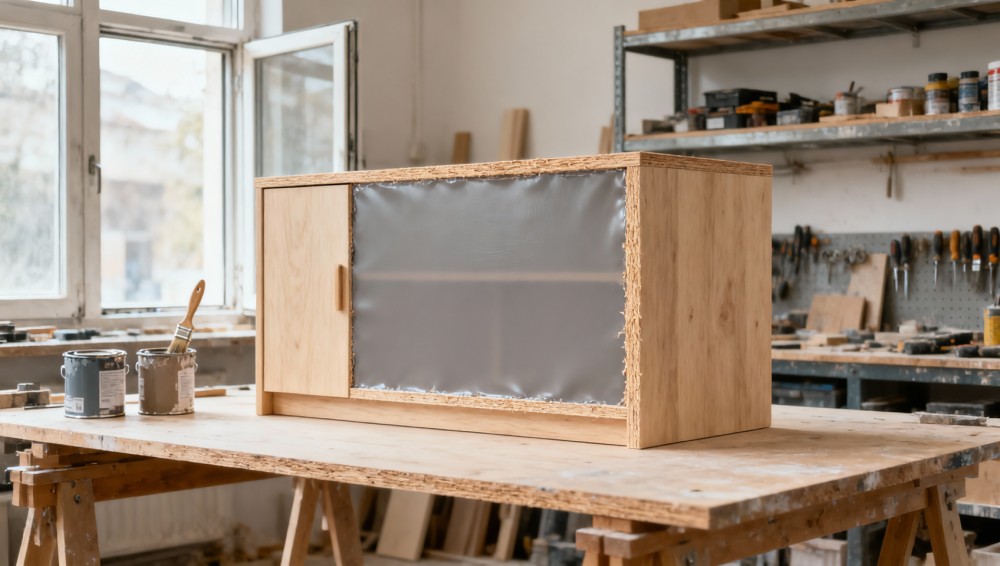
A household coating job also cannot reproduce a controlled emissions test. Gaps, inaccessible joints, hardware openings, and later scratches can interrupt the barrier. Avoid promises that a particular number of coats will eliminate a fixed percentage of emissions unless the claim is supported by testing relevant to that coating and substrate.
Choosing a finish without adding a new indoor-air problem
“MDF sealer” is not a guarantee of formaldehyde control. Some products are designed primarily to stop paint soaking into porous edges or to improve surface smoothness. Those are useful woodworking functions, but they are not the same as demonstrated emissions-barrier performance.
Likewise, “low-VOC” describes only part of the picture. Depending on the labeling scheme, it may refer to the coating’s regulated VOC content rather than substances emitted after application. A low-VOC finish is not automatically formaldehyde-free, and it is not necessarily an effective formaldehyde barrier.
Water-based coatings often reduce solvent exposure compared with conventional solvent-heavy alternatives, but formulations vary. Shellac-based sealers and other film-forming finishes may also be considered; none should be selected by product category alone. Check the technical data sheet, intended substrate, indoor-use instructions, and any emissions testing. For a barrier claim, ask whether testing actually measured formaldehyde transmission or emissions from coated composite wood.
There is a practical trade-off here: a strong barrier is not helpful if applying it introduces substantial fumes into an occupied bedroom. Avoid professional two-component finishes that require specialist exposure controls. An ordinary dust mask does not protect against solvent vapors.
If you decide to seal an existing piece
- Inspect before sanding. Identify exposed board and check whether the existing finish is compatible with the proposed coating. Do not remove an intact factory barrier without a clear reason.
- Work away from occupied living areas. Follow the coating’s ventilation, protective-equipment, and fire-safety instructions. Keep children and pets away during application and curing.
- Keep preparation modest. MDF edges absorb liquid readily. Avoid soaking the board, and use suitable dust extraction if abrasion is necessary.
- Follow the specified coating system. Primer, coverage, recoat intervals, and curing conditions matter. Extra coats applied too quickly can leave a poorly cured finish.
- Distinguish dry from cured. A surface that feels dry may still be releasing coating ingredients. Follow the manufacturer’s curing and return-to-service guidance rather than relying only on smell.
For inexpensive furniture with widespread bare surfaces, taking it apart, preparing it, and coating it properly may cost more effort than replacement. That is not a failure of sealing; it is a reason to compare the whole job with buying a documented low-emitting alternative.
Which furniture labels are worth checking?
For new furniture, source control is generally more dependable than trying to improve an unknown board afterward. In the United States, EPA’s TSCA Title VI requirements establish formaldehyde emission standards for regulated composite wood products, including MDF. California’s CARB Phase 2 requirements are another commonly encountered reference. Neither means “zero formaldehyde,” and neither establishes that the complete furniture item emits no other pollutants.
Look for the applicable compliance statement on the product, packaging, or documentation, and ask the seller to clarify vague claims. “Eco-friendly,” “natural wood fibers,” and “non-toxic finish” are not substitutes for evidence about the board itself.
Independent finished-product emissions certification can add useful information. For example, UL GREENGUARD Gold evaluates chemical emissions against its program criteria. Verify that the listing covers the actual product or product family being purchased, rather than an unrelated material made by the same supplier.
Also distinguish no-added-formaldehyde resin from “contains no formaldehyde.” Wood itself can release small amounts of formaldehyde. A no-added-formaldehyde claim concerns the resin formulation; it should not be stretched into a promise of zero emissions.
For Global Supply Review (GSR), which covers furniture materials and supply-chain information, the relevant distinction is between a supplier’s material claim and evidence tied to the item being sold. Consumers can use the same approach: ask what was tested, whether it was the panel or the complete furniture, and whether the documentation matches the current model.
Bedrooms and nurseries call for a more cautious decision
A new wardrobe in a small bedroom deserves more scrutiny than a similar piece in a large, frequently ventilated hallway. People spend long periods sleeping, often with doors and windows closed. For a nursery, prioritize documented low-emitting furniture before purchase rather than planning to fix uncertain emissions with a coating later.
When new furniture arrives, ventilate with outdoor air where conditions allow and keep the room at a comfortable, moderate temperature and humidity. Avoid deliberately overheating furniture to accelerate off-gassing: heat can increase emissions and may damage finishes or adhesives. There is no reliable universal airing-out period.
Smell is an imperfect guide. A strong odor warrants attention, but it does not identify formaldehyde or measure its concentration. Conversely, an absence of odor does not establish that emissions are negligible. HEPA filtration removes particles, not formaldehyde gas; gas-removal filters require suitable media, adequate capacity, and timely replacement.
If irritation repeatedly occurs in a room after furniture installation, reduce exposure and seek medical advice for persistent symptoms. Do not assume the furniture is the only possible source: coatings, cleaners, other building materials, and inadequate ventilation may contribute.
When sealing is a reasonable choice
Sealing makes the most sense when furniture is sound, exposed MDF is accessible, and a compatible coating can be applied and cured safely away from occupants. It makes less sense when large areas are inaccessible, the board is moisture-damaged, or the refinishing work would create substantial dust and fumes indoors.
If uncertainty remains, qualified indoor-air assessment can help establish whether formaldehyde is elevated. Testing needs appropriate methods and interpretation; a generic consumer “TVOC” reading does not reliably establish formaldehyde concentration or identify the responsible object.
The useful answer is therefore conditional: sealing can reduce emissions, but it is a supplementary measure, not proof of safety. Before opening a can of sealer, inspect the furniture, check its documentation, and consider the room where it will be used. For a new nursery cabinet or bedroom wardrobe, choosing a verified low-emitting product is usually the more straightforward decision.
Recommended News
 Supply Chain InsightsHow to find a custom-printed ring-pull can supplier for small ordersFind a custom printed ring pull cans supplier for small orders. Compare MOQs, printing options, samples, and delivered costs to launch confidently without excess inventory.Oct 15, 2026
 Supply Chain InsightsWhat Should You Check When Auditing a Contract Furniture Supplier?What should be checked when auditing a contract furniture supplier? Discover essential checks for compliance, quality, traceability, and delivery to reduce sourcing risks.Oct 14, 2026
 Office FurnitureDoes sealing MDF furniture reduce the risk of toxic emissions?Concerned about MDF toxicity? Discover how sealing furniture can reduce formaldehyde emissions, where it falls short, and how to choose low-emitting options for your home.Interior Sourcing LeadOct 14, 2026
 Home DecorHow order size affects wholesale prices for round linen tableclothsBuying round linen tablecloths wholesale? Discover how order size, freight, and inventory costs affect pricing—and choose the right quantity to maximize real savings.Interior Sourcing LeadOct 14, 2026