Industry News
Curation by industry experts
Hot Articles
Popular Tags
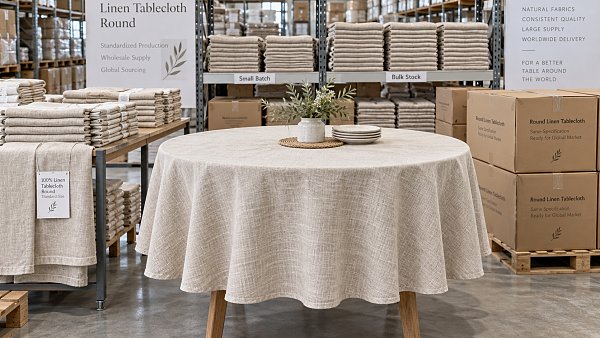
How order size affects wholesale prices for round linen tablecloths
A larger order of round linen tablecloths can reduce the quoted unit price, but the lowest price tier does not necessarily produce the lowest purchasing cost. The saving is worthwhile only when it exceeds the additional cost of freight, financing, storage, and inventory that may remain unused.
The important distinction is between buying more pieces and creating a more efficient production run. A substantial order split across several diameters, colors, and finishes may offer less scope for discounts than a smaller order of one standardized specification. When sourcing round linen tablecloths wholesale, price comparisons therefore need to consider both total quantity and quantity per production batch.
What actually becomes cheaper as order size increases?
A supplier’s quotation combines costs that increase with every tablecloth and costs that can be spread across a production run. Fabric, sewing labor, individual packaging, and some inspection work remain tied to each piece. Sample development, cutting preparation, production scheduling, and certain administrative charges can be distributed across more units.
A simplified pricing model is:
Unit price = variable cost per piece + allocated batch costs per piece + supplier margin.
This explains why moving from a small custom order to a workable production batch can produce a meaningful reduction, while increasing an already efficient batch may yield a smaller saving. Once setup costs represent only a minor portion of the price, additional discounts must come from other sources, such as better fabric purchasing terms or improved production efficiency.
The model also identifies a limit to volume savings. Buying more does not eliminate the fabric required for each tablecloth. If a quotation falls sharply at a higher quantity, confirm that fiber composition, fabric weight, dimensions, finishing, and packing remain unchanged. A cheaper specification is not a volume discount.
Round construction makes fabric width a pricing variable
For round tablecloths, diameter and usable fabric width influence material consumption and construction. A seamless circular piece must fit within the usable width of the cloth, allowing for the specified hem and any dimensional allowance built into production. If it cannot fit, the supplier must use wider fabric or introduce seams.
This matters because order volume cannot remove a geometric constraint. A larger quantity may make a special-width fabric order commercially feasible, but it does not automatically make that fabric cheaper than a narrower alternative. Comparing a seamless wide-width tablecloth with a joined-panel product can create a misleading impression of quantity savings.
Circular cutting also leaves material outside the finished shape. The cutting layout, fabric width, and ability to use offcuts determine how much of that material becomes waste. An order containing several sizes may allow useful layout combinations, but the supplier should demonstrate the resulting saving rather than assume that mixed sizes are cheaper.
Before requesting quantity tiers, establish a common specification covering:
- Fiber composition: 100% linen or a clearly stated blend, rather than “linen-look” fabric.
- Fabric weight and relevant weave or finish requirements.
- Finished diameter and dimensional tolerance.
- Whether diameter is measured before washing or after an agreed laundering procedure.
- Seamless or seamed construction, including acceptable seam placement.
- Hem type, hem width, color reference, and packaging.
These details are not peripheral to the price discussion. They determine whether two offers represent the same product and whether the higher-volume offer preserves the required performance.
Minimum order quantities can apply to different parts of the order
A minimum order quantity, or MOQ, is not always a single factory-wide threshold. It may apply to the finished product, an individual size, a custom color, a fabric specification, or branded packaging. Ask which constraint establishes each minimum and whether quantities can be combined across variants.
For example, a supplier using existing fabric inventory may accept a relatively small finished-goods order. A custom-dyed version could require a larger fabric commitment, even if the sewing requirement is identical. The relevant threshold in that case is driven by fabric processing rather than tablecloth assembly.
A total order of 1,000 pieces divided among ten distinct specifications is not necessarily priced like 1,000 identical pieces. Separate materials, cutting layouts, thread colors, labels, and packing instructions can reduce the efficiency of the combined order. Conversely, different diameters made from the same fabric and color may share some material purchasing benefits.
Request that quotations distinguish between total-order discounts and per-variant production discounts. Without that distinction, an attractive price tier may disappear when the final assortment is confirmed.
Measure the discount against the cash committed
Price breaks should be evaluated at the quantities actually under consideration, not accepted simply because the largest tier has the lowest unit price. The following figures are hypothetical and illustrate the arithmetic; they are not market price benchmarks.
Moving from 300 to 600 pieces reduces the quoted unit price by 6.25%, but requires another $6,300 in goods expenditure. If all 600 pieces will be needed, buying them together saves $900 compared with two 300-piece purchases at the illustrated price, before freight differences and carrying costs.
If demand remains at 300 pieces, however, the extra expenditure is not a saving. It creates inventory whose value depends on future use or recoverable resale proceeds. The lower unit price alone cannot justify that commitment.
The next tier deserves a separate calculation. Buying 1,200 pieces rather than two orders of 600 saves another $900 in goods cost, assuming the later order would retain the same price. That saving must compensate for receiving the second 600 pieces earlier. The percentage reduction is smaller, while the inventory exposure is larger.
This is why the best order size can sit between the supplier’s advertised tiers. Ask for a quotation at the demand-based quantity, rather than rounding upward without checking the economics.
Compare landed cost and inventory cost separately
The quoted factory price is only one part of the purchasing decision. An ex-works quotation and a delivered quotation cannot be compared directly. Normalize the named delivery location, Incoterms® rule, and included charges before evaluating the effect of volume.
For a defined specification and destination:
Landed cost per accepted piece = goods cost, plus applicable transport, insurance, duties, handling, and inspection costs, divided by the accepted quantity.
Recoverable import taxes should be distinguished from permanent costs, although they may still affect cash flow. If rejected goods are credited or replaced, account for that remedy rather than treating every rejection as a permanent loss.
Freight does not necessarily fall smoothly per piece as quantity increases. Shipment minimums, carton dimensions, pallet requirements, container utilization, and destination charges can create cost steps. Request packed carton measurements, gross weights, and pieces per carton at each relevant order size. Estimates based only on the number of tablecloths can miss the effect of packaging volume.
Inventory cost requires a different calculation. Apply financing, storage, handling, and risk assumptions to the expected inventory balance over time, not automatically to the entire order for a full year. An order consumed steadily over six months has a different carrying cost from one held untouched for the same period.
For an illustrative comparison, if an earlier purchase creates $6,000 of additional average inventory for six months and the business uses a combined annual carrying-cost assumption of 20%, the estimated cost is $600. That assumption is company-specific, not an industry benchmark. Add any separately assessed risk of unused sizes or discontinued colors without counting the same risk twice.
Larger batches change delivery and quality exposure
A discount has limited value if reaching the threshold delays the order beyond its required date. Stock fabric, custom weaving or dyeing, sewing capacity, and finishing arrangements can produce different lead times. Ask whether the quoted schedule starts from deposit payment, sample approval, material availability, or another milestone.
Volume can also concentrate quality exposure. A fabric or finishing problem affecting a large batch may leave more pieces unusable at once. Relevant acceptance points include actual diameter, roundness, hem consistency, seam appearance, shade variation, and performance under the agreed laundering conditions.
Linen can change dimensions during washing, so a nominal diameter alone does not define suitability. Specify the laundering method and acceptable dimensional change where fit after washing matters. Confirm whether the approved sample and bulk goods will use the same material and finishing process, and document any permitted substitution.
Inspection arrangements should match the order’s risks. Pre-shipment checks can help identify construction and measurement problems, while agreed fabric or laundering tests address requirements that a visual check cannot establish. Written remedies for short quantities, nonconforming goods, replacement freight, and credits make the economic comparison more meaningful.
Where repeated deliveries must match, clarify whether they will come from one fabric lot or separate production lots. A blanket commitment with later releases does not itself guarantee identical shade or finishing.
Negotiate production volume without automatically taking all the stock
A blanket order with scheduled releases can separate the supplier’s production commitment from the timing of delivery. It may preserve some batch efficiency while reducing immediate storage requirements. However, the saving depends on what the supplier actually consolidates: fabric purchasing, finished-goods production, or only the commercial commitment.
The agreement should state release quantities, delivery windows, deposits, storage charges, ownership, cancellation liability, and responsibility for deterioration. Goods held at the factory may still represent committed inventory if payment or title has already transferred. Multiple releases can also increase total transport and handling costs.
Standardization provides another route to better pricing. Consolidating closely related diameters, using an existing fabric color, or removing unnecessary packaging variations can improve production economics without increasing total demand. These changes are worthwhile only where they preserve the required fit, appearance, and service conditions.
A useful quotation request asks for identical specifications at several realistic quantities, with price breaks, variant-level MOQs, lead times, packing details, payment terms, and release options stated separately. Also clarify whether a discount applies to every piece once a threshold is reached or only to units above that threshold.
The deciding quantity is the one supported by expected consumption and a defensible cost comparison. Where the additional discount is smaller than the cost of holding surplus stock, the lower tier is preferable. Where demand is committed, specifications are stable, and production and freight savings exceed the cost of earlier ownership, a larger order has a clear economic basis.
Recommended News
 Home DecorHow order size affects wholesale prices for round linen tableclothsBuying round linen tablecloths wholesale? Discover how order size, freight, and inventory costs affect pricing—and choose the right quantity to maximize real savings.Interior Sourcing LeadOct 14, 2026
 Outdoor FurnitureHow to verify outdoor furniture manufacturers' production capacityCan outdoor furniture manufacturers deliver on time? Learn how to verify production capacity, uncover bottlenecks, and validate supplier commitments before placing your next order.Interior Sourcing LeadOct 13, 2026
 Commercial DisplaysWhat makes an outdoor digital signage display manufacturer reliable?Discover how to choose a reliable outdoor digital signage display manufacturer with proven weather protection, quality control, smart visibility, and responsive after-sales support.Commercial Tech EditorOct 12, 2026
 Garment MfgWhen do bulk embroidered hoodies offer better value than printed ones?Bulk embroidered hoodies deliver lasting value for uniforms and premium branding. Compare durability, design, comfort, and cost to choose the right decoration.Textile Industry AnalystOct 11, 2026