Industry News
Curation by industry experts
Hot Articles
Popular Tags
How to verify outdoor furniture manufacturers' production capacity
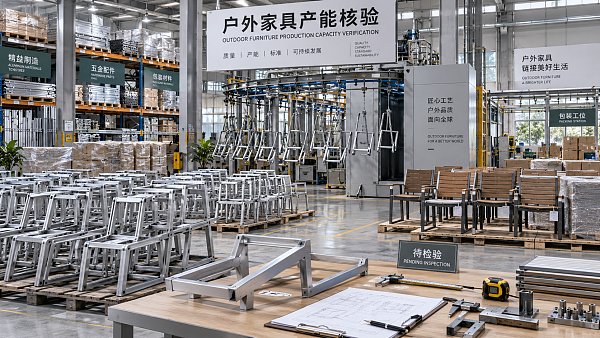
A polished showroom and a competitive quote tell you little about whether outdoor furniture manufacturers can deliver your order on time. The real test is whether a supplier can reserve enough production time, secure the right materials, and maintain acceptable quality while serving its existing customers.
For procurement teams, this matters most when a missed delivery window means losing a retail season, delaying a hotel opening, or leaving a distributor without stock. Verifying capacity is not simply counting machines. It means connecting production records, bottleneck performance, material availability, and current order commitments to your specific purchase.
The question to answer before placing a deposit is straightforward: What evidence shows that this factory can deliver our product mix, in the required quantities, by the agreed shipment date?
Define the order before asking about capacity
A supplier’s claim of “monthly capacity” is rarely useful without a product definition. A factory producing simple stackable chairs may report impressive volumes, yet struggle with a mixed order of welded sofas, extendable tables, woven loungers, and custom cushions.
Prepare an order profile that includes:
- Quantities by SKU, rather than only the total number of pieces.
- Materials, frame construction, finishes, and upholstery specifications.
- Color variations, packaging requirements, and assembly configuration.
- Sample approval deadlines and the required factory-ready or shipment date.
- Any testing, inspection, or documentation required before release.
Ask the supplier to calculate capacity against this profile. Clarify whether “one unit” means a chair, a complete dining set, a carton, or a saleable item. A six-chair dining set can otherwise create a substantial misunderstanding between the quotation and the production plan.
Also distinguish the factory completion date from the delivery date at your destination. Production capacity does not eliminate booking delays, inland transport constraints, customs processing, or ocean transit time.
Separate advertised output from available capacity
Three different numbers often get presented as though they mean the same thing: theoretical capacity, demonstrated output, and available capacity.
For procurement decisions, available capacity matters most—but only when demonstrated output supports it. A factory may have produced large volumes last year while currently operating with fewer workers or carrying a much heavier backlog.
Request recent weekly production records and enough historical information to cover relevant seasonal peaks. Look for output by product family and process, not just an annual sales figure. Revenue is affected by price and product mix; it is not reliable evidence of physical production capacity.
Where customer confidentiality is an issue, accept redacted records or arrange an independent review. The objective is to verify quantities and dates, not obtain another buyer’s commercial information.
Find the process that controls the shipment date
Outdoor furniture production is a chain of dependent operations. Extra assembly workers cannot compensate for an overloaded coating line, and idle welding stations are of little use if frame components have not arrived.
Metal frames: welding and finishing
For aluminum or steel furniture, inspect cutting, bending, welding, grinding, pretreatment, and coating. Welding capacity depends on fixture availability, joint complexity, operator skill, and changeovers between models. A machine count alone says little about daily acceptable output.
Finishing is frequently a shared constraint. Ask how coating batches are scheduled, how color changes affect throughput, and whether oven space or hanging arrangements limit output for bulky products. Confirm that pretreatment and curing requirements remain intact when the factory is busy. Faster movement through the line is not useful if it creates coating defects or premature corrosion.
Woven furniture: skilled labor and frame availability
Handwoven products can be highly sensitive to worker availability and weave complexity. Request actual labor time for comparable designs, including trimming and inspection. A simple weave and an intricate pattern should not share the same capacity assumption.
Check whether weaving is performed onsite, by another controlled facility, or through external workshops. Subcontracting is not automatically a problem, but undisclosed subcontracting makes schedules and quality harder to verify.
Wood furniture and cushions: less visible constraints
For wood products, examine material conditioning, moisture control, machining, sanding, coating, and curing. Where drying or stabilization is necessary, it cannot simply be replaced with overtime. Species, section thickness, and construction affect the schedule.
Cushions introduce another production stream: fabric procurement, cutting, sewing, foam preparation, and packing. Frames may be complete while finished furniture waits for cushions. Confirm whether the upholstery operation is included in the supplier’s capacity claim.
The relevant capacity is the capacity of the slowest required process—not the sum of all departments’ output.
Reconstruct the capacity calculation
Ask the manufacturer to show its calculation rather than repeat a headline number. At each critical operation, assess staffed production hours, demonstrated processing rates, planned downtime, changeovers, and the proportion of output that meets acceptance requirements.
One useful approach is:
Expected acceptable output = available operating hours × demonstrated gross production rate × acceptance yield.
Keep the inputs consistent. If the demonstrated rate already measures accepted units per hour, do not apply the acceptance yield again. Likewise, avoid deducting downtime twice when historical output already includes it.
Consider a simplified, illustrative example. A finishing line operates for 40 scheduled hours per week. After maintenance and color changes, it has 34 operating hours. At 50 frames per operating hour and a 96% acceptance yield, expected acceptable output is approximately 1,632 frames per week. If existing orders consume 1,200 frames of that same capacity, only about 432 remain before any additional contingency allowance.
This is not an industry benchmark. It shows why “2,000 frames per week” may not support a new order requiring 800 weekly frames. For different frame sizes or finishes, convert demand into required processing hours instead of assuming every frame consumes equal capacity.
Cross-check production records against physical evidence
Reliable verification uses several sources that agree with one another. A spreadsheet can be tidy without being accurate; a busy workshop can be impressive without having room for your order.
Compare production logs with material receipts, work-in-progress records, quality reports, packing records, and dispatch documents. Follow a few recent batches through the system: when materials arrived, when processing started, what quantity passed inspection, and when goods shipped.
During a factory visit or independent audit, observe:
- Whether installed equipment is operational and staffed.
- Queues before welding, coating, weaving, or final assembly.
- Rework areas and recurring defects that consume production time.
- Maintenance records and downtime affecting critical equipment.
- Actual shift patterns, attendance, and reliance on overtime.
- Finished-goods storage and packing space during busy periods.
An announced visit is useful, but it is still a snapshot. Ask whether the observed day reflects normal operation and compare it with records from several weeks. If an onsite visit is impractical, live video walkthroughs and document reviews can support screening, although they provide less assurance than direct observation.
Audits should also assess whether the proposed schedule relies on excessive working hours or unsafe practices. Capacity that depends on unsustainable labor conditions is a compliance and continuity risk, not dependable supply.
Check the materials and commitments behind the schedule
A factory can have spare machinery and still miss an order because a specified fabric, aluminum profile, coating powder, or fitting is unavailable. Ask for the bill of materials and identify components with long replenishment times, limited sources, or minimum order quantities.
Distinguish materials already in stock from materials merely quoted by a vendor. For critical items, request evidence of purchase orders, supplier acknowledgments, or confirmed inbound dates. Where responsible sourcing or traceability requirements apply, confirm that the approved material—not an easier substitute—is covered by the plan.
The order book deserves equally close attention. Outdoor furniture manufacturers may serve customers preparing for similar selling seasons, creating concentrated demand across shared processes.
Request a weekly loading plan showing existing commitments and the proposed allocation for your order. Customer names can remain confidential. What matters is whether the total planned workload fits the verified capacity of each critical department.
Be cautious when the schedule assumes every shift runs perfectly, every material arrives on time, and no goods require rework. Ask what happens if a critical machine stops or a component arrives late. A credible contingency identifies a feasible alternative and its limitations; “we will add workers” is not enough.
Use a pilot run to test what documents cannot prove
For a new supplier or a substantially different design, a pilot production run can expose problems hidden by handmade samples. Specify that the pilot uses intended production equipment, normal operators, approved materials, and the planned finishing and packing methods.
Measure actual processing time, accepted output, rework, and packaging performance. Include difficult SKUs or finishes rather than choosing only the easiest item. A mixed order should also test changeovers where these materially affect throughput.
Sample approval establishes appearance and construction; it does not establish repeatable production capacity. Likewise, product test reports may support performance requirements but do not prove that the factory has enough uncommitted line time.
If the pilot performs below the supplier’s assumptions, revise the schedule before committing the full volume. A smaller initial order, phased shipments, or a qualified second source may be safer than relying on a promise to recover lost time later.
Turn verified capacity into a purchasing decision
Before approval, assemble a short evidence file: the agreed order profile, demonstrated output, bottleneck calculation, material status, current loading plan, audit findings, and pilot results where applicable. Record unresolved assumptions alongside the supplier’s proposed remedies.
Then make a practical decision:
- Approve: The evidence supports the product mix and timeline, with credible room for disruption.
- Approve conditionally: Capacity is plausible, but material confirmation, pilot approval, or another defined requirement remains outstanding.
- Reduce or phase the order: The factory is capable, but its available capacity does not support the full request.
- Do not proceed: Records conflict, critical operations are concealed, or the plan depends on unsupported assumptions.
Put agreed milestones into the purchase documentation: material readiness, production start, progress reporting, inspection, packing completion, and shipment readiness. Define how delays are escalated and require approval before changing production sites or critical materials.
For buyers using Global Supply Review to research furniture suppliers, this evidence-led approach connects sourcing intelligence with the decision that ultimately matters. A promising manufacturer still needs to demonstrate order-specific capacity.
The strongest supplier is not necessarily the one quoting the largest monthly output. It is the one that can explain its constraints, show consistent records, and reserve a realistic production window for your order. That clarity gives procurement teams something more valuable than reassurance: a delivery plan they can defend.
Recommended News
 Outdoor FurnitureHow to verify outdoor furniture manufacturers' production capacityCan outdoor furniture manufacturers deliver on time? Learn how to verify production capacity, uncover bottlenecks, and validate supplier commitments before placing your next order.Interior Sourcing LeadOct 13, 2026
 Commercial DisplaysWhat makes an outdoor digital signage display manufacturer reliable?Discover how to choose a reliable outdoor digital signage display manufacturer with proven weather protection, quality control, smart visibility, and responsive after-sales support.Commercial Tech EditorOct 12, 2026
 Garment MfgWhen do bulk embroidered hoodies offer better value than printed ones?Bulk embroidered hoodies deliver lasting value for uniforms and premium branding. Compare durability, design, comfort, and cost to choose the right decoration.Textile Industry AnalystOct 11, 2026
 Carton & PlasticsHow to compare packaging automation suppliers for line integrationPackaging automation supplier comparison guide: evaluate line integration, controls, safety, testing, lifecycle costs, and support to select a proven partner.Packaging Supply ExpertOct 10, 2026