Industry News
Curation by industry experts
Hot Articles
Popular Tags
How to verify the production capacity of a beach lounge chair factory
A beach lounge chair factory may promise impressive monthly output, but the number on a quotation rarely tells you whether your order will leave on time and meet your specifications. A factory producing simple folding chairs, for example, may need more time to manufacture adjustable loungers with sewn fabric panels and custom packaging.
For procurement teams, capacity verification is about finding the output available for your product, during your delivery window. That means checking production records, identifying constraints, understanding existing commitments, and testing whether the factory can maintain quality as volumes rise. The following approach turns a broad supplier claim into a purchasing decision supported by evidence.
What does the factory mean by production capacity?
Before comparing suppliers, establish a common definition. One factory may quote theoretical capacity based on full equipment utilization and overtime. Another may report its average shipped volume under normal working conditions. Those figures are not interchangeable.
Ask the supplier to separate the following measures for the chair design you intend to buy:
- Installed capacity: The potential output of available equipment and workstations under stated assumptions.
- Demonstrated output: The quantity of comparable chairs actually completed and accepted over a defined period.
- Available capacity: The portion of realistic output not already committed to other orders during your production window.
- Shippable capacity: The quantity expected to pass inspection, be packed, and be ready for dispatch on time.
Define a finished unit consistently. A welded frame waiting for fabric, hardware, or a carton is not a finished chair. Similarly, a factory’s monthly output figure should specify the number of working days, shifts, overtime hours, product mix, and whether rejected or reworked units are included.
Start with the order, not the supplier’s brochure
Capacity is product-specific. Give the factory enough detail to assess the work: frame material and dimensions, folding or reclining mechanism, fabric type, finish, accessories, labeling, packaging, order quantity, and required ship date. Note any variations in color or size, because frequent changeovers can reduce the output of a production run.
Ask for a schedule that works backward from the requested dispatch date. It should cover material purchasing, sample approval, production, inspection, packing, and a reasonable allowance for disruptions. If an overseas buyer needs a vessel departure date, distinguish the factory-ready date from the port cutoff; the two are not the same.
Also clarify whether the order will run continuously or in batches. A supplier may have enough capacity across a month but still struggle to complete a large quantity before a single shipment cutoff. Split deliveries can be useful, provided the buyer accepts the additional freight, handling, and inventory implications.
Check the evidence behind the monthly output claim
Request records for recent orders that resemble your chair in construction and complexity. A few representative production runs are more useful than a single peak month. Where confidentiality is an issue, the supplier can redact customer names and commercial terms while retaining dates, quantities, model descriptions, and process information.
Cross-check the documents rather than treating any one record as conclusive. If production reports show a large batch completed in June, corresponding inspection and dispatch records should support the timing and quantity. Differences are not automatically a problem: goods may remain in stock or ship later. Ask the factory to explain the reconciliation.
For a newer factory or a substantially new design, historical records may be limited. In that case, treat capacity as less certain and place greater weight on a pilot run, component readiness, and a conservative production schedule.
Find the bottleneck in the chair-making process
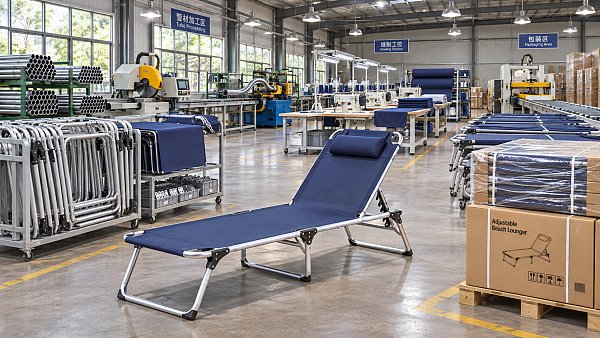
Walk through the production route with the supplier. Depending on the design and the factory’s level of vertical integration, work may include tube cutting and bending, welding, surface finishing, fabric cutting and sewing, assembly, inspection, and packing. Some processes may be outsourced.
The slowest constrained stage sets the pace for the whole order. A supplier may have ample assembly tables but limited bending equipment, a crowded coating line, or too few sewing operators for a complex sling. Inventory between stages can temporarily hide the problem during a short visit.
Ask the production manager to identify the constraint, its normal output, and what happens when the line falls behind. Are trained operators available for another shift? Can a coating subcontractor accept additional work? Is there a backup source for reclining mechanisms? A practical answer should identify resources and lead times, not simply promise that the factory will “work harder.”
A simple capacity calculation
Use the bottleneck as a starting point, then adjust for the conditions of your order:
Estimated shippable capacity = bottleneck gross output per day × available production days × expected acceptance rate.
For illustration, suppose a constrained assembly operation can produce 500 chairs per day under the agreed working schedule. If 18 production days are genuinely available and the planning assumption is that 96% of gross output will be accepted and packed in time, the estimate is 8,640 shippable chairs. These are illustrative assumptions, not industry benchmarks.
The calculation is only useful if its inputs are credible. The 18 days must exclude periods already committed to other orders and allow for maintenance or planned shutdowns. The acceptance assumption should be supported by comparable production records. Also check that packing and material availability can sustain the same rate; otherwise, another stage becomes the constraint.
Validate the numbers during a factory audit
An on-site audit, or an independent assessment when travel is impractical, helps connect paperwork with what is happening on the floor. Arrange access to the actual production location and ask which operations will be performed there. A trading company’s office, sample room, or partner factory does not by itself establish where your order will be made.
During the visit, follow a chair or a comparable product through the process. Look for work-in-progress, equipment in operation, operator allocation, inspection points, and finished goods awaiting shipment. Compare the observed product and line arrangement with the records supplied beforehand.
A short observation is a snapshot, not proof of sustained monthly capacity. If possible, observe a representative run long enough to capture normal stops, quality checks, and changeovers. Record the model, staffing, working time, units started, units accepted, and any rework. Do not extrapolate a brief peak rate into a full month without adjusting for breaks, downtime, other orders, and the remaining production stages.
If key work is subcontracted, identify the subcontractor and confirm its role, location, available capacity, and delivery commitments. Subject to access and confidentiality arrangements, review its evidence or arrange a separate assessment. The purchasing contract should make clear whether subcontracting requires your approval and who remains responsible for quality and delivery.
Materials can limit output before production starts
A factory with open assembly capacity may still miss a deadline if its components arrive late. Beach loungers commonly depend on several supply streams: metal tubing, fabric or mesh, hinges and fasteners, finishing materials, plastic parts, and packaging. Custom colors, prints, or mechanisms can add approval and purchasing time.
Ask for a material readiness plan showing quantities required, current stock, purchase order status, supplier lead times, and expected arrival dates. For critical components, request supporting purchase confirmations where commercially feasible. Check whether stock is allocated to your order or merely visible in a shared warehouse.
Pay particular attention to items with limited alternatives. Replacing a fabric, coating, or locking component may affect appearance, durability, performance, or compliance with the agreed specification. Any substitution should follow an agreed approval process rather than being treated as a scheduling shortcut.
Connect capacity to quality and landed cost
A low unit price can look less attractive if the supplier needs expensive overtime, repeated inspections, air freight, or replacement shipments to meet the order. Ask the factory to explain whether its quotation assumes normal shifts, overtime, subcontracting, or a particular batch size. Clarify which charges are included for packaging, tooling, samples, inspection, and delivery to the agreed handover point.
Quality checks should reflect the product and its intended market. Agree on the applicable requirements before production, including any relevant buyer specifications or mandatory rules. Depending on the design, inspection may address folding and locking function, frame workmanship, fabric attachment, finish, labeling, and packaging. Define the sampling method, acceptance criteria, and who pays for reinspection or corrective work.
Do not assume that a factory’s highest historical output is the right purchasing target. A lower, demonstrated rate with manageable defects may be more valuable than a faster rate achieved through heavy overtime and extensive rework. Compare suppliers on expected usable output, schedule confidence, and total cost—not only the price per chair.
Warning signs worth investigating
- A capacity figure changes with every conversation. Ask which product, shifts, and working days each figure represents.
- Records show production but not accepted or shipped quantities. Investigate whether inspection failures, unfinished work, or delayed dispatch explain the gap.
- The factory will not identify critical subcontractors. Clarify where essential work occurs and how it will be controlled.
- The schedule leaves no time for approvals or material delays. Request a revised plan with dependencies and decision dates.
- Capacity depends on adding people or equipment after the order is placed. Verify hiring, installation, training, and startup timing before relying on the increase.
None of these signals proves a supplier cannot perform. They do indicate that the buyer needs a clearer explanation and stronger evidence before committing a deposit or a time-sensitive launch.
Turn verification into purchasing terms
Once the assessment is complete, document the assumptions that support the order: approved specifications, production site, authorized subcontractors, quantity, milestones, inspection requirements, and shipment dates. Agree on the reporting cadence and the point at which the supplier must flag a material shortage, quality issue, or schedule deviation.
For a substantial or unfamiliar order, consider a pilot batch or staged release before committing the full volume. Set clear criteria for moving to the next stage, and ensure that the pilot resembles the commercial product and process. A successful sample alone is not evidence that thousands of chairs can be made consistently.
The most useful capacity assessment does not produce a perfect number. It produces a defensible range, identifies the weakest assumptions, and gives both parties time to act if conditions change. When a beach lounge chair factory can explain its constraints as readily as its capabilities—and support both with records—you have a firmer basis for negotiating price, delivery, and order size.
Recommended News
 Industrial FastenersHow to verify DIN compliance when choosing a fasteners supplierChoosing a DIN fasteners supplier? Learn how to verify standards, certificates, traceability and quality controls before placing an order.Tooling & Hardware LeadNov 12, 2026
 Eco PackagingCalifornia’s Draft 2027 Packaging Fees Include Weight and Per-Item Charges for PlasticCalifornia’s draft 2027 packaging fees include weight and per-item charges for plastic. Discover what the proposed rates could mean for packaging costs.Packaging Supply ExpertNov 11, 2026
 Outdoor FurnitureHow to verify the production capacity of a beach lounge chair factoryVerify a beach lounge chair factory’s production capacity with practical checks for output, bottlenecks, quality, and delivery before placing your order.Interior Sourcing LeadNov 11, 2026
 Commercial DisplaysHow bright should a window-facing display be in direct sunlight?Window facing display high brightness starts at 2,500–3,500 nits for many sunny storefronts. Discover how to manage glare and heat for clear visibility.Commercial Tech EditorNov 10, 2026