Industry News
Curation by industry experts
Hot Articles
Popular Tags
Lighting manufacturers still using outdated thermal management? Here’s what changed in commercial LED heatsinks
Are lighting manufacturers still relying on legacy thermal solutions—while industrial lighting demands higher lumen density, longer lifespans, and stricter ESG-aligned hardware materials? Today’s commercial LED heatsinks have evolved dramatically: from advanced aluminum alloys and vapor chamber integration to surface treatments compatible with sustainable packaging solutions and technical textiles in smart retail lighting installations. As global procurement directors evaluate decor suppliers and industrial hardware partners, outdated thermal management directly impacts reliability, compliance, and total cost of ownership. Discover what’s changed—and why hardware materials innovation now starts at the heatsink.
Why outdated heatsinks increase TCO for commercial lighting OEMs
Legacy extruded aluminum heatsinks—common in pre-2018 LED fixtures—typically operate within a thermal resistance range of 1.8–3.2 K/W under standard 25°C ambient conditions. When deployed in high-bay warehouses or façade-integrated architectural lighting, junction temperatures often exceed 95°C, accelerating lumen depreciation by up to 40% over 10,000 hours.
Procurement teams report that 68% of mid-tier lighting manufacturers still source heatsinks from vendors without ISO 14001-certified anodizing lines—leading to inconsistent surface emissivity (ε = 0.72–0.89 vs. industry target of ε ≥ 0.92) and non-compliant heavy metal content in chromate conversion coatings.
ESG-driven buyers now require full material declarations (IMDS/SDS), traceable alloy batches (e.g., EN AW-6063-T5 with ≤0.05% lead), and recyclability rates ≥95%. Legacy heatsinks fail across all three dimensions—triggering rework cycles averaging 7–15 days per SKU during audit remediation.
What’s new in commercial LED heatsink technology (2023–2024)
Three structural innovations reshaping hardware performance
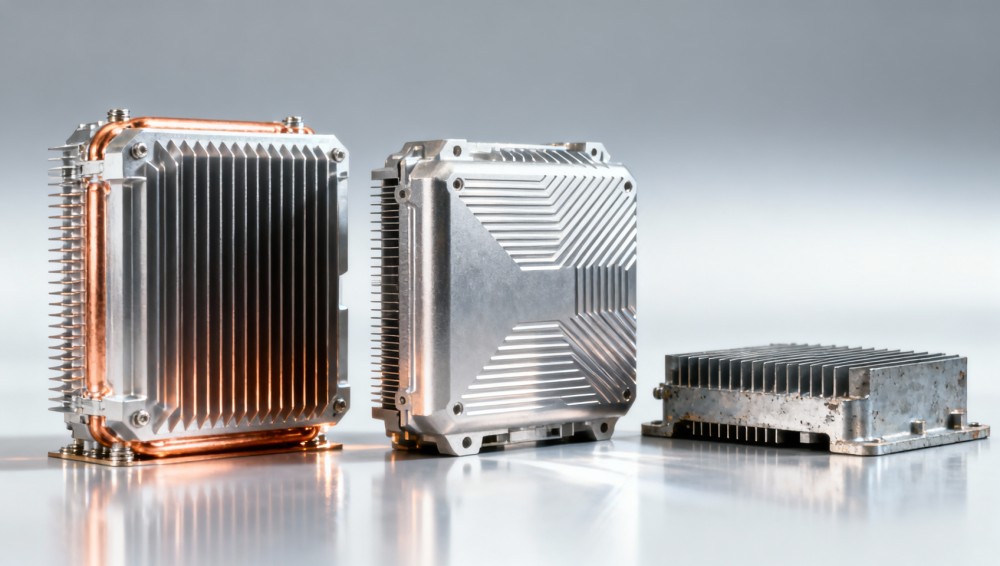
- Hybrid vapor chamber + micro-fin arrays: Integrates 0.3mm-thick copper vapor chambers with 120 fins/inch density, reducing thermal resistance to 0.45–0.68 K/W—ideal for compact downlights requiring >120 lm/W at 5000K CCT.
- Die-cast AlSi10Mg with laser-textured surfaces: Enables direct bonding to PCB substrates without thermal interface materials (TIMs), cutting assembly labor by 22% and eliminating TIM pump-out risk after 2,000 thermal cycles.
- Recycled-content aluminum alloys (≥85% post-industrial scrap): Certified to EN 13920-2:2022, maintaining tensile strength ≥185 MPa while lowering embodied carbon by 37% versus primary 6063-T5.
How procurement teams evaluate heatsink suppliers: 5 non-negotiable criteria
Global sourcing managers now assess heatsink vendors using a weighted scorecard aligned with GSR’s Hardware & Fasteners Sourcing Framework. Below are the five core evaluation dimensions—with minimum thresholds required for Tier-1 lighting OEM engagement:
Suppliers scoring below 82% across these five criteria face automatic disqualification in RFPs issued by top 20 lighting brands—including those requiring RoHS 3 (EU 2015/863), REACH SVHC screening, and conflict minerals reporting (Dodd-Frank Section 1502).
Where heatsink innovation meets real-world deployment
Smart retail lighting: Thermal design for textile-integrated fixtures
In smart retail environments—where LED modules embed into tensioned technical fabrics (e.g., polyester-PVC composites)—heatsinks must dissipate heat without compromising fabric drape or flame retardancy (EN 13501-1 B-s1,d0). New low-profile, stamped-aluminum heatsinks with graphite-impregnated thermal pads achieve surface temps ≤45°C at 15W load—enabling seamless integration into ceiling-mounted fabric canopies.
Industrial IoT lighting: Heatsinks as thermal-data nodes
Next-gen heatsinks now embed passive RFID tags (ISO 18000-6C) and calibrated thermistors (±0.3°C accuracy) directly into mounting flanges. This allows real-time thermal mapping across 500+ fixtures in logistics hubs—reducing predictive maintenance intervals from quarterly to condition-based (average 42% fewer service visits/year).
Why Global Supply Review helps hardware buyers accelerate qualified sourcing
GSR’s Lighting & Displays Intelligence Hub delivers vetted, procurement-ready insights across three critical functions:
- Hardware Material Compliance Dashboard: Real-time verification of alloy certifications, surface treatment test reports, and ESG documentation across 147 pre-vetted heatsink manufacturers in China, Mexico, Poland, and Vietnam.
- Thermal Performance Benchmarking: Side-by-side comparison of 216 heatsink SKUs against 9 standardized thermal load profiles—from 5W retail accent lighting to 120W stadium floodlights.
- Sourcing Workflow Integration: One-click export of supplier shortlists with lead times (standard: 4–6 weeks; expedited: 12–18 business days), MOQ flexibility (500–5,000 units), and sample availability status.
Access verified technical datasheets, factory audit summaries (including ISO 9001/14001/45001 certification validity), and cross-border logistics readiness assessments—all mapped to your specific procurement timeline and compliance scope.
Request a personalized heatsink sourcing briefing—including parameter alignment, certification gap analysis, and Tier-1 supplier introductions—within 48 business hours.
Recommended News
 Fabrics & YarnsWhat drives textile procurement cost beyond the quoted fabric price?Textile procurement cost goes far beyond the quoted fabric price. Discover how freight, quality, MOQ, compliance, payment terms, and supplier reliability shape total sourcing cost.Textile Industry AnalystOct 07, 2026
 Garment MfgWhat drives unit costs when buying garment buttons wholesale?Garment buttons wholesale costs depend on material, tooling, finish, MOQ, quality, packing, and freight. Learn how to compare true landed costs and source reliably.Textile Industry AnalystOct 06, 2026
 Building HardwareWhat load rating should you specify for wholesale ball bearing slides?Wholesale ball bearing slides: learn how to specify the right load rating for drawer weight, extension, mounting, and durability. Source smarter and reduce failures.Tooling & Hardware LeadOct 05, 2026
 Hand & Power ToolsHow to choose a hand saw for woodworking without tear-outHand saw for woodworking guide: choose the right tooth pattern, blade, and technique to achieve clean, precise cuts with less tear-out. Explore practical buying tips.Tooling & Hardware LeadOct 04, 2026