Industry News
Curation by industry experts
Hot Articles
Popular Tags
Can Household Tissue Packaging Be Fully Compostable?
Household tissue packaging can be made fully compostable, provided the complete packaging system meets verified compostability requirements for a clearly specified environment. That includes the wrap or carton, coatings, inks, adhesives, labels, and any other components covered by the claim. A compostable film alone does not establish that the finished pack is compostable, and industrial compostability does not establish suitability for a home compost pile.
For tissue manufacturers and procurement teams, the decision also depends on whether the packaging protects the product throughout distribution and whether consumers have a realistic disposal route. A technically compliant pack may offer limited practical benefit if local composting services reject packaging. The strongest candidates combine verified materials, reliable packing-line performance, and disposal instructions that match the market where the tissue is sold.
Define what “fully compostable” covers before choosing a material
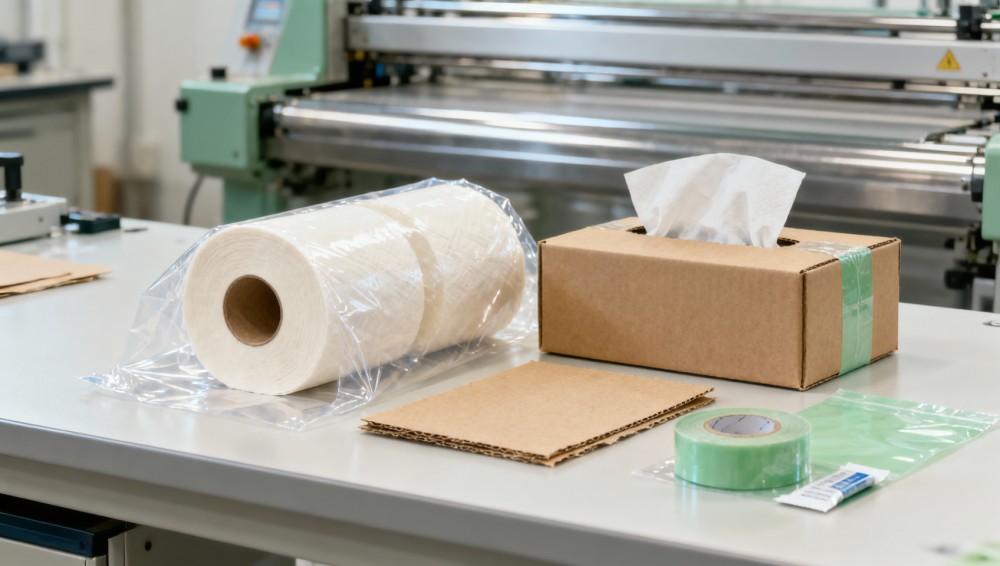
Household tissue packaging takes several forms: flexible wrap around toilet rolls, bundles of kitchen towels, paperboard facial-tissue boxes, and outer packaging for multipacks. These formats have different mechanical and moisture-protection requirements. They also contain different combinations of materials, so a solution that works for a facial-tissue carton may be unsuitable for a large roll bundle.
The first sourcing decision is to define the boundary of the proposed claim. Does it cover the retail wrapper, the complete carton, or every packaging component supplied with the product? If a facial-tissue box has a dispensing film, or a roll bundle carries a separate promotional sticker, those parts need attention. An unqualified claim on the front of the pack can lead consumers to assume that the entire package belongs in the same disposal stream.
Roll cores and secondary transport packaging require separate consideration when they fall within the stated claim. Tissue itself also has its own disposal considerations, particularly after use. Packaging certification should never be presented as evidence that all used tissues are suitable for every composting collection service.
Compostability combines several requirements. The material must biodegrade under the specified conditions, disintegrate sufficiently during composting, and meet relevant limits concerning compost quality and restricted constituents. Fragmentation alone is insufficient. A wrapper that breaks into smaller pieces has not necessarily completed the biological breakdown required by a compostability standard.
“Bio-based,” “biodegradable,” and “compostable” therefore answer different questions. Bio-based describes the origin of some or all of a material’s feedstock. Biodegradability depends on the environment and conditions. Compostability is a more specific claim tied to defined criteria. Plant-derived polyethylene, for example, does not become compostable simply because its feedstock comes from plants.
Material options depend on the tissue format
There is no universal replacement for conventional tissue packaging. Buyers need to compare complete structures, including surface treatments and printing, against the protection and handling requirements of each product.
Paper and paperboard can simplify some formats
Paper wraps and paperboard cartons are plausible candidates where the package mainly provides containment, printability, and protection from handling. A design with limited coatings and carefully selected adhesives can be easier to assess than a complex multilayer structure. Facial-tissue cartons are an obvious starting point, although dispensing windows and surface finishes can complicate the claim.
Paper construction does not automatically establish compostability. Wet-strength treatments, barrier coatings, laminates, inks, and adhesive systems may affect the finished package’s eligibility. A supplier should identify these additions and show how the complete structure meets the intended requirements.
Paper also introduces practical tradeoffs. It can tear at folds or around openings, and its response to humidity depends on the grade and treatment. Increasing basis weight or adding a barrier may improve performance while changing cost, material consumption, and end-of-life options. A paper substitution should be evaluated as a packaging redesign rather than a direct material swap.
Compostable films can preserve flexible packaging formats
Flexible films made with compostable polymer formulations can support wraps and multipacks where transparency, sealing, and flexibility matter. Potential material families include PLA, PHA, certain compostable polyester blends, and regenerated cellulose films. Their suitability depends on the exact formulation, film construction, and intended composting environment.
Polymer names are a poor basis for approving a package. Some compostable formulations contain fossil-derived constituents, while some bio-based plastics are not compostable. PLA-based packaging, for instance, should not be assumed to break down satisfactorily in a home compost pile. Cellulose films can also carry coatings that change their barrier properties and compostability status.
A film’s sealing behavior, stiffness, elongation, and tear resistance determine how it performs on a tissue line. A formulation that works for a small pack may fail when used around a bulky bundle with sharp folds and concentrated stresses. Film thickness matters both to package performance and to the scope of compostability evidence.
Every added component can affect the result
Printing and converting turn a material into a finished package. They can also introduce components that the original material certificate does not cover. Adhesive labels, sealing tapes, reinforcement strips, laminated graphics, and dispensing inserts deserve the same scrutiny as the main wrapper.
Separate certification of every ink or adhesive is not always the relevant requirement; certification schemes may assess components through their own rules and allowable limits. The buyer nevertheless needs evidence that the actual combination is covered. A certificate for an unprinted base film should not be treated as unrestricted approval for any ink system, label, or coating subsequently applied to it.
Certification must match both the package and the disposal route
For industrial compostability, commonly referenced standards include EN 13432 for packaging and ASTM D6400 for plastics designed for aerobic composting in municipal or industrial facilities. ASTM D6868 addresses relevant products incorporating plastics or polymers as coatings or additives with paper and other substrates. These standards provide assessment frameworks; citing a standard on a specification sheet does not by itself demonstrate that a particular finished package has been certified.
Industrial composting uses controlled conditions that a household compost pile may not reproduce. Home composting involves more variable temperatures, moisture, aeration, and management. A claim for one environment cannot simply be extended to the other. Buyers seeking home-compostable packaging need evidence specifically addressing that environment, with certification or testing appropriate to the product and intended market.
Certificate review should establish exactly what was assessed. Relevant details include the product name, material structure, permitted thickness, printing conditions, and any restrictions on additional components. Buyers should also check certificate validity and confirm that the supplier’s production specification corresponds to the certified product.
Three questions make that review more useful:
- Does the evidence cover the finished configuration? Check the actual film or carton, printing, coatings, adhesives, and accessories.
- What composting environment does it support? Distinguish industrial composting from home composting and retain any required qualifications.
- Can the claim remain valid after a specification change? Establish how changes to thickness, ink coverage, formulations, or suppliers will be reviewed.
Even a valid certificate cannot guarantee collection. Composting operators set acceptance policies according to their processes, contamination controls, and output requirements. Some accept selected certified packaging; others exclude packaging altogether. Collection programs may impose their own conditions, so the intended destination needs checking separately from material certification.
That distinction is particularly relevant for tissue packs. The wrapper normally enters the household waste stream when the product is opened, without the food residues that sometimes make compostable packaging useful for collecting organic waste. Its route into composting must be credible on its own. If consumers lack an accepted collection route and cannot use the package in home composting, the practical case weakens.
A claim such as “industrially compostable where accepted” is more informative than an unexplained “100% compostable” statement. Disposal instructions should make the required route clear and address components that need separating. Compostability also does not establish suitability for littering, marine degradation, landfill disposal, or conventional plastics recycling.
Test protection and production performance before committing
Tissue is lightweight and bulky, which makes packaging efficiency important. The wrapper must hold the product together through compression, transport, retail handling, and consumer carrying. It must also provide the level of protection from humidity, dirt, and incidental moisture required by the distribution route.
The appropriate barrier is application-specific. A facial-tissue carton distributed in a dry, controlled channel faces different demands from a toilet-roll multipack exposed to humid storage or repeated handling. Buyers should define those demands before selecting a material. Otherwise, a successful compostability assessment can obscure a package that performs poorly in service.
Qualification should use finished packs produced under representative conditions. Useful checks include seal strength, tearing around folds, puncture resistance, bundle stability, opening behavior, and performance after expected storage and transport exposure. For paper structures, examine whether folds, glued joints, and dispensing openings retain their integrity. For films, evaluate shrinkage or distortion where heat is involved.
Packing-line trials are equally important. A replacement film may require different sealing temperatures, dwell times, tension settings, or cutting adjustments. Paper alternatives may require changes to wrapping and gluing equipment. Record achievable throughput, rejected packs, and seal consistency, then determine whether the line can maintain acceptable performance across normal production variation.
Storage conditions deserve attention before commercial orders are placed. Obtain the supplier’s recommended conditions and usable storage period for packaging stock. Evaluate finished packs over the intended distribution and shelf-life window, including relevant seasonal conditions. Compostability under specified treatment conditions does not mean a package should deteriorate during normal use, but its service durability still needs demonstrating.
Cost comparisons should use the accepted finished pack as the basis. Material price alone excludes changes in film gauge, conversion yield, line speed, rejects, equipment settings, certification, and artwork control. A lower-priced material that increases package failures can be more expensive in operation. Conversely, a higher purchase price may be manageable if the design performs consistently without substantial production changes.
When a fully compostable pack is a sound choice
The case is strongest when a defined market offers an accessible disposal route, the complete package has suitable evidence, and trials show that protection and production requirements can be met. A geographically limited launch may provide a clearer basis for adoption than a single global claim applied across markets with different collection systems.
Where paper packaging has a credible recycling route, assess whether designing for that route better serves the product and its users. Compostability alone does not establish a lower environmental impact. Material consumption, product protection, transport, and actual disposal all affect the outcome. Adding compostability to a pack that consumers will routinely discard in residual waste may provide little operational value.
Before awarding a supply contract, put the certified construction, approved components, performance requirements, and change-control obligations into the specification. Request documentation for the exact commercial pack and agree on how proposed substitutions will be assessed. Environmental claims can lose their basis when a supplier changes a coating or label that appears minor from a production perspective.
A fully compostable tissue package is achievable, but the purchasing decision should end with a defined answer: this complete pack meets the stated compostability requirements, protects this tissue product, runs reliably on this line, and has an appropriate disposal route in this sales market. If one of those conditions is missing, the next step is to resolve that gap before expanding the claim or the rollout.
Recommended News
 Carton & PlasticsWhen should you heat seal aluminum foil zipper bags for food storage?When should you heat seal aluminum foil zipper bags? Learn when stronger closures matter, how to protect dry foods, and which sealing checks help ensure reliable storage.Packaging Supply ExpertOct 16, 2026
 Supply Chain InsightsHow to find a custom-printed ring-pull can supplier for small ordersFind a custom printed ring pull cans supplier for small orders. Compare MOQs, printing options, samples, and delivered costs to launch confidently without excess inventory.Oct 15, 2026
 Household Tissue & Hygiene PackagingCan Household Tissue Packaging Be Fully Compostable?Can household tissue packaging be made fully compostable? Explore certified materials, home vs. industrial composting, and practical sourcing tips to choose the right pack.Packaging Supply ExpertOct 14, 2026
 Supply Chain InsightsWhat Should You Check When Auditing a Contract Furniture Supplier?What should be checked when auditing a contract furniture supplier? Discover essential checks for compliance, quality, traceability, and delivery to reduce sourcing risks.Oct 14, 2026