Industry News
Curation by industry experts
Hot Articles
Popular Tags
When should you heat seal aluminum foil zipper bags for food storage?
When should you heat seal aluminum foil zipper bags for food storage?
A zipper makes food packaging convenient, but it is not a substitute for a validated heat seal when stronger closure integrity is needed. Knowing when to heat seal aluminum foil zipper bags helps operators protect dry foods during storage, shipping, and handling before first opening. The decision depends on the food, intended storage period, pouch construction, and supplier-recommended sealing conditions—not simply how tightly the zipper closes.
Heat seal when the unopened package needs a dependable primary closure: for distribution, extended storage, moisture-sensitive products, or visible evidence of first opening. A zipper alone may be sufficient for short-term, frequently accessed storage of suitable dry foods. Neither closure makes perishable food shelf-stable.
The zipper and the heat seal do different jobs
A zipper is primarily a reclosure feature. It lets someone take out a portion of granola, dried fruit, or seasoning and close the pouch again. Its performance depends on full engagement across the opening, an undamaged profile, and freedom from trapped particles. A closure can feel secure while a small section remains unfastened.
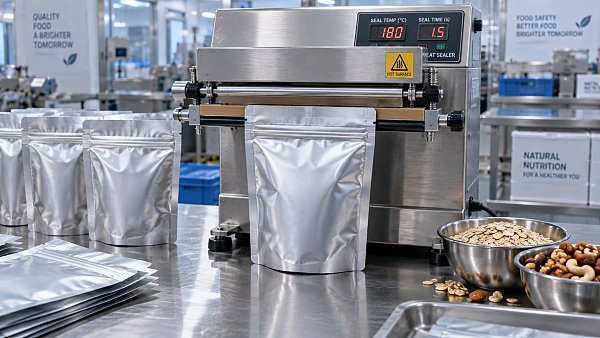
A correctly formed heat seal bonds compatible inner sealant surfaces into a continuous closure. On many premade zipper pouches, that seal belongs in the designated area above the zipper. The user later tears or cuts away the sealed header and uses the zipper for reclosure. Check the pouch drawing rather than assuming every design works this way.
The distinction matters because barrier film and package integrity are separate issues. A foil laminate may resist moisture and oxygen transmission very well, yet the finished package can still leak through a defective top seal, damaged side seam, or puncture. Heat sealing addresses one potential entry route; it does not compensate for the others.
When the extra sealing step is worthwhile
Food will be shipped, displayed, or handled repeatedly
For filled pouches moving through cartons, warehouses, and delivery networks, a zipper-only closure leaves too much dependent on correct engagement. Compression and rough handling make closure reliability more consequential. A top heat seal provides a primary closure before first opening and can provide visible opening evidence when the pouch design requires that seal to be broken for access.
For commercial distribution, treat the heat seal as part of the packaging specification—not an optional finishing touch. The closure still needs checking under realistic transport conditions. A pouch that looks acceptable beside the sealer may behave differently when packed tightly with other products.
The dry food is sensitive to moisture or oxygen
Freeze-dried snacks, crisp crackers, powdered ingredients, and some seasonings can lose acceptable texture or handling properties after moisture exposure. Nuts and other fat-containing foods may develop oxidative off-flavors. These are situations where a reliable initial closure is worth prioritizing, especially if storage conditions vary.
However, sealing does not remove moisture already in the food or oxygen already inside the pouch. Shelf-life decisions must consider the product’s condition at filling, headspace, film barrier, storage environment, and any validated atmosphere-control system. There is no defensible universal claim that heat sealing adds a particular number of months.
The bag will remain unopened for an extended period
An ingredient portion packed for later production has different needs from a pouch opened throughout one shift. For unopened reserve stock, heat sealing usually makes more sense because the closure must remain dependable without repeated inspection. For daily-use stock, smaller working portions can be more useful than repeatedly opening one large reserve bag.
There is no single storage-duration cutoff. A moisture-sensitive powder in a humid room may justify heat sealing sooner than a less sensitive food in controlled storage. Use the product’s vulnerability and actual handling pattern to make the decision, not a generic “long-term storage” label.
When a zipper alone may be enough—and when sealing is the wrong answer
For suitable dry foods used frequently over a short period, a clean, fully engaged zipper may be adequate. Examples include a working portion of dry seasoning or snacks intended for prompt consumption. Keep the pouch protected from heat, humidity, pests, and physical damage, and follow the food’s storage instructions.
Repeatedly heat sealing the same pouch is not automatically better. Each cut removes usable material, and some bags have little space above the zipper. Eventually, the remaining opening may no longer fit the sealing jaws properly. If repeated portioning is expected, choose smaller pouches or a container designed for repeated access.
Do not use heat sealing as a preservation process for cooked meals, fresh meat, moist sauces, or other perishable foods. Sealing is not sterilization, canning, or refrigeration. Reduced-oxygen conditions can also introduce food-safety hazards for certain foods. Refrigerated or frozen products still require their specified temperature controls, and commercial reduced-oxygen packaging may require additional controls under applicable food rules.
Likewise, an oxygen absorber is not a universal safety upgrade. Its use requires a suitable food and a validated packaging approach. Freshly roasted coffee presents a different issue: continuing gas release may require a suitable degassing valve and a defined packing process. Simply making the closure tighter does not solve gas management.
Confirm the pouch construction before setting the machine
The term “aluminum foil zipper bags” does not identify one construction. Suppliers may offer true foil laminates, metallized films, and other foil-look structures under similar descriptions. Their barrier properties, heat response, and suitability for a particular food can differ. Appearance is not a reliable specification.
The inner sealant layer forms the seal—not the aluminum itself. Before production, obtain the laminate structure, intended food-contact conditions, designated sealing area, and recommended equipment conditions. Confirm whether the pouch is suitable for freezing, hot filling, or any other planned exposure rather than assuming compatibility.
This connects with the packaging-sourcing focus of Global Supply Review (GSR): a bag specification only becomes useful when it matches the operating process. A material substitution that looks identical can still change the sealing window. Operators need that information before the replacement stock reaches the filling station.
Avoid generic online temperature recipes. Seal temperature, pressure, dwell time, and cooling interact with laminate thickness, sealant chemistry, and machine design. An impulse sealer’s timer setting is not interchangeable with a continuous band sealer’s temperature display. Start with supplier guidance, then establish a repeatable working range on the actual equipment.
Build a seal that survives beyond the packing bench
The practical challenge is often contamination, not insufficient heat. Flour dust, spice particles, oil, or crumbs between the sealing surfaces can create channels or weak areas. Increasing temperature may damage the pouch without resolving the underlying problem.
- Leave adequate filling clearance. Keep product below the sealing area so the mouth can lie flat without stretching or trapped folds.
- Keep the sealing surfaces clean and dry. Use a filling method and food-safe cleaning procedure that prevent contamination rather than spreading it across the opening.
- Align the intended seal zone. Keep the zipper profile out of the jaws unless the supplier explicitly specifies otherwise.
- Allow the seal to set. Follow the equipment’s cooling or hold requirements before loading the closure by lifting, squeezing, or stacking the pouch.
- Recheck after changes. A new pouch lot, product, machine speed, or maintenance intervention can justify fresh trial seals.
Filled-pouch trials matter. Empty bags are easier to position and do not reproduce dust, headspace pressure, or product near the opening. Test the actual fill weight and normal operator handling before treating an empty-pouch trial as a production setting.
Check integrity, not just whether the seal looks straight
Visual inspection is a useful first screen. Look for continuity across the intended seal width, wrinkles crossing the seal, trapped product, scorching, distortion, or laminate separation. Inspect the ends carefully, where alignment or thickness changes can cause problems.
But a neat-looking seal is not proof of leak resistance. A hand pull can reveal gross weakness; it cannot establish a validated barrier closure. Commercial operations should select documented checks suited to the pouch and risk, which may include controlled seal-strength testing and an appropriate leak-detection method. Follow the chosen method’s procedure and limitations.
Useful records connect results to pouch lot, machine settings, product, and inspection time. If defects appear, hold affected stock while the cause is investigated. Simply running a second seal over a contaminated or damaged area is not a reliable corrective action.
The practical rule is straightforward: heat seal aluminum foil zipper bags when unopened storage or distribution requires more dependable closure integrity than the zipper alone can provide. Then verify the pouch, process, and finished seal together. After first opening, use the zipper for reclosure—but reassess storage time, because the original sealed-package shelf-life no longer describes the same conditions.
Recommended News
 Carton & PlasticsWhen should you heat seal aluminum foil zipper bags for food storage?When should you heat seal aluminum foil zipper bags? Learn when stronger closures matter, how to protect dry foods, and which sealing checks help ensure reliable storage.Packaging Supply ExpertOct 16, 2026
 Supply Chain InsightsHow to find a custom-printed ring-pull can supplier for small ordersFind a custom printed ring pull cans supplier for small orders. Compare MOQs, printing options, samples, and delivered costs to launch confidently without excess inventory.Oct 15, 2026
 Supply Chain InsightsWhat Should You Check When Auditing a Contract Furniture Supplier?What should be checked when auditing a contract furniture supplier? Discover essential checks for compliance, quality, traceability, and delivery to reduce sourcing risks.Oct 14, 2026
 Office FurnitureDoes sealing MDF furniture reduce the risk of toxic emissions?Concerned about MDF toxicity? Discover how sealing furniture can reduce formaldehyde emissions, where it falls short, and how to choose low-emitting options for your home.Interior Sourcing LeadOct 14, 2026