Industry News
Curation by industry experts
Hot Articles
Popular Tags
How roll diameter affects downtime when using jumbo paper rolls
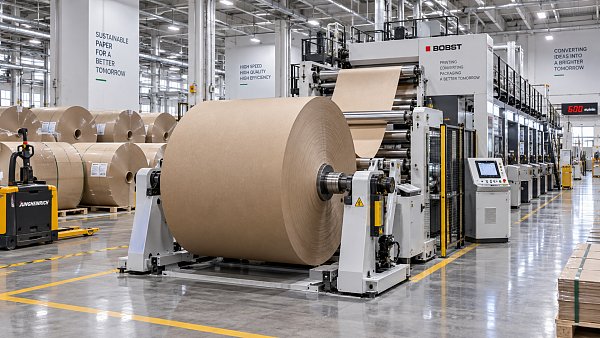
A larger roll diameter usually reduces planned downtime because it holds more paper and therefore requires fewer roll changes. That benefit is real only when the unwinder, core chucks, roll-handling method, web-control system, and storage area can manage the larger roll without creating slower changeovers, unstable tension, or safety problems.
For converting, printing, laminating, coating, and packaging lines, the useful question is not simply, “What is the largest jumbo paper roll available?” It is: Which roll diameter produces the lowest total lost production time for this line? A roll that runs longer but takes too long to load, needs frequent tension corrections, or causes material damage can deliver less usable output than a smaller, better-matched roll.
Why larger diameter rolls extend production runs
Paper consumption is driven mainly by line speed, web width, basis weight, and the length of material wound onto the roll. When width, grade, and core size remain the same, a larger outside diameter generally contains substantially more linear length than a smaller one. The line can continue running longer before the roll reaches its tail.
Each roll change involves more than stopping the web. Depending on the process, it may include slowing the machine, cutting or preparing the splice, removing the spent core, bringing in a new roll, aligning it, securing the roll, threading the web, restoring tension, checking print or registration, and bringing the line back to stable speed. Some lines also create waste during startup or splice stabilization.
Using jumbo paper rolls reduces the number of times that sequence occurs during a shift. This can be especially valuable when roll changes interrupt a continuous process, when downstream equipment must wait for material, or when a restart produces quality loss. A longer uninterrupted run can also make production planning easier because fewer stops need to be coordinated around job changes and breaks.
However, roll diameter affects more than run length. As diameter increases, roll mass, inertia, floor-space demand, and the force acting on the web during acceleration also increase. Those factors determine whether a larger roll is an improvement or simply a bigger handling problem.
Downtime has two parts: frequency and duration
It is easy to measure how often a roll runs out. It is harder, and more useful, to examine everything that happens around the change. Total downtime from roll supply has two components:
- Change frequency: how many times a new roll is required during a production period.
- Time and loss per change: the time needed to replace, thread, splice, stabilize, inspect, and return the line to normal output.
A larger diameter reduces the first component. It does not automatically reduce the second. In fact, a larger roll can increase the time per change if lifting equipment is unavailable, roll loading is awkward, shaft insertion is difficult, or alignment takes longer. The right decision comes from comparing total lost time, not from comparing diameter alone.
Consider two supply arrangements. A smaller roll may require more frequent changes but can be loaded quickly with a simple trolley and positioned accurately by one person. A much larger roll may reduce the number of changes, yet require a lift truck, a waiting operator, careful staging, and a more deliberate setup. If the material arrives late at the line or the lift truck is shared with other work, the planned reduction in changeovers can disappear.
This is why production teams should include material preparation time in their evaluation. A roll is not truly ready when it is in the warehouse; it is ready when it is correctly identified, inspected, staged, and available at the unwinder before the active roll reaches its end.
Where diameter creates new sources of lost time
The main limitation is usually the unwinder. Every unwinder has practical limits for maximum roll diameter, roll weight, core size, brake capacity, chuck engagement, and clearance around the machine. A roll that physically fits between the arms may still be unsuitable if the braking system cannot control it consistently or if the roll’s centerline cannot be positioned correctly.
Acceleration and braking become more demanding
A large roll has greater rotational inertia. It takes more controlled force to bring it up to web speed and more controlled braking to slow it down. If brake response is weak, poorly adjusted, or unsuitable for the roll mass, the web can surge, slacken, or tighten sharply during starts and stops. That may lead to breaks, wrinkles, register variation, coating defects, or repeated speed reductions.
These events are often recorded as process faults rather than roll-related downtime, even though the oversized supply roll contributed to the problem. When assessing jumbo paper rolls, review the line’s stop-and-start behavior, not only its steady-state performance.
Web tension changes as the roll unwinds
The effective leverage at the roll surface changes continuously as diameter decreases. A tension-control system must compensate for that change while maintaining a stable web. On a well-configured driven or braked unwinder, this adjustment is routine. On a basic system, a larger starting diameter can widen the operating range and expose weak settings, worn brakes, unsuitable sensors, or inconsistent roll build.
Paper is less forgiving than many materials when tension is unstable. Excess tension can stretch or break a lightweight grade; insufficient tension can allow wandering, wrinkles, telescoping, or poor nip control. Printed webs may also suffer from register problems. The time spent correcting these issues can exceed the time saved by using fewer rolls.
Roll quality matters here. A jumbo roll with uneven winding hardness, crushed edges, poor lateral alignment, or a damaged core cannot be made reliable merely by fitting it to a suitable unwinder. Diameter should be specified alongside paper grade, width tolerance, core dimensions, winding direction, roll hardness, and permitted edge condition.
Loading time can outweigh theoretical savings
The handling method should be evaluated before changing to a larger diameter. A roll that requires a clamp truck, lift table, hoist, shaft extractor, or powered cart needs a clear movement route and available equipment at the moment of change. Improvised handling creates delays and increases the chance of edge damage or injury.
Large rolls also need enough room to be turned, lifted, and loaded without striking guarding, posts, or adjacent stock. A cramped layout can turn an otherwise quick change into a series of small repositioning steps. The lost minutes are often normalized because they happen every day, but they are precisely the kind of recurring delay that a roll-size project should uncover.
The “largest possible roll” is often the wrong specification
Specifying the maximum diameter allowed by the machine is a common shortcut. It assumes the equipment’s published physical capacity is the same as its best operating capacity. In practice, the best diameter may be lower because of roll weight limits, the grade’s sensitivity to tension, loading constraints, or the way production is scheduled.
Short jobs are a clear example. If a job normally ends before a jumbo roll is consumed, a large roll may create an awkward remainder. That partially used roll must be labeled, protected, stored, located later, and matched to a compatible future job. Reusing it is possible, but it adds inventory complexity and creates more opportunities for contamination, edge damage, or incorrect stock selection.
Frequent substrate changes produce a similar result. A line running several paper grades, widths, or print jobs may gain little from very large rolls because planned job changeovers already interrupt production. In that environment, a diameter that supports easy handling and low leftover inventory may be more productive than the maximum available size.
Conversely, a stable, high-volume run with the same paper specification can justify a large diameter even when loading requires powered equipment. The reduction in roll changes is more meaningful because each uninterrupted run has enough time to use the added paper length.
Check the whole material path before changing roll size
A roll-size decision should be made across the full path from receiving to the final unwind. Checking only the unwind stand misses the operational constraints that create avoidable downtime.
- Confirm the machine envelope. Verify usable diameter clearance, maximum supported roll mass, minimum and maximum core dimensions, shaft or chuck compatibility, and the range of the braking or drive system.
- Review the paper specification. Confirm the exact grade, width, moisture sensitivity, winding direction, roll build, and acceptable edge condition. A larger roll does not remove the need for consistent converting quality.
- Map the changeover sequence. Observe the current process from the point at which the next roll is called for through stable running after the change. Record waiting, searching, movement, alignment, threading, and reject material separately.
- Evaluate handling and staging. Ensure the required lifting and transport method is available, that the route is clear, and that the next roll can be staged without blocking access or creating a safety hazard.
- Test at realistic operating conditions. A roll that runs acceptably at a moderate speed may behave differently during normal acceleration, deceleration, splice events, and full production speed.
This review also helps distinguish a paper-supply issue from a machine issue. If the current roll changes are slow because of poor staging, unclear roll labels, worn chucks, or an inefficient threading path, moving to a larger roll may mask the problem without solving it. Improving the change process first can make the appropriate diameter easier to identify.
Use run time as a planning tool, not a standalone answer
Estimated roll run time is useful for scheduling labor, preparing the next roll, and deciding whether a larger diameter is justified. But it should be treated as an operating estimate rather than a guarantee. Actual consumption changes with line speed, startup waste, splicing method, web breaks, trim removal, and job-specific rejects.
For planning purposes, the calculation starts with usable paper length divided by average line consumption. The important word is usable. Outer wraps may be damaged during transport, the final wraps may not be suitable for a process, and some material can be lost during threading or splice preparation. A practical schedule leaves time to stage the next roll before the active roll reaches its end rather than treating every theoretical meter as available production time.
In continuous operations, predictable roll-end timing can be as valuable as longer run time. When the remaining diameter is monitored and the replacement roll is prepared early, downtime becomes controlled work instead of an urgent interruption. Some lines benefit more from disciplined roll-end management than from a major increase in roll diameter.
Warning signs that a jumbo roll is too large for the current setup
Several recurring symptoms suggest that the diameter has exceeded the line’s practical capability. They include difficulty starting the roll smoothly, repeated manual brake adjustments, web slack after stops, tension spikes during acceleration, frequent edge damage during loading, delays while waiting for handling equipment, and unused partial rolls accumulating in storage.
Another warning sign is that production staff reduce line speed during the first portion of each roll to maintain control. The line may technically accept the roll, but the lost speed can offset the fewer changeovers. The same applies when a roll has to be moved or re-centered repeatedly before it can be loaded.
These conditions do not always require abandoning jumbo paper rolls. They may point to a specific improvement: a better brake-control setup, compatible chucks, a roll-lift assist, clearer staging locations, or a smaller increase in diameter. The goal is a stable process with fewer interruptions, not the largest possible inventory unit.
A practical selection rule for daily production
Choose the largest roll diameter that can be received, stored, moved, loaded, accelerated, unwound, and changed safely without slowing normal production or increasing web defects. Then compare that roll against the planned job length and the frequency of paper-grade changes. This rule keeps the decision tied to usable production time rather than purchasing convenience alone.
When sourcing specifications are being reviewed, it is useful to compare supply options against the full operating context: packaging and transport condition, roll consistency, handling requirements, equipment compatibility, and expected run length. Procurement intelligence is most useful when it preserves these production details instead of treating paper rolls as interchangeable commodities.
A larger diameter is valuable when it removes genuine changeovers from a stable line. It is not valuable when it transfers the same lost time into loading delays, tension faults, or difficult leftover-roll management. Measure the complete change cycle, confirm the limits of the unwinder and handling system, and select the diameter that keeps the web moving reliably.
Recommended News
 Office Paper & Printing PaperHow roll diameter affects downtime when using jumbo paper rollsJumbo paper rolls can cut changeovers and downtime—if your unwinder, handling, and tension control can support them. Find the optimal roll diameter for smoother output.Packaging Supply ExpertSep 25, 2026
 Office Paper & Printing PaperWhen does carbonless paper for invoices reduce billing errors?Carbonless paper for invoices reduces billing errors by creating clear, consistent copies for deliveries, service calls, and approvals. Learn when it strengthens billing control.Packaging Supply ExpertSep 24, 2026
 Home DecorHow to compare floating wall shelves suppliers for consistent load capacityFloating wall shelves supplier comparison guide: evaluate load capacity, brackets, wall fixings, testing, and production consistency before you buy.Interior Sourcing LeadSep 23, 2026
 Office FurnitureWhen does a custom executive office desk justify its higher cost?Discover when a custom executive office desk is worth the investment—from tailored layouts and integrated technology to durable materials and long-term value.Interior Sourcing LeadSep 22, 2026