Industry News
Curation by industry experts
Hot Articles
Popular Tags
How to check BS 5852 test reports for fire retardant upholstery fabric
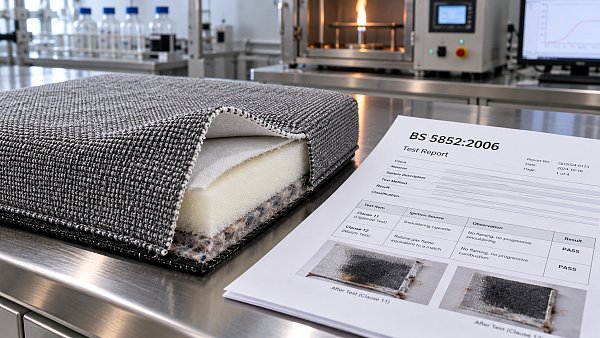
A BS 5852 test report supports approval only when the tested upholstery combination matches the combination you intend to use, or when a technically justified assessment covers the differences. A “pass” beside a fabric name is not enough: the ignition source, filling, interliner, specimen construction and test procedure define what the result actually demonstrates.
For fire retardant fabric for upholstery, the critical distinction is between a material description and evidence of performance. Fabric tested over one foam with a protective interliner does not automatically support use over another foam without that interliner. Report review therefore needs to establish both the validity of the test and its relevance to the proposed furniture.
Establish the requirement before interpreting the result
Begin with the requirement in the purchase specification, project fire strategy or applicable legislation. “BS 5852 compliant” is incomplete unless it identifies the required test method, ignition source and relevant upholstery construction.
BS 5852:2006 addresses the ignitability of upholstered seating by smouldering and flaming ignition sources. Older reports may refer to BS 5852-1:1979, BS 5852-2:1982 or BS 5852:1990. These references should not be treated as interchangeable simply because they share the same standard number.
An older edition is not automatically unacceptable. A regulation or contract may explicitly reference an older method, sometimes with modifications. Conversely, a historical report may not meet a project specification that requires a different edition. Record the complete reference, including the year, part and any stated amendments or modifications.
Keep the following distinctions clear:
- A test standard describes how performance is assessed.
- A project specification establishes the performance required for a particular application.
- A legal requirement determines the obligations applicable to the product and market.
For UK domestic furniture, a generic BS 5852 result does not by itself demonstrate compliance with the Furniture and Furnishings (Fire) (Safety) Regulations. Those requirements distinguish between components and test schedules. Contract furniture requirements also need to be checked against the specific application; “Crib 5” is not a universal legal requirement for every upholstered item.
Read the ignition-source designation, not just “pass”
The ignition source defines the exposure used in the test. The most recognisable designations include:
A report for source 1 cannot support a specification requiring source 5. Equally, a source 5 result should not be used as a blanket substitute for every other required test. Smouldering and flaming involve different ignition mechanisms, and any permitted testing sequence or substitution must come from the applicable standard or specification—not an assumption that a higher number covers everything below it.
Check whether the source designation appears in the actual test results, rather than only in the supplier’s covering email or product sheet. If several sources were used, each should have an identifiable outcome. A report containing both passing and failing results needs to be read in full; a selected passing page can conceal a materially different conclusion.
Identify the fabric precisely enough to trace a delivery
A sample description such as “polyester upholstery fabric, grey” is too broad to connect a test result reliably to a production delivery. Look for the manufacturer or supplier, article number, colour reference, fibre composition, mass per unit area and relevant construction or finish details. Batch or treatment references strengthen traceability where available.
Not every report contains every manufacturing parameter. The practical question is whether the information in the report, supported by controlled supplier records, identifies the tested product without ambiguity.
Compare the description with the purchase specification and incoming inspection records. Pay particular attention to:
- A changed product code presented as a commercial renaming.
- A different fabric weight, weave, pile or backing.
- A flame-retardant treatment applied by a different processor.
- An added stain-resistant finish, coating, lamination or adhesive.
- A colour range claimed to be covered by a report for one colour.
These differences do not prove that the supplied fabric will fail. They do mean that the existing report may not establish its performance. Colourants, finishes and backing systems can affect burning behaviour, so a shared base cloth is not sufficient justification on its own.
If a supplier claims that a report covers a product family, ask for the basis of that coverage. A defined assessment linked to specific constructions and processing limits is more useful than a statement that all colours are “the same quality.” Where necessary, obtain clarification from the issuing laboratory.
Reconstruct the tested upholstery combination
This is the most consequential part of the review. BS 5852 evaluates upholstery behaviour under defined test conditions; it is not simply a measurement of an isolated fabric’s flame resistance.
The report should identify the filling and any intermediate layers sufficiently to understand the tested construction. Relevant details include foam type, grade, density and thickness; fibre wraps or batting; interliners or barrier fabrics; and the order in which the layers were assembled.
Foam density alone does not establish equivalence. Two foams with the same nominal density may have different chemistry, cell structure and combustion behaviour. Similarly, “fire-retardant foam” is a category description, not a traceable material specification.
An interliner deserves particular scrutiny. If a passing specimen used a barrier between the cover and filling, that barrier is part of the evidence. Removing it, replacing it with a lighter material or changing how it covers vulnerable areas creates a different construction.
Check whether the report concerns a standard test assembly, another specified composite or finished seating. Evidence from a laboratory assembly does not automatically resolve every construction issue in a finished chair, especially where seams, gaps, exposed edges or other details differ from the tested arrangement.
A useful review record places the two constructions side by side:
Any mismatch should have an explicit disposition: confirmed within the applicable scope, supported by a competent technical assessment, or referred for additional testing. “Similar material” is not a disposition.
Check the observations behind the conclusion
A valid-looking conclusion still needs to agree with the results section. Check that the stated pass or fail follows the acceptance criteria for the cited edition and ignition source.
Depending on the method, the report may record progressive smouldering, flaming behaviour, combustion duration, extent of damage and findings after examination of the specimen. The relevant criteria are not reducible to whether the visible flame went out.
Do not impose a single remembered time limit across all BS 5852 tests. Different sources and procedures have specific requirements. Use the referenced standard to interpret the observations, particularly when a report gives measurements without a clear compliance statement.
Look for the required test repetitions and ignition positions, together with any procedural deviations. If these are unclear, request clarification rather than assuming one successful ignition represents the complete test.
Laboratory photographs can help confirm sample identity and layer arrangement, but they do not replace the written method and results. A photograph showing little surface damage cannot rule out internal smouldering.
Also check the conditioning and pretreatment statements. Standard conditioning before a test is different from washing, water soaking, dry cleaning or accelerated ageing. A report on an as-received fabric does not demonstrate that its flame-retardant performance survives cleaning. Where durability is required, the evidence must include the specified pretreatment and subsequent testing.
Verify the laboratory and the document’s integrity
Obtain the complete report, including appendices, photographs and referenced schedules. A one-page certificate or supplier summary may omit the filling description, deviations or limitations that determine whether the result is usable.
Check the laboratory’s legal name, report number, issue date, page numbering, authorisation and revision status. Sample receipt and testing dates should be coherent. If a report has been revised, establish which version supersedes the earlier one and why.
ISO/IEC 17025 accreditation provides evidence of laboratory competence within a defined scope. It is not blanket approval of every test a laboratory offers. Verify the accreditation through the relevant accreditation body’s directory and check whether the applicable method falls within scope. In the UK, this can be checked through UKAS; elsewhere, consult the responsible accreditation body and its recognition arrangements.
A laboratory may issue both accredited and non-accredited results. Read the report’s markings and disclaimers rather than assuming that an accreditation logo covers every page or test.
If authenticity is uncertain, contact the laboratory using independently obtained contact details. Request confirmation of the report number, revision and relevant sample description, subject to the laboratory’s confidentiality procedures. A genuine report can still be applied to the wrong product, so authenticity and applicability remain separate checks.
Decide whether the evidence supports release
Report age alone is a poor acceptance rule. A recent report can cover the wrong assembly, while an older report may remain relevant to an unchanged product under an applicable requirement. A test report records a test event; it is not inherently a time-limited product certificate.
Nevertheless, customer specifications or certification schemes may impose retesting intervals. Changes to materials, treatment recipes, processing sites or construction can also undermine continued reliance on an earlier result.
The approval record should distinguish between three outcomes:
- Accept: the required method and source are covered, the product and construction match, and no material evidence gaps remain.
- Hold for clarification: the report may be applicable, but identity, scope, results or construction details remain unresolved.
- Require further evidence or testing: a material difference falls outside the demonstrated coverage, or the required performance has not been tested.
A conditional acceptance should identify the unresolved point and prevent it from disappearing into routine purchasing. For example, approval dependent on a named interliner must carry that requirement into the bill of materials and production controls.
The final approval should reference the report number, revision, ignition source and exact approved upholstery combination. Link it to supplier change-notification requirements so that substitutions trigger review. The defensible conclusion is not that a fabric is universally “BS 5852 certified,” but that identified evidence supports a defined construction for a defined requirement.
Recommended News
 Commercial LEDSignify Q3 2026 Earnings: €28 Million Tariff Refund Lifts ProfitExplore Signify Q3 2026 earnings: a reported €28 million tariff refund lifts profit as comparable sales fall 3.4%. Discover the implications for lighting costs and demand.Commercial Tech EditorOct 24, 2026
 Fabrics & YarnsHow to check BS 5852 test reports for fire retardant upholstery fabricChoosing fire retardant fabric for upholstery? Learn how to check BS 5852 reports, verify ignition sources and match tested constructions for confident purchasing decisions.Textile Industry AnalystOct 24, 2026
 Export UpdatesChina’s Textile and Apparel Exports Rise 21.5% in September, Up 5.1% Year to DateChina’s textile and apparel exports rose 21.5% in September and 5.1% year to date. Explore the figures and key signals to watch for sustained industry growth.Oct 23, 2026
 Hand & Power ToolsHow to choose resin-bonded cutting wheels for stainless steelChoose resin bonded cutting wheels for stainless steel with confidence. Compare abrasives, thickness, safety, and cost per cut to find the right wheel for cleaner cuts and less rework.Tooling & Hardware LeadOct 23, 2026