Industry News
Curation by industry experts
Hot Articles
Popular Tags
What drives unit costs when buying garment buttons wholesale?
The unit price quoted for garment buttons wholesale is only the starting point. A low quote can become expensive once tooling, rejected pieces, special packing, delayed replenishment, or freight are included. A higher quote can be the lower-cost choice when it produces consistent shade, survives laundering, arrives in the required packing format, and does not force a production line to stop.
Button costs are driven by a combination of physical inputs and commercial conditions. The useful question is not “Which supplier has the lowest price per button?” but “What does one usable, delivered button cost for this garment program?” That distinction makes supplier comparisons more accurate and exposes where apparently similar offers are not actually comparable.
Material is the first cost decision, but not just a design decision
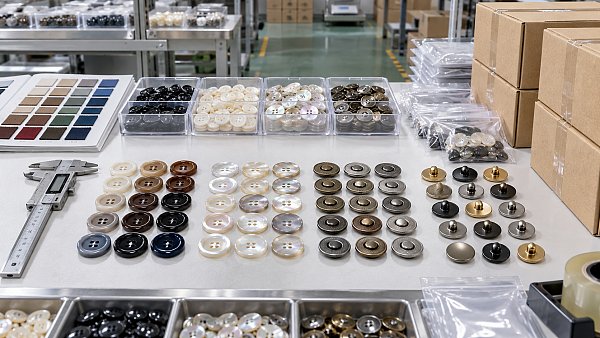
Buttons that look similar can have very different cost structures because their base materials behave differently in production. Common materials include polyester resin, nylon, ABS, urea, natural shell, corozo, wood, metal, and covered-button components. The material affects raw-material cost, molding or forming speed, finishing options, breakage risk, color consistency, and the amount of manual work required.
Polyester buttons are widely used because they can be dyed or pigmented in many colors, molded into varied shapes, and produced efficiently at scale. They are often practical for shirts, uniforms, knitwear, and general apparel. That does not mean every polyester button is interchangeable. Thickness, translucency, marbling, pearl effects, engraving, and color matching can turn a basic molded item into a more involved product.
Natural shell, corozo, horn-look materials, wood, and other natural-origin options tend to introduce more variation. Their visual character may justify the cost for premium apparel, but color, grain, thickness, and surface appearance are less uniform than on a standard molded plastic button. Sorting and selection may therefore be needed to achieve an acceptable production range. Material yield can also be less predictable where the starting material varies in size or condition.
Metal buttons add another layer of cost because they may require stamping, casting, plating, painting, enamel filling, attachment hardware, or corrosion-resistant finishing. A metal jeans button, snap-compatible shank button, and decorative crest button should not be compared as though they are simply different colors of the same component. Their production routes, quality risks, and finishing requirements are fundamentally different.
Shape and construction determine how much manufacturing work is involved
A flat, two-hole round button with a standard edge is usually easier to make than a custom shank button with a deep logo, multiple surface levels, an unusual silhouette, or a simulated natural texture. Complexity matters because it affects tooling, cycle time, demolding, finishing, and inspection.
For a standard stock construction, a supplier may already have a usable mold or can offer an existing size and shape. For a custom development, the mold becomes a separate commercial issue. Tooling charges may be quoted upfront, absorbed into a volume commitment, or embedded in the piece price. These approaches are not equivalent. A quote with “free mold” often assumes that the order quantity, repeat potential, or unit price will recover that cost over time.
Logo details deserve close attention. Raised letters, recessed marks, intricate crests, sharp geometry, and very small legible text all make tooling and molding more demanding. The same applies to laser marking, screen printing, pad printing, embossing, engraving, or inlaid effects. A logo that appears simple in artwork can be difficult to reproduce consistently at button scale.
Construction also affects the garment-making process. A four-hole sew-through button may be economical and versatile, while a shank construction can improve drape and attachment for outerwear or tailoring. The shank must be sufficiently secure, aligned, and smooth for the intended use. Cutting cost by choosing a weaker attachment construction can create much larger costs through garment repairs, returns, or failed inspection.
Size, thickness, and weight influence both production and logistics
Button diameter is usually specified in ligne or millimetres, but the practical cost effect goes beyond the stated size. Larger buttons consume more material and may take longer to mold, cure, stamp, polish, or coat. Thick buttons may need longer processing time and can be harder to keep consistent through the center of the part. Heavy metal buttons increase freight weight more noticeably than lightweight resin buttons.
Very small buttons create a different problem. They use less material, but handling, counting, printing, and inspection may become more demanding. Tiny holes, narrow shanks, or fine decorative details raise the risk of blocked holes, incomplete filling, rough edges, and inconsistent markings. Unit cost is therefore not always proportional to material weight.
Specify the dimensions that matter to garment performance: face diameter, overall thickness, hole diameter, hole spacing, shank height where applicable, and any tolerance that is genuinely necessary. Requiring excessively narrow tolerances without a functional reason can increase inspection and rejection costs. Leaving key dimensions vague, however, encourages variation that can interrupt sewing performance or alter the finished garment appearance.
Color, finish, and surface effects often separate a basic quote from a realistic one
Color matching is a frequent source of misunderstanding in garment buttons wholesale. A supplier may quote a standard color at one level and a brand-specific color match at another. The difference is not cosmetic. Custom coloring can require sample matching, dye or pigment adjustment, batch controls, and approval rounds. Translucent or pearlescent materials may also appear different depending on button thickness, underlying garment fabric, and lighting.
Finishes can add cost through extra processes and lower yield. Examples include matte coatings, high-gloss polishing, soft-touch surfaces, imitation horn effects, pearl effects, spray finishes, antique plating, brushed metal, printed decoration, and protective topcoats. Each layer introduces an opportunity for variation: uneven coating, color shift, scratches, adhesion problems, fingerprints, or inconsistent sheen.
The right specification describes the intended appearance without prescribing unnecessary complexity. For example, a durable matte black finish for workwear has a different purpose from a carefully controlled fashion black intended to match a specific trim set. The first may prioritize abrasion resistance and repeatability. The second may prioritize exact visual coordination, even if it requires additional development.
Order quantity lowers some costs, but MOQ is not the whole story
Volume affects button cost because fixed activities are distributed across more pieces. These activities can include color setup, mold preparation, machine setup, sampling, inspection preparation, labeling, and export packing. Larger runs may also allow more efficient machine scheduling and better use of material.
However, a large order only improves economics when the specification is stable and the quantity will be consumed. Ordering well above actual demand to obtain a lower button price can create surplus inventory, shade mismatch on later production, obsolescence after a style change, or storage and handling costs. The lowest unit price is not automatically the best buying decision if it locks cash into components that cannot be reused.
A useful comparison is to ask each supplier to price the same annual demand in more than one release pattern: one consolidated order, planned call-offs, and separate smaller orders. This reveals whether the apparent price advantage depends on taking all inventory immediately. It also makes clear whether raw material, molds, and approved color standards can be held for repeat production.
Quality requirements have a price, but vague quality requirements cost more
Buttons are small components with outsized consequences. A cracked button, rough hole, sharp metal edge, loose shank, plating defect, or inconsistent color may affect sewing efficiency or finished-garment acceptance. Quality controls add direct cost through inspection, sorting, testing, and replacement allowances. They also reduce the risk of receiving components that cannot be used on the line.
There is little value in requesting “best quality” because it leaves the standard open to interpretation. A better approach is to connect quality requirements to the garment and its expected use. Consider laundering or dry-cleaning exposure, heat during pressing, abrasion, dye transfer, corrosion risk, sewing-machine requirements, children’s apparel safety considerations where relevant, and the visual consistency required across one garment and between repeat orders.
Approved samples are essential, but they should be treated as a reference rather than the whole quality system. A single sample cannot demonstrate batch-to-batch repeatability. For ongoing styles, retain an approved physical standard and record the material, color code, finish, dimensions, packing format, and critical construction details. This reduces the chance that a repeat order is made to a verbal description rather than the original approved product.
Packaging can raise the real cost or prevent costly production interruptions
Button packing is often dismissed as a minor detail until the factory must recount mixed bags or discovers that buttons are scratched during transit. Bulk packing is economical for many basic items, but fragile, plated, printed, or premium-finish buttons may need separators, smaller inner packs, protective film, or more controlled carton loading.
The correct packing method depends on what happens after delivery. If the receiving operation counts, sorts, and distributes buttons to several sewing lines, pack size and labeling can materially affect handling time. If buttons are sent directly to a garment factory, the buyer may need a packing format compatible with the factory’s issue process rather than the supplier’s most convenient format.
Confirm whether quoted quantities are based on piece count, gross weight, net weight, or a permitted counting tolerance. Also clarify whether spare pieces are included, how cartons are marked, and whether mixed sizes or colors are separated. These details do not usually change the button’s factory cost dramatically, but they can change the usable quantity and receiving workload.
Freight, duty treatment, and shipment timing change landed cost
A button quote should identify the delivery basis clearly. Ex-works pricing, port-based pricing, and delivered pricing allocate responsibility differently for inland transport, export handling, main freight, insurance, clearance, and destination charges. Comparing one supplier’s ex-works offer with another supplier’s delivered offer produces a misleading result unless all missing costs are added.
Buttons are usually compact, but their freight profile varies with material and packing. Metal components can be weight-sensitive. Large decorative buttons or heavily protected packing can be volume-sensitive. Urgent air shipment can erase a unit-price saving that looked meaningful at the factory gate. Replenishment lead time matters just as much: an inexpensive supplier that cannot meet a production window may force a costly last-minute shipment or a substitute component.
For cross-border sourcing, landed-cost planning should use the actual product description, material composition, shipping route, and destination treatment applicable to the transaction. The key operational discipline is simple: compare suppliers on the same delivery term, same packing basis, same quality standard, and same required arrival date.
How to make comparable wholesale button quotations
Send one controlled request-for-quotation sheet rather than allowing each supplier to interpret a short product description. Include a clear reference sample or artwork; material; size; thickness; construction; hole or shank details; color reference; finish; logo method; intended garment use; order quantity; expected repeat demand; quality requirements; packing method; delivery location; and requested delivery term.
Then separate one-time, recurring, and conditional charges. Tooling, development samples, color matching, special testing, artwork revisions, and urgent production should not disappear inside a single headline price. A supplier that itemizes these elements is often easier to evaluate than one that gives a single low number with undefined exclusions.
Before placing production, confirm the approved sample, the production lead time measured from final approval, the quantity basis, the defect-handling process, and the ownership or retention terms for custom tooling. These points matter most when the button is branded, color-sensitive, or difficult to replace after garment production has started.
Market intelligence resources such as Global Supply Review can be useful when comparing material options, supplier capabilities, and supply-chain conditions across textiles and apparel components. The practical value lies in using those inputs to frame a better specification and supplier comparison, not in treating a broad market view as a substitute for sample approval and a defined commercial agreement.
The most reliable way to control button cost is to lock the few specifications that affect garment performance, avoid decorative complexity that does not serve the design, and compare complete landed costs rather than headline prices. A button that is consistent, available on time, correctly packed, and fit for the garment often delivers better economics than the lowest-priced piece on a quotation sheet.
Recommended News
 Garment MfgWhat drives unit costs when buying garment buttons wholesale?Garment buttons wholesale costs depend on material, tooling, finish, MOQ, quality, packing, and freight. Learn how to compare true landed costs and source reliably.Textile Industry AnalystOct 06, 2026
 Building HardwareWhat load rating should you specify for wholesale ball bearing slides?Wholesale ball bearing slides: learn how to specify the right load rating for drawer weight, extension, mounting, and durability. Source smarter and reduce failures.Tooling & Hardware LeadOct 05, 2026
 Hand & Power ToolsHow to choose a hand saw for woodworking without tear-outHand saw for woodworking guide: choose the right tooth pattern, blade, and technique to achieve clean, precise cuts with less tear-out. Explore practical buying tips.Tooling & Hardware LeadOct 04, 2026
 Eco PackagingWhat affects the price of kraft paper rolls bought wholesale?Kraft paper rolls wholesale pricing depends on grade, basis weight, roll size, order volume, freight, and certifications. Learn how to compare landed costs and choose reliable value.Packaging Supply ExpertOct 03, 2026