Industry News
Curation by industry experts
Hot Articles
Popular Tags
What load rating should you specify for wholesale ball bearing slides?
For most applications, the right load rating is not the highest rating available. It is the rating that carries the fully loaded drawer reliably in its real installation, with a sensible allowance for repeated use, uneven loading, and normal variation between production lots.
When sourcing wholesale ball bearing slides, start with the maximum expected weight of the drawer box, front, handles, dividers, and contents. Then select a slide rating that exceeds that total under the supplier’s stated test conditions. A light residential drawer, a retail fixture, and a frequently opened industrial storage drawer may have similar static weights but need very different specifications because their duty cycle, extension, mounting method, and consequences of failure are different.
The costly mistake is specifying by drawer category alone: “kitchen drawer slide,” “tool drawer slide,” or “heavy-duty slide.” Those labels do not establish a usable capacity. A specification should connect the load rating to the actual drawer design and operating conditions.
Begin with the real moving load
A slide does not carry only the stored items. The moving load includes every part that travels when the drawer opens:
- Drawer box, including side panels, bottom panel, back, and front
- Drawer front, pull handle, locks, labels, and decorative hardware
- Internal trays, dividers, organizers, or metal inserts
- Maximum expected contents, not the average contents
- Attachments that move with the drawer, such as wire baskets or mounted equipment
This total should be calculated at the drawer’s heaviest intended condition. A storage drawer that is normally half full may still be filled to capacity during replenishment, stocktaking, maintenance work, or a change in use. Designing only for the everyday average transfers risk from the product specification to the end user.
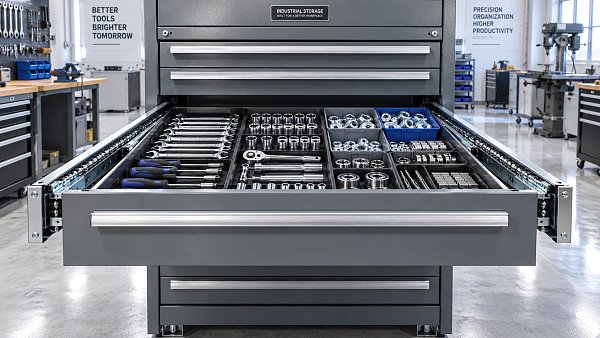
Weight also needs to be understood as a moving load, not just a number resting inside a cabinet. When a drawer is extended, the center of gravity shifts forward. The slide members, mounting screws, cabinet side walls, and drawer construction all experience greater leverage than they do in the closed position. Long, deep drawers and full-extension designs therefore require more careful evaluation than short drawers holding the same total weight.
Do not compare load ratings until the test conditions match
A stated capacity is only meaningful when the conditions behind it are clear. One supplier may rate a slide in a short, well-supported drawer under evenly distributed weight. Another may quote a rating from a different mounting orientation or slide length. Treating those figures as interchangeable can create an apparent cost saving that disappears after installation failures, returns, or replacement work.
Ask suppliers to state how the load rating was established and what configuration it applies to. At minimum, the documentation should identify slide length, extension type, mounting position, pair rating or individual-slide rating, drawer width limits where relevant, and the intended distribution of the load. It should also make clear whether the figure is intended for static loading, repeated cycling, or a defined operating condition.
For a pair of side-mounted slides, the quoted rating commonly refers to the pair, but this should be written into the purchase specification rather than assumed. If the rating refers to one slide instead, the comparison changes immediately. The same clarification is needed for special products with center mounting, bottom mounting, or multi-slide arrangements.
Slide length changes the practical decision
Longer slides can place more leverage on the cabinet and drawer structure, especially at full extension. A nominal rating that is acceptable in a short drawer may not be the right basis for a deeper drawer with a long travel distance. Do not substitute a longer length into an approved bill of materials solely because the catalog presents the same slide family and a similar load claim.
Extension type matters as well. Partial-extension slides leave a portion of the drawer supported inside the cabinet. Full-extension slides give better access but expose more of the load outside the cabinet. Over-travel slides may be necessary for access around a countertop, door, or enclosure, yet they deserve closer scrutiny because their use condition is more demanding.
Specify a margin based on use, not habit
There is no universal extra-capacity percentage that fits every drawer. The appropriate margin depends on how predictable the load is and how severe the service is. A fixed-purpose drawer containing lightweight, evenly arranged components can be specified closer to its measured maximum. A drawer intended for tools, files, spare parts, consumer goods, or mixed inventory needs more headroom because the contents will vary and may be concentrated near the front.
Use a larger margin when the drawer may be overloaded by the end user, when the load cannot be evenly distributed, or when a failure can damage stored equipment or interrupt operations. A smaller margin may be reasonable in a controlled product with a defined payload and a rigid, repeatable installation. The point is to document the assumption, so future sourcing changes do not quietly reduce the design allowance.
Mounting orientation can invalidate a good-looking rating
Most ball bearing drawer slides are designed for side mounting. Their published capacity usually depends on that orientation. Turning a side-mount slide flat for a horizontal shelf, mounting it underneath without an approved configuration, or using it as a structural support can substantially change how the ball bearings and raceways are loaded.
Do not assume that a pair of slides will perform identically after a mounting change. If the design needs flat mounting, bottom mounting, or an unusual bracket arrangement, obtain a rating specifically applicable to that orientation. When none is available, select hardware designed and documented for the intended use rather than trying to adapt a standard drawer slide.
The cabinet itself also belongs in the load calculation. Thin panels can flex, wood screws can loosen in low-density board, and poorly aligned sides can force the slide members out of parallel. In those conditions, moving to a higher-rated slide may not resolve the failure mode. The slide needs a stable, square mounting surface and appropriate fasteners; otherwise, smooth travel and service life will suffer regardless of the catalog rating.
Separate capacity from durability
A slide can carry a given weight once and still be a poor choice for repeated operation. Load rating answers one part of the question: how much weight the slide assembly is intended to support. Durability depends on the frequency of opening and closing, travel distance, loading pattern, contamination, alignment, and the quality of the mounting assembly.
For frequently used drawers, request cycle-test information relevant to the selected configuration. The useful question is not simply whether a supplier has tested a product. It is whether the quoted test resembles the drawer you are buying: comparable load, length, extension, mounting orientation, and operating pattern. A low-cost slide that needs early replacement costs more than its unit price once labor, downtime, shipment handling, and customer complaints are included.
Features such as soft close, hold-in, hold-out, or lock-in/lock-out mechanisms should be evaluated separately from basic load capacity. They can improve usability or safety, but they add moving components and operating resistance. The selected slide should be rated and tested with those features in the configuration being ordered, particularly when the drawer is heavy or is opened many times per day.
Watch for load distribution and drawer width
Evenly distributed contents are the easiest condition for a slide pair. Actual drawers often behave differently. A bin of fasteners, a stack of documents, a power tool, or a piece of mounted equipment may place most of the weight near one side or near the front. That imbalance can make one slide carry more than its expected share and can twist a wide drawer box during travel.
Wide drawers are especially sensitive to racking. If the drawer can rack, one slide may bind while the other continues moving. The resulting wear is often blamed on the slides even though the underlying issue is insufficient drawer rigidity, inadequate front-to-back support, or poor installation alignment. For wide or heavy drawers, specify the drawer construction, allowed side clearance, mounting-hole pattern, and any required cross-bracing alongside the slide model.
Where the stored item is inherently concentrated or mounted off-center, treat that condition as the design load. Do not convert it into an “average” load merely because the total weight appears to fall within the rating.
Build a specification that suppliers can quote consistently
Vague requests such as “45 kg slides” invite inconsistent quotations. A usable purchase specification gives every supplier the same operating target and makes incoming inspection more practical. It should include:
- Required slide type and mounting orientation
- Closed length and required travel or extension
- Minimum load rating for the pair, stated at the specified length
- Maximum drawer width and the material or rigidity requirement for the drawer box
- Expected load distribution, especially where point loads are likely
- Required functions, such as full extension, soft close, detent, or locking
- Finish and corrosion-resistance expectations appropriate to the environment
- Cycle-life or endurance requirement tied to the intended use condition
- Mounting hardware, screw-hole layout, packaging, labeling, and lot traceability needs
It is also useful to request a retained production sample and a dimensional drawing before authorizing volume supply. Small differences in slide thickness, hole placement, closed length, and member travel can disrupt an established cabinet design even where the stated load rating is similar.
For multi-source programs, avoid qualifying suppliers on price and rated capacity alone. Compare samples in the actual drawer assembly. Check opening force, smoothness near full extension, side-to-side play, closure behavior, resistance to drawer racking, and condition after repeated loaded operation. This evaluation is more relevant than a catalog comparison because it reveals the interaction between the hardware and the furniture or equipment structure.
When higher capacity is the wrong purchase
Over-specifying every drawer can raise hardware cost, increase opening force, add unnecessary weight, and create fit issues in compact furniture. Heavy-duty slides may also require more mounting clearance or a stronger cabinet than the existing design provides. Their benefit is real only when the drawer, mounting structure, and service condition need it.
A more expensive rating is not a substitute for a weak drawer bottom, an oversized drawer width, poor screw retention, or a use case that requires a different hardware format. If the design cannot keep the load supported and aligned, solve that structural problem before escalating the slide rating.
A practical buying decision is therefore based on the loaded drawer at full extension, not the empty cabinet and not a single headline capacity figure. Define the maximum moving load, account for length and extension, confirm the mounting orientation, allow for real use variation, and compare supplier ratings only on like-for-like conditions. That process produces a specification that protects lifecycle cost without paying for capacity the product will never use.
Recommended News
 Building HardwareWhat load rating should you specify for wholesale ball bearing slides?Wholesale ball bearing slides: learn how to specify the right load rating for drawer weight, extension, mounting, and durability. Source smarter and reduce failures.Tooling & Hardware LeadOct 05, 2026
 Hand & Power ToolsHow to choose a hand saw for woodworking without tear-outHand saw for woodworking guide: choose the right tooth pattern, blade, and technique to achieve clean, precise cuts with less tear-out. Explore practical buying tips.Tooling & Hardware LeadOct 04, 2026
 Eco PackagingWhat affects the price of kraft paper rolls bought wholesale?Kraft paper rolls wholesale pricing depends on grade, basis weight, roll size, order volume, freight, and certifications. Learn how to compare landed costs and choose reliable value.Packaging Supply ExpertOct 03, 2026
 Commercial LEDHow to evaluate a canopy lights factory before placing a bulk orderCanopy lights factory evaluation guide: verify specifications, compliance, quality control, capacity, and after-sales support before placing a bulk order.Commercial Tech EditorOct 02, 2026