Industry News
Curation by industry experts
Hot Articles
Popular Tags
How to choose a hand saw for woodworking without tear-out
How to Choose a Hand Saw for Woodworking Without Tear-Out
Choosing the right hand saw for woodworking is the first step toward clean, accurate cuts without frustrating tear-out. Whether you are trimming hardwood, cutting plywood, or shaping delicate joinery, tooth geometry, blade thickness, and cutting direction all affect the final surface. The goal is not simply to buy the finest-looking saw or the one with the most teeth. It is to match the saw to the material, the direction of the cut, and the amount of cleanup your project can tolerate.
Tear-out happens when wood fibers are lifted, split, or broken away rather than cleanly severed. It often appears at the exit edge of a cut, but it can also occur along veneered faces, across figured grain, or beside a layout line where the saw has wandered. A better hand saw helps, but technique and work support matter just as much. The most reliable approach is to choose a saw that cuts efficiently without forcing the fibers apart.
Start With the Material, Not the Saw Category
Woodworkers often begin by asking whether they need a Japanese saw or a traditional Western saw. That can be useful later, but the more practical first question is: what are you cutting?
Solid softwood, dense hardwood, plywood, MDF, veneered panels, and laminates do not respond the same way to a blade. A coarse rip saw may move quickly through construction-grade pine, yet leave a ragged edge in birch plywood. A very fine back saw may produce an excellent shoulder cut for a tenon, but feel slow and awkward when breaking down a wide board.
For visible furniture parts, especially cabinet doors, drawer fronts, trim, and veneered sheet goods, prioritize surface quality over speed. A slower cut that requires only light sanding is usually preferable to a fast cut that chips veneer or removes material beyond the line. If the cut will be hidden, such as an internal rough-sizing cut before planing or routing, a more aggressive blade is reasonable.
Pay particular attention to engineered panels. Plywood can tear differently on its two faces because the outer veneers run in different directions. Melamine-faced board and laminates can chip at the surface coating rather than tear as ordinary wood fibers do. These materials generally favor a sharp, fine-toothed saw, a carefully marked line, and a controlled stroke.
Understand How Tooth Geometry Changes the Cut
The teeth do more than determine how quickly a saw cuts. Their shape determines whether the blade is mainly severing fibers, removing material along the grain, or doing a compromise between both jobs.
Rip teeth are designed to cut with the grain. They act more like a row of small chisels, removing fibers from the kerf efficiently. A rip-pattern saw is the sensible choice for lengthwise cuts in solid wood, such as preparing a board for a narrower rail or resawing a small section by hand. Used across the grain, however, it can leave a comparatively rough surface.
Crosscut teeth are shaped to score and sever fibers across the grain before clearing the waste. They are the better choice for trimming boards to length, cutting miters, and cutting across the face grain of solid lumber. A fine crosscut pattern is also more forgiving on delicate surfaces.
Hybrid or combination teeth attempt to handle both directions. They can be useful when one general-purpose hand saw must cover household repairs, rough furniture preparation, and occasional woodworking. The trade-off is predictable: a combination saw rarely matches a dedicated rip saw for fast long-grain work or a fine crosscut saw for the cleanest joinery.
Tooth count is usually expressed as teeth per inch (TPI) on many Western-pattern saws, while Japanese saws may use a different convention. Rather than treating a higher number as automatically better, use it as an indication of cut character. Fewer, larger teeth generally clear waste quickly but leave a coarser finish. More, smaller teeth take a smaller bite and usually give more control. For finish-sensitive cuts, fine teeth are valuable; for thick stock and rough sizing, they can be unnecessarily slow.
Choose a Saw Style That Fits the Operation
A hand saw for woodworking should be selected around the actual operation, not just the project label. “Building a table” may involve crosscutting legs, ripping aprons, cutting tenons, trimming plugs, and fitting drawer components. One saw can do all of this in a basic sense, but it will not do every task cleanly.
A Western saw usually cuts on the push stroke. Its blade is often thicker and more resistant to accidental bending, which can help beginners maintain a straight path. A Japanese saw generally cuts on the pull stroke, allowing a thinner blade and narrow kerf. That thin kerf can reduce effort and material waste, but it also means the blade can kink if twisted in the cut. Neither system is inherently tear-out-free. The better choice is the one you can start accurately and guide without forcing.
Blade Thickness, Set, and Backing Matter More Than They Seem
The kerf is the slot left by the saw. It must be wide enough for the blade to travel without binding, but excessive width means more waste and more force. The “set” is the slight alternating bend of the teeth that creates this clearance. A saw with aggressive set is less likely to bind in damp, resinous, or unstable stock, but it can leave a wider, rougher kerf. Fine joinery saws typically use a narrower kerf because precision is more important than fast waste removal.
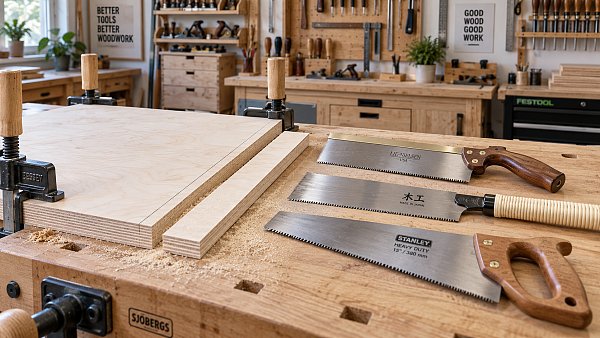
A stiffened back on a tenon saw or dozuki keeps the blade straight and makes it easier to follow a line. The limitation is depth of cut: once the spine reaches the wood, the saw cannot go deeper. For through-cuts in thick boards, a panel saw or ryoba gives more capacity.
Blade length should also match the work. A long saw stroke is efficient on wide boards because more teeth engage gradually and the blade can clear dust. Yet a long blade is cumbersome for small joinery or tight bench work. For dovetails, small box parts, and narrow moldings, control matters more than reach.
Sharpness Is a Surface-Quality Issue
A dull saw does not merely cut more slowly. It crushes and pulls at fibers, encourages extra downward pressure, and makes the blade drift. These are common causes of splintering and an uneven kerf. If a saw requires you to push hard, skips in the cut, or leaves fuzzy fibers where it previously cut cleanly, it may need sharpening or replacement.
Traditional Western saws can often be resharpened, depending on the tooth profile and the owner’s willingness to learn filing. Many modern hardpoint saws are intended to be replaced when dull because their hardened teeth are not readily filed with ordinary saw files. Japanese saw blades are commonly sold with replaceable blades, although exact availability depends on the maker and model. Before buying, consider this maintenance path. A low initial price is less attractive if the saw becomes disposable after limited use, while a resharpenable saw may be worthwhile for frequent woodworking.
Do not judge sharpness only by touch. Saw teeth are sharp enough to injure skin, and a finger test says little about how well the teeth track through hardwood. A clean test cut in scrap from the same material is more useful.
Prevent Tear-Out Before the First Stroke
Even an excellent saw cannot compensate for unsupported material or a careless start. A few preparation habits make a noticeable difference:
- Mark the cut with a knife line when the edge will remain visible. A knife severs surface fibers and gives the saw a small track to follow.
- Place the waste side clearly. Saw just to the waste side of the line, leaving material for a plane, chisel, or sanding block if accuracy is critical.
- Support the board close to the cut. Vibration causes splintering and can pinch the blade near the end of the stroke.
- Use light, short starting strokes. Let the teeth establish a shallow kerf before using the full length of the blade.
- Reduce pressure as the cut approaches the exit edge. The final unsupported fibers are where breakout often occurs.
For plywood and veneer, score the line on the show face and, where practical, place that face on the side where the saw’s cutting action is least likely to lift fibers. The exact orientation depends on the saw and cutting stroke, so test a scrap first. A sacrificial backing board clamped against the exit face can also support fragile veneer. Masking tape may help on some surfaces, but it is not a substitute for sharp teeth and proper support.
Avoid the “One Fine Saw Does Everything” Mistake
A common buying mistake is choosing an ultra-fine joinery saw as a universal solution to tear-out. It can create remarkably clean cuts, but it may clog or bind in thick material, cut slowly during rough stock preparation, and be too shallow for some tasks. The opposite mistake is relying on a coarse general-purpose saw for cabinet-grade cuts and then spending unnecessary time repairing the edge.
For many home woodworkers, a sensible starting set is a medium or fine general-purpose crosscut saw for boards and panels, plus a fine back saw for joinery and precise trimming. If you frequently rip solid lumber by hand, add a dedicated rip saw or choose a ryoba with distinct rip and crosscut tooth patterns. This is more practical than accumulating several similar saws with no clearly defined role.
Handle comfort deserves a real trial as well. The best tooth geometry is of limited value if the handle forces an awkward wrist angle or gives poor control. Hold the saw as you would during a cut. Check whether your index finger can guide the handle naturally, whether the grip suits your hand size, and whether the balance feels stable near the start of the stroke.
A Practical Decision Before You Buy
Before selecting a hand saw for woodworking, write down the material thickness, whether cuts are mostly with or across the grain, and whether the edge will be visible in the finished piece. Then decide how much post-cut refinement is acceptable. A rough cut followed by planing calls for a different tool than a finished miter on painted trim or a clean cut through veneered plywood.
When comparing saw specifications from different manufacturers, look beyond promotional terms such as “precision” or “professional.” Ask whether the tooth pattern is rip, crosscut, or hybrid; whether the blade is resharpenable or replaceable; how deep it can cut; and whether replacement blades are likely to remain available. These details are especially relevant when buying tools through broad online marketplaces, where similar-looking saws can have very different tooth patterns and service life.
Global Supply Review follows the wider hardware supply chain closely because details such as tooth treatment, blade steel, handle construction, replacement availability, and packaging integrity affect the end user long after purchase. For a consumer, the useful takeaway is simple: compare the working characteristics that affect the cut, not just the product image or the number of accessories in the box.
Clean cuts come from a matched system: the right tooth pattern, a sharp blade, stable work support, and a deliberate final stroke. Choose the saw around the cut you need to make most often, keep a finer option for exposed work, and test unfamiliar material on offcuts before committing to a finished part.
Recommended News
 Hand & Power ToolsHow to choose a hand saw for woodworking without tear-outHand saw for woodworking guide: choose the right tooth pattern, blade, and technique to achieve clean, precise cuts with less tear-out. Explore practical buying tips.Tooling & Hardware LeadOct 04, 2026
 Eco PackagingWhat affects the price of kraft paper rolls bought wholesale?Kraft paper rolls wholesale pricing depends on grade, basis weight, roll size, order volume, freight, and certifications. Learn how to compare landed costs and choose reliable value.Packaging Supply ExpertOct 03, 2026
 Commercial LEDHow to evaluate a canopy lights factory before placing a bulk orderCanopy lights factory evaluation guide: verify specifications, compliance, quality control, capacity, and after-sales support before placing a bulk order.Commercial Tech EditorOct 02, 2026
 Commercial LEDHow to choose lighting systems that meet workplace safety needsLighting systems for workplace safety: learn how to control glare, improve visibility, meet environmental demands, and protect workers with reliable, compliant lighting choices.Commercial Tech EditorOct 01, 2026