Industry News
Curation by industry experts
Hot Articles
Popular Tags
How to Evaluate a Furniture and Decor Supplier for Consistency and Lead Time
A reliable furniture and decor supplier protects more than unit cost. It protects brand standards, launch timing, and replenishment stability.
That is why consistency and lead time deserve a deeper review than a sample approval or a price sheet.
In practice, the stronger supplier is often the one with fewer surprises, clearer controls, and better recovery when conditions change.
Across global sourcing, this matters even more for furniture and decor, where materials, finishing, packaging, and transport all affect final performance.
Drawing on the kind of structured market thinking associated with Global Supply Review, the best evaluation starts with evidence, not promises.
What does consistency really mean when reviewing a furniture and decor supplier?
Consistency is not only visual similarity. It includes dimension accuracy, color stability, assembly fit, finish durability, and carton protection.
For a furniture and decor supplier, consistency also shows up across batches, production seasons, and raw material substitutions.
A first sample can look excellent and still hide future variation. The better question is whether the supplier can repeat that result at scale.
This is especially important with wood grain, fabric dye lots, metal plating, ceramics, glass, and hand-finished decorative items.
When evaluating a furniture and decor supplier, ask for tolerance standards, approved material references, and records from previous production runs.
If the answer stays general, the risk is usually higher than it appears.
Useful signs of repeatable quality
- Documented incoming material inspection for wood, foam, hardware, fabric, and surface coatings.
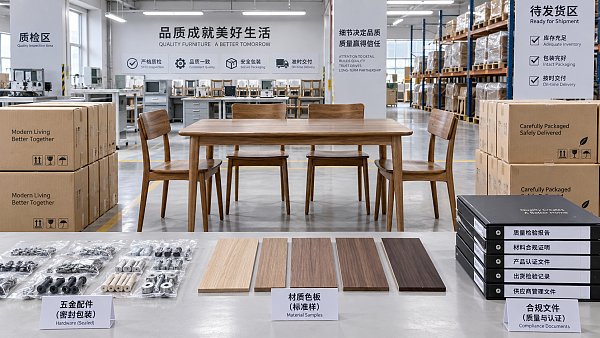
- Clear golden samples or approved reference boards kept on site.
- In-line quality checkpoints, not only final inspection.
- Corrective action records showing how defects were traced and fixed.
- Stable subcontractor control for parts such as glass, stitching, cushions, or electroplating.
How can you tell if lead time is dependable, not just competitive?
Quoted lead time and achievable lead time are often different. A dependable furniture and decor supplier can explain the gap between them.
Lead time should be broken into material readiness, production queue, manufacturing cycle, inspection, packing, and dispatch preparation.
Without that breakdown, it is hard to know where delay is most likely.
More importantly, ask for on-time delivery data over several months. One punctual shipment proves very little.
A capable furniture and decor supplier usually tracks schedule attainment by order type, season, and product complexity.
That matters because custom upholstery, mixed-material items, and fragile decor typically carry longer and less predictable cycles.
Questions that expose real scheduling strength
A supplier that can answer in this level of detail is easier to plan around and easier to trust.
Which factory checks matter most before placing a larger order?
Not every audit needs to be complex, but some checks are hard to skip.
Start with production flow. A furniture and decor supplier should show how materials move from receipt to cutting, assembly, finishing, packing, and loading.
Disorganized flow often leads to mixed parts, damage, and late completion.
Then review capacity in a practical way. Count active lines, not just total machines. Some equipment exists but is rarely available for your product type.
It also helps to confirm whether key processes are internal or outsourced. Finishing, powder coating, upholstery, printing, and carton production can all affect lead time.
Where outsourced steps exist, review how the furniture and decor supplier monitors outside partners.
A practical pre-order checklist
- Sample room matches approved specifications and revisions are logged.
- Work instructions are visible at stations for assembly, sanding, finishing, or packing.
- Moisture control, fabric storage, and surface protection are managed correctly.
- Packaging drop test or transit protection standards are defined.
- Inspection records include defect rate trends, not only pass or fail results.
These checks are often more useful than a polished presentation deck.
When do low prices signal a hidden consistency or timing risk?
A low quote is not automatically a problem. The issue is whether the cost structure is stable enough to support repeatable output.
In furniture and decor, underpricing can reflect thinner materials, lighter packaging, outsourced finishing, or weak process control.
Those savings may not be obvious in a showroom sample.
More common warning signs include unclear hardware grades, vague fabric composition, inconsistent carton specs, and unusually short quoted lead time.
A furniture and decor supplier that wins on price but misses delivery windows can create extra freight cost, lost shelf timing, and costly replacement handling.
That is why total sourcing cost should include defect exposure, rework, storage, and claim management.
Quick comparison points before approving the quote
How should performance be tested before a long-term commitment?
The safest approach is a staged qualification process. This gives a clearer picture than jumping from sample approval to full rollout.
Begin with a pilot order that is large enough to stress the system. Very small test orders can hide planning and quality issues.
For a furniture and decor supplier, the pilot should include real packaging, normal inspection, and standard shipment timing.
Next, score performance with a simple supplier review card. Keep the metrics few, but measurable.
- First-pass quality rate.
- On-time production completion.
- On-time shipment readiness.
- Packaging damage rate on arrival.
- Response speed on corrective actions.
In actual sourcing decisions, this scorecard often reveals more than reference claims.
It also aligns with the broader data-led mindset used by platforms that track supplier credibility across light manufacturing categories.
What final signals suggest a furniture and decor supplier is ready for scale?
The strongest signal is controlled predictability. You should see similar quality outcomes, believable planning, and fast issue closure.
Another good sign is disciplined communication. Reliable suppliers confirm changes early, document revisions clearly, and do not hide production pressure.
A scalable furniture and decor supplier also understands compliance, packaging sustainability, and cross-border documentation, because these affect delivery as much as factory output.
If the supplier performs well across one product family, ask whether the same controls apply to adjacent categories such as upholstered items, lighting-adjacent decor, or flat-pack case goods.
That answer helps separate genuine operating discipline from one-off success.
Before moving forward, gather production records, compare pilot results, and challenge the lead time assumptions one more time.
A well-chosen furniture and decor supplier should make future buying easier, not more fragile. The next step is to formalize your review criteria and apply them consistently across every shortlisted source.
Recommended News
 Industrial FastenersWhen do zinc drop in anchors need corrosion-resistant coatings?Zinc drop in anchors need corrosion-resistant coatings in damp, outdoor, chloride-rich, or chemical environments. Learn how to select durable, approved protection.Tooling & Hardware LeadSep 29, 2026
 Carton & PlasticsHow to assess seam quality in 250ml aluminum beverage cansLearn how to assess seam quality in 250ml aluminum beverage cans with practical visual checks, precise measurements, teardown methods, and defect-control guidance.Packaging Supply ExpertSep 28, 2026
 Carton & PlasticsWhat drives breakage rates in bulk wine bottles wholesale orders?Bulk wine bottles wholesale buyers: discover what drives breakage rates, from glass quality and packaging to pallet loading, and reduce costly claims.Packaging Supply ExpertSep 27, 2026
 Office FurnitureHow supplier scorecards reduce risk in furniture procurementFurniture procurement supplier management becomes more resilient with supplier scorecards that track quality, delivery, compliance, and corrective actions. Learn how to reduce sourcing risk.Interior Sourcing LeadSep 26, 2026