Industry News
Curation by industry experts
Hot Articles
Popular Tags
How to choose a furniture vendor for apartments that can handle bulk orders
Choosing a furniture vendor for apartments is not really a furniture question. It is a procurement question about volume reliability, schedule control, and how much risk you are willing to carry across many units at once. For apartment projects, the wrong vendor rarely fails in one dramatic way. More often, it fails gradually: a few delayed shipments, a batch of mismatched finishes, inconsistent assembly quality, or replacements that take too long to matter.
That is why bulk apartment sourcing should be evaluated differently from one-off furniture purchases. A vendor may look competitive on unit price and still be a poor fit if it cannot handle phased delivery, project coordination, or the kind of repeatability that large residential deployments require. Buyers need to look past catalog breadth and focus on operational discipline.
What apartment procurement is really asking for
Apartment furniture programs usually sit at the intersection of hospitality-style coordination and commercial durability requirements. The furniture may be used in model units, lease-up inventory, furnished rentals, student housing, workforce housing, or multifamily common areas. Each use case changes the decision slightly, but the core demands are similar: consistent quality across many units, predictable lead times, and enough flexibility to absorb changes without breaking the schedule.
A vendor for apartments should be able to do more than quote a price list. It should support repeatable production, stable materials sourcing, carton and label discipline, and a project management process that can work across multiple delivery windows. If the supplier cannot explain how it handles shortage allocation, substitutions, or inspection before shipping, that is usually a sign of operational weakness rather than a harmless sales gap.
Start with the project shape, not the catalog
Before comparing suppliers, define the buying problem clearly. “Furniture for apartments” can mean very different things depending on how the units will be delivered and occupied.
- Model units: high visual consistency matters more than heavy-duty wear performance, but finish matching and replacement speed still matter.
- Lease-up or furnished rentals: durability, repairability, and quick replenishment become more important because turnover is higher.
- Student or workforce housing: the vendor must handle bulk quantities, simple SKUs, and dependable packaging because damage risk is higher during move-in cycles.
- Common areas: you may need better fire, fabric, or finish compliance depending on local requirements and building standards.
Once the use case is clear, the sourcing brief becomes much more useful. A vendor that is strong in decorative residential pieces may not be the right partner for a project that requires thousands of near-identical pieces delivered in waves. In bulk apartment work, the ability to repeat the same standard over time is often more valuable than having the widest design range.
What to evaluate in a vendor
The best way to assess a furniture vendor for apartments is to review its ability to absorb project complexity without creating surprises downstream. Five areas matter most.
1. Production capacity and repeatability
Bulk orders only work when the vendor can maintain output without drifting on materials, dimensions, or finish consistency. Capacity should be judged not only by factory size but also by how the supplier manages parallel orders, seasonal spikes, and component availability.
Ask for evidence of recent apartment-scale or multi-site deliveries. A vendor that has only handled small custom orders may be unable to keep tolerances tight across hundreds of units. Buyers should also check whether key components come from stable sources or from spot-buying arrangements that can introduce variation.
2. Lead-time realism
Many vendors quote aggressive lead times during the sales stage and then extend them once orders are placed. For apartment projects, that creates cascading risk because furniture delivery is often tied to turnover dates, staging windows, or leasing milestones.
Good vendors can explain what drives their timeline: raw material procurement, sampling, production slotting, inspection, packing, and shipping. If the schedule is presented as a single number with no breakdown, procurement teams should treat it as provisional.
3. Quality control and damage handling
Apartment furniture is exposed to repeated use, and bulk shipments amplify small defects. A minor issue in a single chair becomes a project-level issue when multiplied across dozens or hundreds of units.
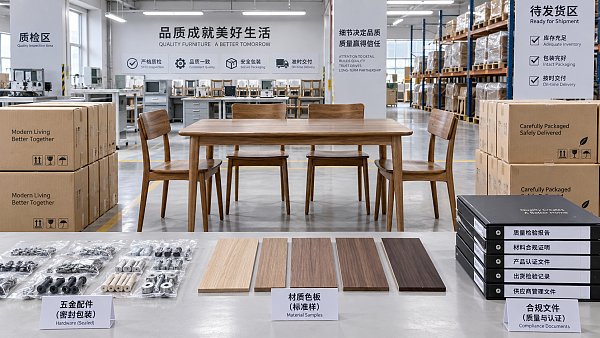
Buyers should look for clear QC checkpoints, pre-shipment inspection options, and documented packaging standards. The practical question is not whether the vendor claims quality control. It is whether it can show how defects are prevented, detected, and corrected before delivery. Replacement policy matters too, especially for finish mismatch, broken hardware, and transit damage.
4. Customization without process loss
Apartment projects often need some degree of customization: dimensions adjusted for tight floorplans, finishes aligned to interior schemes, or fabric selections tied to a project palette. That customization is useful only if the vendor can preserve production discipline while doing it.
Too much flexibility can create confusion in ordering and increase error rates. A reliable vendor usually offers a controlled customization menu rather than open-ended changes. This is often the better sign of maturity. It means the supplier understands which variations are manageable at scale and which ones will compromise consistency.
5. After-sales support
Bulk apartment sourcing does not end at delivery. Parts may need replacing. Pieces may arrive damaged. A small number of units may require restocking after move-in or during lease turnover.
Vendors should be able to support spare parts, warranty claims, and communication around issue resolution. In practice, the quality of after-sales support is often what separates a tolerable supplier from a dependable one. Procurement teams should make this part of the evaluation, not an afterthought.
Signals that matter more than marketing language
In this category, vendors often sound similar on paper. They all claim quality, customization, and service. The more useful filter is operational evidence.
A vendor that can speak specifically about these items is usually more credible than one that only emphasizes design range or factory scale. For apartment buyers, credibility comes from operational detail.
The questions procurement teams should ask early
It is easier to screen out weak suppliers before sampling than after PO placement. These questions tend to expose the difference quickly:
- What is your typical monthly output for this product category?
- How do you keep color, finish, and dimension consistency across bulk lots?
- What percentage of your apartment or project orders are delivered in phases?
- How do you handle substitutions if a material becomes unavailable?
- Can you support third-party inspection before shipment?
- What is your process for damaged or missing items after arrival?
- How do you manage spare parts and replenishment for repeat orders?
If the answers are vague, procurement teams should not assume the issue is only communication style. In many cases, vagueness reflects weak internal process. That becomes expensive once the project is live.
Where price comparisons go wrong
Apartment buyers often start with unit cost because budgets are fixed and margin pressure is real. But the cheapest quote can be misleading if it excludes the costs that matter in project delivery.
Common hidden costs include packaging failures, late delivery, low assembly efficiency, higher damage rates, and replacement delays. A lower-priced vendor can become the more expensive option once site teams spend time rechecking shipments, managing complaints, or waiting on backordered parts.
That is why the comparison should be built around landed and delivered performance, not just factory price. For bulk apartment work, the cost of inconsistency usually exceeds the savings from a marginally cheaper piece.
What a strong vendor relationship looks like in practice
The best furniture vendors for apartments tend to operate like project partners rather than pure sellers. They keep communication structured, share realistic timelines, and surface risks before the buyer has to ask. They can quote, sample, produce, inspect, and replace with minimal ambiguity. They also understand that a bulk apartment rollout is a sequence of deadlines, not a single shipment.
That does not mean buyers should expect perfection. Delays and defects can still happen. The difference is whether the vendor has enough process discipline to absorb problems without turning them into project disruption.
A practical shortlist framework
For procurement teams building a shortlist, the decision can usually be reduced to four filters:
- Can they produce at your scale?
- Can they deliver on your schedule?
- Can they maintain consistency across all units?
- Can they support the project after shipment?
If a supplier fails two of those four, it is usually not worth forcing the fit. Apartment programs have too many moving parts to compensate for weak vendor fundamentals.
For B2B buyers, the right furniture vendor for apartments is the one that lowers coordination burden, not the one that merely offers more styles. Bulk sourcing works when the supplier can repeat a standard, hold a timeline, and respond when reality changes. That is the standard that matters once orders become large enough to affect occupancy, turnover, and project economics.
Recommended News
 Industrial FastenersWhen do zinc drop in anchors need corrosion-resistant coatings?Zinc drop in anchors need corrosion-resistant coatings in damp, outdoor, chloride-rich, or chemical environments. Learn how to select durable, approved protection.Tooling & Hardware LeadSep 29, 2026
 Carton & PlasticsHow to assess seam quality in 250ml aluminum beverage cansLearn how to assess seam quality in 250ml aluminum beverage cans with practical visual checks, precise measurements, teardown methods, and defect-control guidance.Packaging Supply ExpertSep 28, 2026
 Carton & PlasticsWhat drives breakage rates in bulk wine bottles wholesale orders?Bulk wine bottles wholesale buyers: discover what drives breakage rates, from glass quality and packaging to pallet loading, and reduce costly claims.Packaging Supply ExpertSep 27, 2026
 Office FurnitureHow supplier scorecards reduce risk in furniture procurementFurniture procurement supplier management becomes more resilient with supplier scorecards that track quality, delivery, compliance, and corrective actions. Learn how to reduce sourcing risk.Interior Sourcing LeadSep 26, 2026