Industry News
Curation by industry experts
Hot Articles
Popular Tags
What Are the Key Furniture and Home Decor Trends for 2026?
What are the latest trends in furniture and decor for 2026? The answer is no longer simply “warmer colors” or “more sustainable materials.” The strongest shifts are tied to how people use space, how long products are expected to last, and how easily a design can adapt to changing household needs. Furniture is being assessed as a long-term functional asset rather than a short-cycle decorative purchase. That changes what sells, what gets specified, and what suppliers need to demonstrate.
Across residential, hospitality, workspace, and mixed-use projects, the market is moving toward adaptable layouts, material transparency, tactile comfort, repair-conscious construction, and a more deliberate use of technology. Decorative trends still matter, but surface fashion alone is unlikely to sustain a product range if it cannot meet expectations for durability, safety, traceability, and efficient delivery.
Will adaptable furniture become a mainstream requirement in 2026?
Yes. Adaptability is one of the most commercially significant furniture trends for 2026 because it responds to a structural reality: rooms increasingly serve multiple purposes. A dining space may double as a work zone; a living room may be used for entertaining, remote work, exercise, or occasional overnight guests. In urban markets, limited floor area makes this need even more pronounced, but the trend extends well beyond compact apartments.
The market is therefore favoring furniture that changes function without looking temporary or overly mechanical. This includes extendable dining tables with stable leaf systems, nesting tables, storage-integrated benches, modular seating, wall-mounted storage, height-adjustable work surfaces, and beds or ottomans with usable concealed storage.
The important distinction is between genuinely adaptable design and feature overload. Products with too many moving parts may create higher warranty exposure, more complicated assembly, and increased packaging requirements. The most effective designs solve one or two real use problems cleanly. A sectional sofa with reconfigurable modules, for example, may offer more lasting value than a sofa with several rarely used mechanisms.
For suppliers, this trend raises practical engineering questions. Hinges, slides, gas springs, locking devices, and connectors must be tested for repeated use under realistic loads. Instructions also become part of the product experience. If a customer cannot understand how to extend, fold, connect, or maintain a piece of furniture, the flexibility that appeared attractive at purchase can become a source of dissatisfaction.
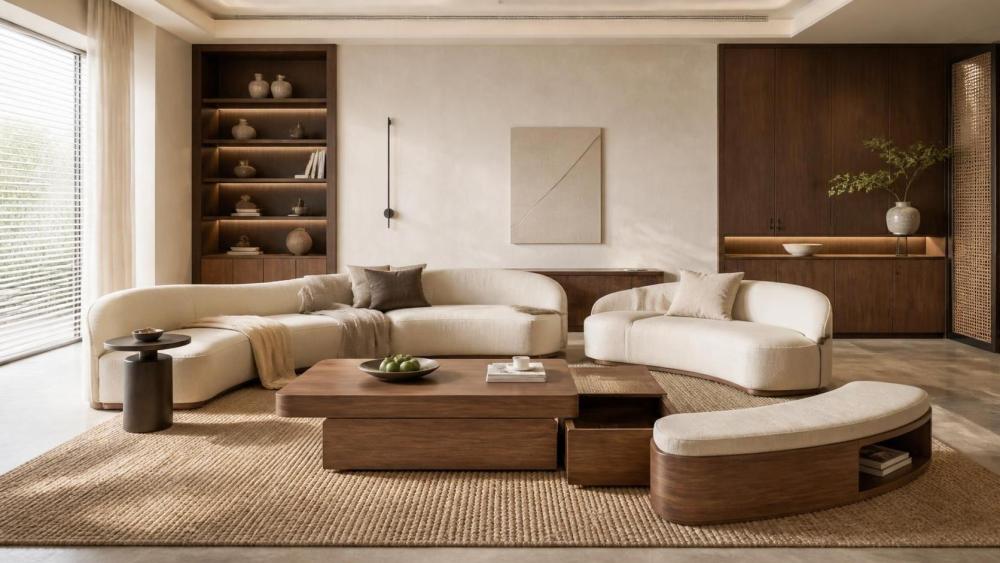
Why are softer forms and tactile surfaces gaining ground?
After years of interiors dominated by sharp minimalism, cool neutrals, and visually light furniture, 2026 is expected to continue the shift toward more enveloping and tactile environments. Rounded silhouettes, softened edges, low-profile lounge seating, sculptural occasional chairs, pleated upholstery, textured wall coverings, and hand-finished-looking surfaces are becoming more prominent.
This does not mean that every market will abandon clean-lined furniture. Rather, a more restrained architectural base is increasingly being paired with pieces that add visual softness and material depth. A rectilinear dining table may sit with upholstered dining chairs; a minimal bedroom may use a deeply textured bedhead; smooth cabinetry may be offset by a natural stone, ceramic, or woven decorative element.
Materials are central to this trend. Bouclé-style fabrics, chenille, brushed weaves, wool blends, ribbed textiles, natural-fiber rugs, limewash-like finishes, ceramics, timber grain, and textured glass all support a desire for interiors that feel less standardized. Yet material selection cannot be based on appearance alone.
High-pile and looped fabrics can be difficult to clean and may snag in high-contact environments. Open-grain timber finishes may show staining if finishing systems are poorly specified. Matte coatings can reveal scratches or polishing marks more readily than gloss finishes. Decorative texture must therefore be aligned with the intended use, cleaning regime, and expected product life.
Are warm neutrals replacing gray interiors?
Warm neutrals are likely to remain influential in 2026, but the shift should not be interpreted as a simple replacement of one color family with another. The broader movement is toward layered palettes with greater depth: clay, sand, mushroom, oat, tobacco, muted olive, deep brown, mineral blue, burgundy, and softened terracotta are often being used alongside familiar off-whites and pale woods.
Brown, especially in walnut-inspired tones, smoked oak finishes, leather-like upholstery, and dark stained timber, has regained relevance because it brings visual weight and a sense of permanence. It is frequently used to anchor rooms that might otherwise feel overly pale or generic. Darker shades are also helping designers create contrast without relying solely on black metal frames, which became highly common in the previous industrial-inspired cycle.
Color decisions should be made at collection level rather than item level. A supplier may be able to offer a fashionable tone quickly, but a coherent range requires matching capability across wood stain, powder coating, upholstery, trim, and decorative accessories. Color inconsistency between production batches remains a common problem, particularly where natural materials, hand-applied finishes, or multiple component factories are involved.
For commercial programs, it is prudent to define approved color references, acceptable variation ranges, and inspection methods before bulk production. A sample that looks correct under showroom lighting may appear substantially different in daylight or under warm hospitality lighting.
What does “sustainable furniture” mean in practical terms for 2026?
Sustainability is moving away from broad claims and toward evidence that can be examined. In furniture and home decor, credible environmental progress is usually connected to material origin, product longevity, chemical management, repairability, packaging reduction, and end-of-life considerations.
Wood sourcing remains a central issue. Where wood or wood-based panels are used, buyers increasingly ask for traceability and responsible forestry documentation. Forest Stewardship Council (FSC) and Programme for the Endorsement of Forest Certification (PEFC) chain-of-custody systems are widely recognized mechanisms, although certification requirements depend on the market, project, and procurement policy. Certification alone does not make a product environmentally superior, but it can provide a more auditable basis for material sourcing.
Low-emission materials are also receiving greater scrutiny. Composite wood products, adhesives, coatings, foam, and upholstery treatments can affect indoor air quality. Requirements vary by destination market and application, but formaldehyde emissions from composite wood are regulated in several jurisdictions. California Air Resources Board (CARB) requirements and the United States Environmental Protection Agency’s TSCA Title VI framework are frequently referenced for composite wood products entering the US market. In Europe, chemical obligations may also arise under REACH, depending on the substances and product configuration involved.
The 2026 opportunity is not merely to substitute one material for another. Recycled content, for example, can be useful but requires control of consistency, odor, color variation, mechanical performance, and chemical compliance. Reclaimed wood can add character, but it may create supply variability, hidden contamination risks, and difficulty in matching finishes at scale. Better sustainability decisions are often those that balance lower impact with a product that remains serviceable for years.
Will repairability and longevity affect furniture design?
Increasingly, yes. The market is placing greater value on products that can be maintained, reupholstered, refinished, or partially repaired instead of discarded. This is particularly relevant for upholstered seating, tables, storage systems, beds, and contract-grade furniture.
Design choices with a direct impact on service life include replaceable cushion covers, accessible fittings, standardized hardware, detachable legs, removable upholstery panels, repairable surface finishes, and spare-part availability. A dining chair with replaceable glides and a separately serviceable seat pad can be more practical over time than one built as a sealed unit.
This trend also changes the quality conversation. A heavy product is not automatically durable, and a lightweight product is not automatically inferior. Actual longevity depends on joint construction, frame design, material thickness, load distribution, hardware performance, coating adhesion, fabric abrasion resistance, and the ability to correct normal wear. Furniture specifications should identify the failure modes most likely in real use rather than rely on visual impressions or generic “premium” descriptions.
There is a commercial challenge: repairable construction may initially cost more. It can require more components, clearer documentation, and a spare-parts process that continues after the original order is delivered. But for brands and projects seeking lower replacement frequency, the lifecycle case can be stronger than a lower initial purchase price.
How is technology changing home furniture and decor?
Technology is becoming less visible and more integrated. The era of novelty-focused smart furniture is giving way to practical features that reduce friction in daily life: discreet charging, cable management, task lighting, adjustable ergonomic support, sensor-controlled lighting, and modular power access.
Integrated USB charging, wireless charging surfaces, concealed sockets, and cable-routing channels can be valuable in desks, bedside furniture, lounge seating, and hospitality applications. However, these features introduce electrical, thermal, repair, and regional-compatibility considerations. A power component suitable for one market may not meet requirements in another. Plug types, voltage, charging standards, certification obligations, and local installation rules must be considered early, not after a furniture design has been finalized.
Smart lighting is also shaping decor choices. Tunable-white systems, dimmable fixtures, portable rechargeable lamps, and layered ambient lighting support spaces that shift between work, relaxation, and entertaining. In this area, quality depends heavily on driver reliability, battery safety, color consistency, light output maintenance, control compatibility, and the availability of replacement components.
The best technology-enabled products do not force people into an app-dependent routine for basic functions. Manual operation, clear controls, service access, and data privacy should be considered where connected features are present. A decorative lighting product that cannot be used when a wireless connection fails is not genuinely user-centered.
Which materials are likely to gain further traction?
Natural-looking materials will remain important, though “natural” should not be confused with unfinished or untreated. Oak, ash, walnut tones, rattan, cane, jute, wool, linen blends, clay-based finishes, ceramic, travertine-inspired surfaces, and stone-look composites are likely to remain visible across many price points.
At the same time, material innovation will continue in areas such as recycled textiles, recycled glass, engineered stone alternatives, bio-based composites, and lower-impact foam systems. These materials can help diversify product portfolios, but performance validation is essential. A new composite may behave differently under humidity, UV exposure, impact, heat, or cleaning chemicals than the familiar material it replaces.
In upholstered furniture, fabric selection deserves particular care. Consumers increasingly expect easy-care performance, but stain resistance, water repellency, and antimicrobial claims should be evaluated against their chemistry, durability through cleaning cycles, and market-specific regulatory expectations. Broad health claims should not be made without substantiation. In many cases, a removable washable cover or a well-designed cleaning protocol provides more practical value than an aggressively treated fabric.
Are maximalism and personal expression returning?
Personal expression is returning, but in a more edited form than the maximalist interiors associated with earlier decades. The 2026 version is likely to involve collected-looking spaces: vintage-inspired sideboards, artisanal ceramics, framed textiles, distinctive lamps, mixed timber tones, patterned rugs, and decorative objects with an apparent story or material identity.
This creates room for decor categories that had been overshadowed by uniform, low-cost accessories. Handmade-looking products, irregular glazing, carved details, vintage references, and limited-run decorative pieces can add differentiation. Yet this is also an area where quality variability can be severe. Hand-finished surfaces may have intended variation, but the boundary between authentic variation and unacceptable defect needs to be defined.
For suppliers, reference samples, finish boards, and realistic tolerance agreements are especially important for ceramic, glass, natural stone, woven fibers, and hand-applied finishes. For buyers, it is important to confirm whether visual variation is controlled within each shipment and whether replacement items can reasonably match earlier deliveries.
What are the main sourcing risks behind the 2026 trends?
The strongest-looking trend can still produce a weak product program if its supply chain is not ready. The common risks are not always dramatic; they are often found in detail. These include unstable availability of specific veneers or fabrics, inconsistent stain matching, insufficient hardware cycle testing, overloaded packaging, long lead times for custom components, unclear chemical documentation, and an inability to supply spare parts after launch.
Modular products can create SKU complexity. A seating system with multiple arms, bases, covers, connectors, and configurations may appear efficient on paper, but forecasting errors can leave stock stranded in unusable combinations. Decorative collections based on handmade materials can experience batch inconsistency. Furniture with integrated electronics may depend on components with shorter technology cycles than the furniture itself.
Quality planning should begin with the intended use environment. Indoor residential furniture, rental accommodation furniture, hotels, restaurants, and office settings face different loading, cleaning, fire-safety, and maintenance conditions. It is risky to treat a visually similar product as equivalent across these applications without checking the relevant performance requirements.
How should a 2026 furniture and decor range be evaluated?
A useful evaluation starts with function, not with a mood board. Ask whether the product responds to a durable behavior change, whether its material choices are defensible, and whether its visual language can remain relevant beyond one selling season. Then examine the operational evidence behind it.
For furniture, this means reviewing construction drawings, material specifications, hardware details, packaging design, assembly instructions, quality-control criteria, and available compliance documentation. For decor, it means understanding finish consistency, breakage risk, labeling, packaging protection, and the realistic replenishment capability for bestselling lines.
The most resilient 2026 collections will combine emotional appeal with operational discipline. They will feel warmer, more individual, and more adaptable than the interiors of the recent past, while also being easier to maintain, more transparent in material origin, and better suited to long-term use. That is the direction behind the latest trends in furniture and decor for 2026: not a rejection of style, but a higher expectation that style must work in the real world.
Recommended News
 Export UpdatesChina’s Textile and Apparel Exports Rise 21.5% in September, Up 5.1% Year to DateChina’s textile and apparel exports rose 21.5% in September and 5.1% year to date. Explore the figures and key signals to watch for sustained industry growth.Oct 23, 2026
 Hand & Power ToolsHow to choose resin-bonded cutting wheels for stainless steelChoose resin bonded cutting wheels for stainless steel with confidence. Compare abrasives, thickness, safety, and cost per cut to find the right wheel for cleaner cuts and less rework.Tooling & Hardware LeadOct 23, 2026
 Export UpdatesChina’s Textile and Apparel Exports Rise 5.1% to $232.97 Billion in January–September 2026China’s textile and apparel exports rose 5.1% to $232.97 billion in January–September 2026. Explore September’s surge and key considerations for bridal suppliers.Oct 22, 2026
 Home DecorCan wholesale woven storage basket suppliers mix styles in one order?Can a wholesale woven storage baskets supplier mix styles in one order? Explore MOQ rules, packing options, and cost considerations to build a smarter assortment before you buy.Interior Sourcing LeadOct 22, 2026