Industry News
Curation by industry experts
Hot Articles
Popular Tags
Do Functional Textiles Need Special Storage for Export?
Yes. Functional textiles often require storage conditions that are more controlled than those used for standard fabrics, especially when export involves long lead times, multimodal transport, humid ports, temperature swings, or extended destination warehousing. The required level of control depends on the fabric construction, chemical finish, active component, packaging format, and intended end use. A plain woven polyester may tolerate ordinary dry storage, while a conductive fabric, phase-change textile, coated medical material, flame-resistant laminate, or antimicrobial nonwoven may need defined limits for moisture, light, pressure, temperature, and contamination.
Export storage should preserve the properties stated in the technical specification, not merely keep rolls visually clean. A fabric can arrive without obvious damage while losing water repellency, electrical continuity, adhesion strength, color consistency, odor neutrality, or surface activity. The storage plan therefore needs to begin with the finished material's performance risks and continue through packing, container loading, inland transfer, port dwell time, and receiving inspection.
Why ordinary warehouse conditions can be insufficient
Functional textiles usually contain features that react to their environment. These may include polymer coatings, microcapsules, conductive yarns, metallic layers, membrane laminations, chemical finishes, optical elements, adhesive films, or bio-based components. Some features are stable across broad conditions; others can gradually change when exposed to heat, humidity, ultraviolet radiation, oxygen, dust, oils, or mechanical stress.
Moisture is a frequent export risk. Natural fibers absorb water readily, but synthetic textiles and composites can also be affected. Humidity may encourage mildew on cellulosic content, weaken carton integrity, alter the feel of coated surfaces, and create hydrolysis risk in certain polymer systems. Moisture trapped inside tightly wound rolls can be particularly problematic because the roll core and inner layers may dry slowly after unloading.
High temperature may soften thermoplastic coatings, cause blocking between fabric layers, reduce adhesive performance, or accelerate the degradation of sensitive finishes. Low temperature can also matter. Some films and coatings become less flexible in cold conditions and may crack when a roll is bent, dropped, or unwrapped before it returns to a suitable handling temperature.
Light exposure is relevant where ultraviolet-sensitive dyes, photoactive treatments, optical fibers, reflective components, or surface coatings are involved. Even if export cartons remain closed, prolonged exposure near warehouse doors, skylights, open loading areas, or damaged packaging can produce uneven fading or premature material aging.
Contamination is another concern. Functional surfaces can retain dust, release agents, oil mist, cardboard fibers, packaging residues, and foreign particles. Such contamination may interfere with bonding, printing, lamination, cleanroom conversion, sensor contact, or a final product's appearance. Storage areas used for chemicals, untreated wood, fuel-powered equipment, or strong-smelling goods can create avoidable exposure.
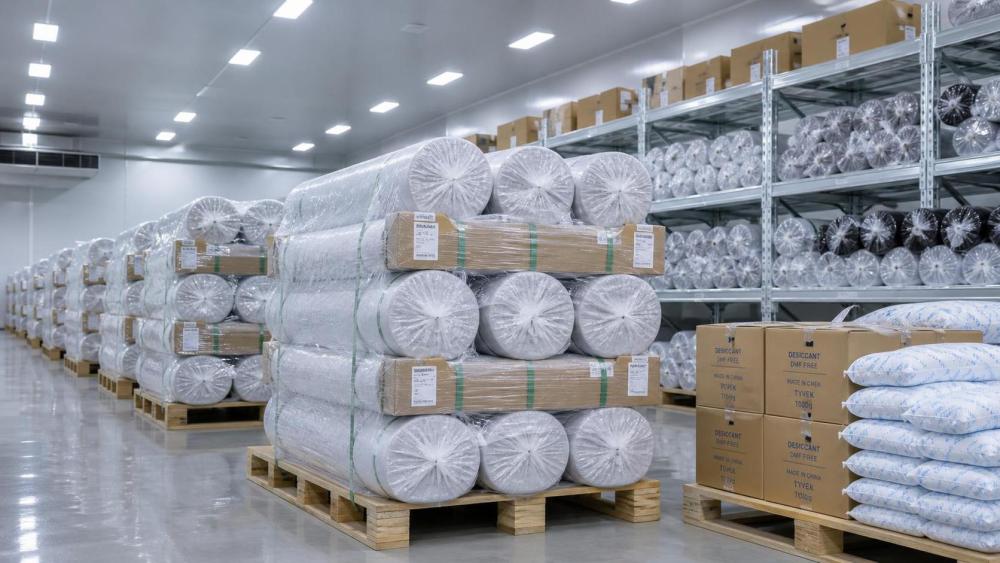
Storage conditions should follow the functional layer
The base fabric alone is not a reliable guide. A nylon fabric may be robust in conventional logistics, yet become sensitive after polyurethane coating, fluorine-free water-repellent finishing, membrane lamination, or conductive printing. The relevant question is which component has the narrowest acceptable storage range. That component generally determines the handling instructions for the complete textile.
For coated and laminated materials, heat, compression, and interlayer contact deserve close attention. If a coating remains in contact with itself for a long period under pressure, adjacent layers can block together. The risk rises when rolls are stacked too high, stored near heat sources, or loaded into containers that experience solar heating. Release paper, protective interleaf material, winding tension, roll diameter, and pallet design can all influence the outcome.
Conductive textiles need protection from excessive humidity, corrosive vapors, and repeated abrasion. Silver-coated yarns, copper-based elements, carbon coatings, and printed conductive tracks do not share the same storage behavior. Some may be affected by sulfur-containing atmospheres, salt-laden air, or direct contact with incompatible packaging materials. The shipping specification should identify whether a barrier bag, desiccant, antistatic liner, or sealed carton is appropriate.
Textiles treated for antimicrobial, odor-control, insect-resistance, or moisture-management performance should be shielded from conditions that might cause chemical migration, surface abrasion, or wash-off from condensation. Storage cannot guarantee the permanence of a finish, but it should avoid accelerating loss before the textile enters its intended conversion or use cycle.
Flame-resistant materials require particular care because the performance mechanism varies. Inherently flame-resistant fibers may primarily need protection from contamination and physical damage. Durable topical treatments may have additional sensitivity to moisture, alkaline contamination, harsh temperature exposure, or incompatible finishing contact. The correct storage conditions must be tied to the tested material construction rather than inferred from a general flame-resistant label.
Packaging is part of the preservation system
Export packaging should form a controlled barrier between the textile and its logistics environment. Its design needs to account for the shipment mode and storage duration. A fabric packed for a short enclosed truck movement may need a different configuration from goods crossing tropical sea lanes, waiting at a transshipment port, and then entering a colder inland warehouse.
For roll goods, a common protective arrangement may include an inner wrap, end protection, a moisture-resistant outer layer, and a rigid or reinforced shipping unit. The exact materials should be compatible with the textile surface. Packaging that sheds fibers, transfers plasticizer, traps excessive moisture, or reacts with metalized finishes can create a new problem while attempting to prevent another.
Desiccants can reduce moisture risk inside sealed packaging, but they are not a substitute for dry packing conditions. If textile rolls are wrapped while damp from ambient air, cleaning, or incomplete conditioning, desiccant capacity may be consumed quickly. The package must also be sufficiently sealed for a humidity-control approach to work. A loosely wrapped pallet covered by perforated film will not behave like a barrier-packed unit.
Container desiccants may be considered when sea transport presents a credible condensation risk. Their placement matters. They should not lie directly against cartons or textile rolls, where leakage or concentrated contact could damage packaging. Container linings, ventilation strategy, cargo spacing, and pallet elevation can also affect moisture behavior. There is no universal setup because a container's internal climate depends on route, loading moisture, temperature changes, cargo density, and transit interruptions.
Carton selection deserves more attention than it often receives. Weak cartons can collapse when exposed to humidity, transferring compression loads to the textile. For folded goods, distorted cartons may create permanent creases. For coated fabrics, prolonged force at carton edges can leave pressure marks. Strong outer packaging is useful only when internal support prevents the material from shifting and rubbing during handling.
Temperature and humidity limits need usable wording
Instructions such as “store in a cool, dry place” are too vague for materials with defined performance constraints. Storage requirements should state a target condition, an acceptable operating range where available, and the action needed when exposure occurs outside that range. The wording should distinguish between ordinary short-term variation and exposure that requires inspection, conditioning, or technical review.
A practical specification may address the following points:
- Whether storage must remain below a stated temperature because a film, adhesive, coating, or encapsulated additive could soften, deform, or react.
- Whether a minimum temperature is needed before unrolling or folding the material, particularly where cold stiffness could lead to cracking or delamination.
- Humidity expectations for the warehouse and for the interior of sealed packaging, with separate treatment for materials susceptible to mildew, corrosion, hydrolysis, or dimensional change.
- The maximum time a package may remain opened before resealing, when moisture-sensitive or contamination-sensitive components are present.
- Whether receiving stock needs conditioning at the destination before inspection, cutting, printing, lamination, or installation.
Any stated limits should come from the material supplier, coating system provider, laboratory validation, or established product specification. It is unsafe to assign generic limits simply because textiles appear similar. A durable outdoor coating and a soft-touch interior coating may have very different tolerances despite sharing the same base fabric.
Transit exposure can differ sharply from warehouse exposure
A controlled origin warehouse does not remove the risk created after dispatch. Textile cargo may sit on an apron, pass through unconditioned consolidation facilities, wait inside a sealed container, or remain at a destination port during weather changes. Storage planning should therefore treat transport as a sequence of exposure zones rather than a single shipment event.
Sea freight commonly raises concern about temperature cycling and condensation. Warm, moisture-bearing air can condense as surfaces cool, sometimes described as container rain. The effect is influenced by the textile's own moisture content, other cargo in the container, external climate, and the container's dwell time. Goods placed directly on the container floor or against sidewalls have greater exposure to local condensation and physical contact with metal surfaces.
Air freight can reduce voyage duration but may still involve cold cargo holds, rapid pressure and temperature changes, tarmac delays, or humidity exposure during transfers. Road and rail legs can introduce vibration, stacking pressure, and repeated loading events. A packaging design that survives ocean movement may be unnecessarily bulky for air shipment, while a lightweight airfreight pack may not protect a roll during extended sea transit.
Where temperature-sensitive functional textiles are involved, data loggers may be useful for resolving disputes or reviewing an uncertain exposure event. Their value depends on correct placement and documented handling. A logger attached near a container door may not represent the temperature within a central pallet. It should be positioned according to the risk being assessed: package interior, pallet center, container airspace, or another defined location.
Receiving inspection should look beyond visible damage
Export storage controls are incomplete without an arrival process. Outer packaging should be examined before opening for water staining, crushed corners, broken seals, mold odor, punctures, excessive dust, and signs of heat exposure. Findings should be recorded with package identification and photographs before materials are moved or repacked.
After opening, inspection may include roll-edge condition, winding tightness, surface tack, coating transfer, discoloration, corrosion of conductive elements, abnormal odor, dampness, and foreign particulate matter. Sampling should reflect the package configuration. Inspecting only an outer layer may miss damage at the roll core or at a carton-facing fold line.
Performance verification should match the claimed function and the suspected risk. A water-repellent textile may require a repellency-related evaluation after moisture exposure. A conductive construction may require continuity or resistance testing. A laminated material may need adhesion assessment after heat or cold exposure. Visual acceptance alone is not enough where the function cannot be seen.
When a shipment arrives outside its specified storage conditions, immediate use should not be assumed. The material may need a defined conditioning period, controlled drying, limited sampling, or technical review before release. Aggressive drying or heating can worsen certain coatings and films, so recovery measures should be documented in advance where possible.
Common storage assumptions that create avoidable risk
One frequent mistake is treating all synthetic textiles as moisture-proof. Polyester and polypropylene may resist water absorption, yet coating systems, adhesives, carton packaging, conductive layers, and contaminants can still be affected by humid storage. Another is assuming sealed plastic wrapping always provides better protection. If moisture is sealed in, the wrapping may preserve an undesirable internal environment.
Stacking rolls vertically without suitable support can deform edges or create uneven pressure. Storing rolls directly on concrete exposes them to floor moisture and dirt, even in a warehouse that appears dry. Placing pallets under strong sunlight near a loading bay can generate localized heat that is not represented by the building's general temperature reading.
Odor is also sometimes overlooked. Textiles intended for close-contact, interior, filtration, hygiene, or sensitive technical applications can absorb odors from adjacent cargo or warehouse chemicals. A clean, segregated area with controlled housekeeping may be necessary where odor transfer would affect acceptance or downstream processing.
Clear documentation prevents conflicting handling
Storage instructions should travel with the product in a format that warehouse, freight, and receiving records can use. The documents should identify the material, lot or batch reference, packaging configuration, orientation requirements, environmental limits, stacking restrictions, shelf-life information where applicable, and the action required after an excursion.
Labels need to remain readable after handling and exposure to humidity. Where cartons are opened for inspection or customs procedures, resealing instructions should be available so the original protection level can be restored as closely as practical. A package that leaves the origin correctly protected can lose that protection during a routine inspection if replacement materials are incompatible or the resealed unit is not identified.
Functional textiles do require special export storage when their active construction has environmental or handling sensitivities. The appropriate measures may be modest for stable materials, while more complex constructions can require tightly defined packaging, climate controls, and verification steps. The storage standard should be specific to the textile's functional components, its export route, and the conditions expected before the material reaches its next processing stage.
Recommended News
 Export UpdatesChina’s Textile and Apparel Exports Rise 5.1% to $232.97 Billion in January–September 2026China’s textile and apparel exports rose 5.1% to $232.97 billion in January–September 2026. Explore September’s surge and key considerations for bridal suppliers.Oct 22, 2026
 Home DecorCan wholesale woven storage basket suppliers mix styles in one order?Can a wholesale woven storage baskets supplier mix styles in one order? Explore MOQ rules, packing options, and cost considerations to build a smarter assortment before you buy.Interior Sourcing LeadOct 22, 2026
 Policy & RegulationsEU Apparel Exports Face PFHxA Limits and New PPWR Packaging RulesEU apparel exports face PFHxA limits and PPWR packaging rules. Explore key compliance checks to protect bridalwear shipments, manage unsold stock and reduce delivery risks.Oct 21, 2026
 Outdoor FurnitureIs a rattan wicker patio sofa suitable for an uncovered patio?Is a rattan wicker patio sofa right for your uncovered patio? Discover which materials, frames, and cushions withstand outdoor exposure—and what to check before you buy.Interior Sourcing LeadOct 21, 2026