Industry News
Curation by industry experts
Hot Articles
Popular Tags
Are Biodegradable Packaging Materials More Expensive Than Traditional Options?
Are biodegradable packaging materials more expensive than traditional ones? Usually, the unit price is higher, especially when compared with standard virgin plastic film, foam, or high-volume conventional packaging. But that is not the whole commercial answer. Material choice, order size, product protection needs, local disposal systems, regulatory exposure, and the cost of packaging failure can change the calculation substantially.
A compostable pouch that costs more per unit may still be the better purchasing decision if it helps meet a packaging requirement, avoids an expensive redesign later, or supports a credible sustainability claim. On the other hand, paying a premium for a material that cannot be composted in the markets where it is sold may add cost without delivering the intended environmental benefit.
The useful question is not simply, “Which option is cheaper?” It is: “What will this packaging cost us to buy, run, ship, comply with, and replace if it fails?”
Are Biodegradable Packaging Materials More Expensive Than Traditional Ones?
In many current sourcing situations, yes. Biodegradable packaging materials often cost more upfront than conventional plastic packaging, particularly for commodity formats produced at massive scale. Traditional polyethylene, polypropylene, polystyrene, and similar materials benefit from mature supply chains, established tooling, broad converter capacity, and highly standardized production.
Biodegradable alternatives may use materials such as PLA, PHA, cellulose-based films, bagasse, starch blends, coated paper, or molded fiber. Their pricing can be affected by smaller production runs, fewer qualified suppliers, tighter specifications, higher raw-material costs, and more demanding conversion processes.
That said, “biodegradable” is not a single material category. A molded-fiber tray and a certified compostable flexible film face very different cost structures. A simple uncoated paper sleeve may be price-competitive with some plastic alternatives, while a high-barrier compostable food pouch can be materially more expensive than a conventional multilayer laminate.
For a direct answer: biodegradable packaging is commonly more expensive at purchase, but the premium varies widely and may narrow when volume, design simplification, regulatory needs, and end-of-life requirements are considered.
The Price Difference Depends on What You Are Actually Comparing
A common sourcing mistake is comparing a biodegradable product against the cheapest possible conventional alternative. That may produce a dramatic price gap, but it rarely produces a useful decision.
A better comparison matches the packaging function. If a conventional pouch provides moisture protection, oxygen barrier performance, heat sealing, print quality, shelf-life support, and puncture resistance, the sustainable option needs to be evaluated against a conventional pouch with the same job requirements. Comparing it with a thin low-cost bag tells you very little.
Packaging should be compared across several practical dimensions:
Consider a takeaway container. A molded-fiber format can cost more than a foam equivalent, yet it may suit a retailer that has eliminated foam due to local rules or customer expectations. The relevant alternative is then not foam at all; it is another compliant, food-safe option that protects the meal during delivery.
Why Some Biodegradable Formats Carry a Higher Upfront Cost
Scale is the first reason. Conventional plastic packaging has been optimized for decades. Resin supply, extrusion lines, printing, sealing, recycling infrastructure, and distribution networks are built around it. A packaging converter can often buy standard materials quickly and operate familiar machinery at high speed.
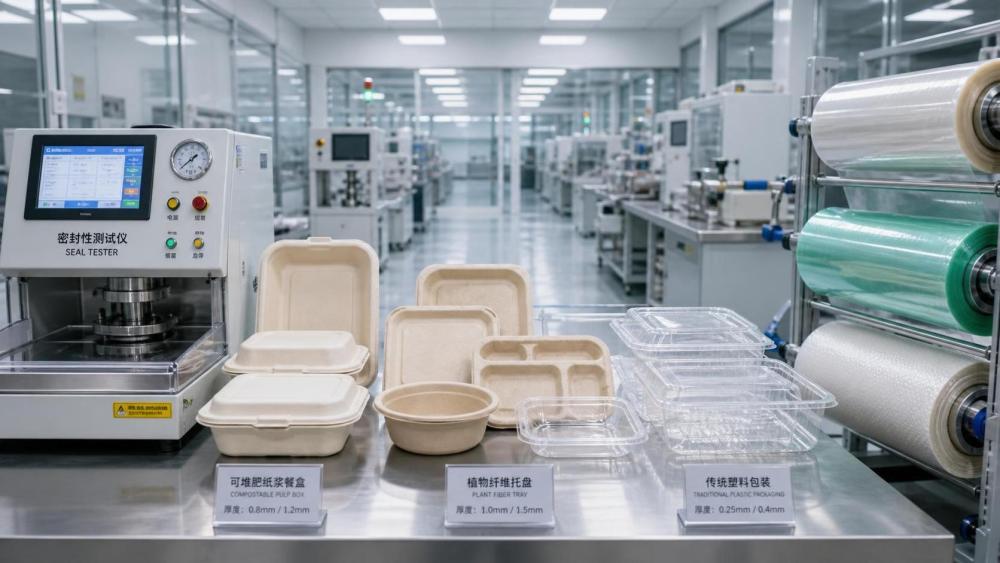
Biodegradable materials can be less forgiving. Certain compostable films have narrower heat-sealing windows. Some fiber products need more material to meet stacking-strength or grease-resistance requirements. Moisture sensitivity may influence storage conditions and shelf-life planning. These details do not automatically make the material unsuitable, but they do mean the quote reflects more than the raw substrate.
Certification is another factor. Terms such as “biodegradable,” “compostable,” and “home compostable” are not interchangeable. Where a buyer requires independently verified compostability standards or food-contact documentation, suppliers must provide relevant test records and maintain production controls. That work has value, and legitimate documentation should not be treated as a free add-on.
Printing can also change the economics. A package designed with heavy ink coverage, metallic effects, multiple finishes, or an unusually wide color range may be costly in any substrate. On compostable or fiber-based materials, artwork choices can further affect recyclability, compostability, adhesion, and appearance. Sustainable packaging sometimes becomes expensive because the design brief was never adjusted to suit the material.
When the Premium Can Be Worth Paying
The premium makes more sense when the packaging decision solves a real business problem rather than merely adding a green-looking feature.
One clear case is regulatory readiness. Packaging rules vary by country, state, municipality, and product category. A business selling across markets may need to review restrictions on certain plastics, producer-responsibility obligations, labeling requirements, and food-service packaging rules. Requirements change, so the applicable authority and current local guidance should be checked before finalizing a specification. A slightly more expensive material can be less costly than holding non-compliant stock or making an emergency packaging switch.
Another case is customer-facing disposal. In a venue, campus, workplace, or event with a controlled collection system, certified compostable food-service packaging may have a sensible end-of-life route. The material choice is supported by operations: bins are labeled, waste streams are managed, and the disposal partner accepts the material. In that setting, the claim and the system can align.
There is also a brand decision. Some products are closely associated with waste concerns, such as single-use food packaging, cosmetics samples, e-commerce void fill, and promotional merchandise. Better packaging can support customer trust when the claim is specific and substantiated. “Compostable where accepted” is more credible than vague language that suggests a package will disappear harmlessly anywhere.
Still, brand value should not be used to excuse poor functionality. A compostable mailer that tears during fulfillment or a fiber tray that fails in a humid distribution environment creates a worse customer experience and potentially more waste. Sustainable intent does not compensate for a package that cannot protect the product.
The Costs That Quotes Often Miss
Unit price is easy to see. Total packaging cost is harder, and it is where many decisions go wrong.
Start with product loss. For food, drinks, personal-care liquids, hardware with sharp edges, or fragile goods, inadequate packaging performance can quickly erase an apparent saving. Test seal integrity, compression strength, puncture resistance, transit behavior, and product compatibility before scaling. A short production trial is usually less expensive than a nationwide failure.
Then look at conversion and packing-line performance. If a new film runs slower, causes sealing defects, or requires frequent adjustments, the operational cost may matter more than a modest material premium. Suppliers should be asked whether their structure has been run on comparable equipment and whether they can provide recommended processing conditions. “Compatible” should mean more than the package physically fits through the machine.
Freight deserves attention as well. Lightweight flexible packaging can be efficient to transport, but it may need protective secondary packaging. Molded fiber may stack well, but its cube and weight can influence freight rates. The best option is often the one that reduces the total shipped package, not the one with the lowest per-piece purchase price.
Finally, include the cost of discarded inventory. If regulations, customer requirements, or internal ESG commitments are likely to change within the life of a packaging order, buying an oversized quantity of a cheap conventional format can be a false economy.
Do Not Treat “Biodegradable” as Proof of Sustainability
This is the most important caution. Biodegradable does not automatically mean compostable, recyclable, low-carbon, non-toxic, or suitable for every disposal system. It describes a general degradation concept, but the rate and conditions matter. Some materials need industrial composting conditions involving controlled heat, moisture, oxygen, and time. Those conditions are not available in every location.
Claims must match the actual package construction. A compostable base film combined with an incompatible adhesive, label, ink, zipper, or barrier layer may not perform as the claim suggests. A paper package with a plastic coating may not be accepted in paper recycling streams. The entire structure matters.
Ask suppliers for documentation that relates to the exact material and intended use, rather than accepting broad statements on a sales sheet. For food-contact packaging, confirm the relevant market requirements. For compostability claims, clarify whether the claim applies to industrial composting, home composting, or a specific collection system. For recycled-content or renewable-content claims, request a clear basis for the statement.
A practical rule: choose the disposal route first, then choose packaging designed for that route. Do not choose a claim first and hope the waste system will make it true.
How to Make Biodegradable Packaging More Affordable
There are several ways to reduce the premium without compromising the objective.
First, simplify the structure. Avoid adding windows, multiple materials, unnecessary coatings, oversized labels, and decorative finishes unless they are essential. A simpler format is usually easier to source, test, and communicate to the end user.
Second, consolidate demand. Fragmented purchasing across many sizes, colors, and seasonal variants tends to raise cost. Standardizing a few core formats can improve order volume and make supplier qualification easier. This is especially useful for businesses working across several markets or product lines.
Third, match material to use duration. It may make sense to pay for a specialty compostable material in a short-life food-service application with a defined composting route. It may make less sense for a durable item that requires long shelf life, high moisture resistance, or complex barrier protection. In those cases, recyclable mono-material packaging, recycled-content packaging, or a reduction in overall material use may be a better environmental and commercial choice.
Fourth, request total-cost quotations. Ask for prices by order volume, lead time, tooling requirement, freight basis, artwork setup, and expected production yield. A transparent quote makes it easier to identify whether the cost driver is material, printing, tooling, certification, or logistics.
Supply intelligence also matters. Sources such as Global Supply Review can help teams compare supplier capabilities, packaging technologies, and market developments across the broader packaging and printing supply chain. The point is not to chase every new material; it is to identify which suppliers can document performance consistently and support the required production scale.
Questions to Settle Before You Switch
Before approving a biodegradable packaging specification, get clear answers to a few basic questions:
- What must the pack protect against: moisture, grease, oxygen, impact, heat, abrasion, or tampering?
- What disposal route is realistically available where the package will be used?
- Does the sustainability claim apply to the complete package, including labels, inks, coatings, and closures?
- Can the current packing line process it at an acceptable speed and defect rate?
- What happens to cost at the expected annual volume rather than the initial sample quantity?
- Which market-specific rules or customer standards need verification before purchase?
These questions are not bureaucracy. They prevent a familiar failure: choosing a material because it sounds environmentally preferable, then discovering it is unsuitable for the product, the machinery, or the local waste stream.
Frequently Asked Questions
Is biodegradable packaging always more expensive than plastic?
No. Some simple paper-based or molded-fiber formats can be competitive, especially at suitable volumes. Specialty compostable films and high-performance barrier structures are more likely to cost more than standard plastic equivalents.
Is compostable packaging better than recyclable packaging?
Not automatically. The better option depends on the product, contamination risk, local collection infrastructure, and package construction. A recyclable format is only useful if it is likely to enter and be accepted by the relevant recycling stream; compostable packaging faces the same practical question.
Can biodegradable packaging be used for food?
It can, provided the specific material is appropriate for food contact, product conditions, and the intended market. Grease, heat, moisture, storage duration, and sealing needs should be tested against the actual product.
Will switching packaging reduce waste?
It may, but only if the new packaging protects the product properly and has a realistic end-of-life route. Preventing product damage and food waste is often as important as improving the package material itself.
Should a business switch its entire range at once?
Usually, a phased approach is more practical. Begin with a high-volume format or a product category where disposal, performance, and customer communication are clear. Use the result to refine specifications before expanding the change.
Are biodegradable packaging materials more expensive than traditional ones? They often are at the invoice level, but a thoughtful decision should include performance, freight, operations, compliance, and disposal reality. The strongest choice is not necessarily the cheapest material or the most ambitious claim. It is the packaging system that protects the product, fits the market, and can be supported with clear evidence.
Recommended News
 Export UpdatesChina’s Textile and Apparel Exports Rise 5.1% to $232.97 Billion in January–September 2026China’s textile and apparel exports rose 5.1% to $232.97 billion in January–September 2026. Explore September’s surge and key considerations for bridal suppliers.Oct 22, 2026
 Home DecorCan wholesale woven storage basket suppliers mix styles in one order?Can a wholesale woven storage baskets supplier mix styles in one order? Explore MOQ rules, packing options, and cost considerations to build a smarter assortment before you buy.Interior Sourcing LeadOct 22, 2026
 Policy & RegulationsEU Apparel Exports Face PFHxA Limits and New PPWR Packaging RulesEU apparel exports face PFHxA limits and PPWR packaging rules. Explore key compliance checks to protect bridalwear shipments, manage unsold stock and reduce delivery risks.Oct 21, 2026
 Outdoor FurnitureIs a rattan wicker patio sofa suitable for an uncovered patio?Is a rattan wicker patio sofa right for your uncovered patio? Discover which materials, frames, and cushions withstand outdoor exposure—and what to check before you buy.Interior Sourcing LeadOct 21, 2026