Industry News
Curation by industry experts
Hot Articles
Popular Tags
Does an IP65 LED lamp qualify for use in a wet location?
An IP65 LED lamp does not automatically qualify for use in a wet location. IP65 describes enclosure protection against dust and water jets; it does not, by itself, establish the wet-location suitability required by an electrical code or product certification scheme. For an exposed walkway, loading area, or washdown space, accepting “IP65” as the only compliance evidence can lead to rejected submittals, installation changes, or unsuitable equipment.
The selection depends on the complete lighting product, its documented approval, and the actual exposure. Where North American electrical codes apply, look for the relevant wet-location marking and recognized certification covering the exact model. In other markets, verify the applicable luminaire standards and local installation requirements rather than assuming the North American marking system applies everywhere.
IP65 answers an enclosure question, not the entire approval question
The IP classification defined in IEC 60529 describes protection provided by an enclosure. In IP65, the first digit, 6, means dust-tight protection. The second digit, 5, indicates protection against water jets under specified test conditions, with no harmful effects.
That is useful evidence for an enclosure exposed to rain or splashing. However, the test does not establish suitability for every wet environment, mounting arrangement, or electrical installation. It also does not mean that absolutely no water can enter under any circumstances.
Neither designation replaces the other. A wet-location luminaire may not advertise an IP rating, while an IP65 product may lack the certification needed for a particular project. Compare the documentation with the governing specification instead of treating the labels as interchangeable.
Decide whether the mounting point is damp or wet
A sheltered position is not necessarily a dry position. Under the National Electrical Code framework, damp locations generally include protected places subject to moderate moisture, while wet locations include places exposed to weather or saturation by water or other liquids. The adopted code and the authority having jurisdiction determine how those definitions apply to the installation.
A luminaire beneath a substantial canopy may be in a damp location when it is genuinely protected from rain. Move it toward the canopy edge, where wind-driven rain reaches the housing or connection box, and the assessment can change. A roof above the fixture is not enough evidence by itself.
For an IP65 LED lamp wet location assessment, document exposure at the fixture and its electrical connections:
- Exposed walkway: Consider wind-driven rain, runoff from adjacent surfaces, and water reaching the mounting plate.
- Washdown room: Establish whether cleaning involves ordinary splashing, directed hose jets, high pressure, hot water, or chemicals.
- Recessed outdoor fitting: Check whether drainage failure could leave the housing standing in water.
- Humid interior: Examine condensation and moisture accumulation, not just visible spray.
Do not resolve an uncertain classification by choosing a higher IP number alone. The exposure description should first establish the location category, then identify any additional performance requirements beyond ordinary wet-location use.
Check whether “lamp” means a replaceable bulb or a complete luminaire
Supplier descriptions often use “LED lamp” for both screw-base bulbs and complete lighting fixtures. That distinction matters because water can reach components outside the rated enclosure.
An IP65 replaceable lamp does not make an open lampholder, ceiling fitting, or junction box suitable for wet locations. The lamp’s rating may protect its own housing while leaving the socket and supply terminals exposed. The complete assembly must be appropriate for the environment, and the lamp must be permitted for use in that assembly.
With an integrated LED luminaire, confirm the rating covers the housing as supplied, including its driver compartment, covers, seals, and cable entries. An IP65 optical chamber is not evidence that a separate driver enclosure has equivalent protection. Remote drivers require their own environmental assessment.
For North American documentation, UL 1598 is a common standard for luminaires, UL 1993 addresses self-ballasted lamps and lamp adapters, and UL 8750 addresses LED equipment used in lighting products. Certification of an LED driver or module as a component is not the same as wet-location certification of the finished luminaire. The applicable standard depends on the product category.
The evidence to request before approving a submittal
A catalog line stating “IP65, outdoor” is a starting point, not a complete compliance file. Request documents that connect the claimed suitability to the model being purchased.
- Identify the exact configuration. Record the model number, voltage, mounting option, driver arrangement, and accessories. A related model’s approval may not cover the proposed version.
- Obtain the product marking. Request a legible label showing the model, certification mark, and wet-location designation where applicable. Compare it with the submitted data sheet.
- Verify the certification record. Check the certification body’s directory for the manufacturer, product category, model coverage, and relevant conditions. Do not rely solely on a logo in a brochure.
- Read the installation instructions. Confirm mounting orientation, permitted entries, gasket requirements, ambient limits, and any restrictions on exposure or accessories.
- Clarify the IP claim. Establish whether IP65 applies to the entire luminaire or only a compartment, and whether the tested configuration matches the proposed installation.
A test report supports a technical claim but is not automatically equivalent to a product listing or ongoing certification. Likewise, a CE marking alone is not a North American wet-location listing. For an IEC-based project, the relevant IEC 60598 luminaire requirements and national installation rules may be central to acceptance.
Where the project requires a listed product, resolve missing or conflicting evidence before releasing the purchase order. Obtain written clarification from the manufacturer and involve the electrical designer or authority having jurisdiction when acceptance remains uncertain.
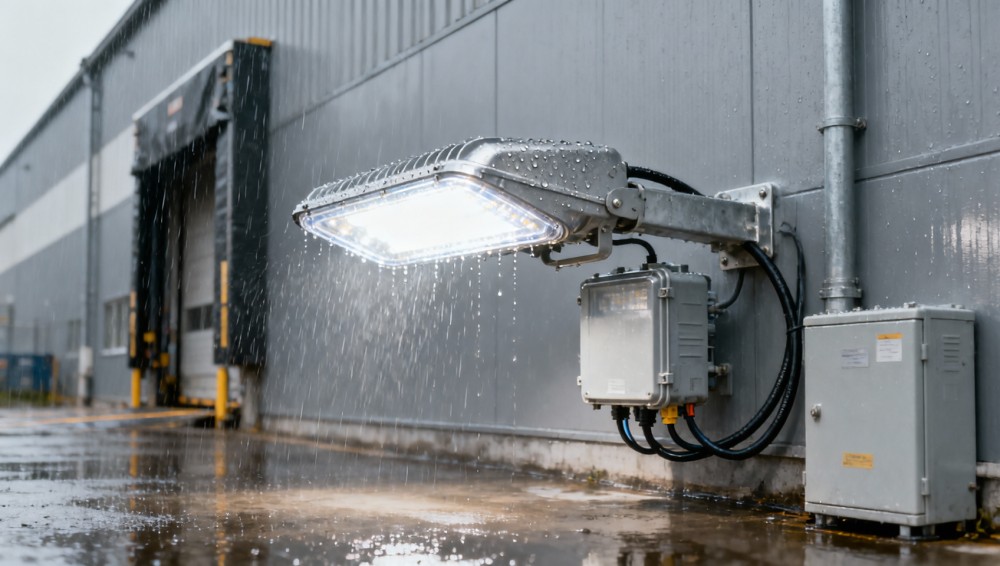
Where IP65 can fall short despite ordinary rain protection
Washdown is not one uniform exposure
An IP65 water-jet test should not be interpreted as permission for unrestricted pressure washing. Cleaning equipment may introduce pressure, temperature, nozzle distance, and spray duration outside the product’s evaluated conditions. Detergents and sanitizers can also attack seals, coatings, or plastics even when water alone would not cause a problem.
For a washdown area, give the supplier the cleaning method and chemical exposure. Request explicit suitability for those conditions. A higher ingress rating may be needed, but it still does not establish chemical resistance or compliance with every requirement of the facility.
Standing water requires a different assessment
IP65 does not cover immersion. Ground-mounted fixtures, pits, and poorly drained recesses can experience flooding rather than water jets. Where temporary or continuous immersion is foreseeable, specify equipment evaluated for that exposure and check the manufacturer’s depth, duration, and installation limits.
Do not assume a single “higher” IP designation covers all lower-numbered water exposures. Immersion and jet tests address different conditions; dual ratings may be relevant when both occur. Correcting drainage remains necessary even when the enclosure has immersion protection.
Salt, sunlight, and temperature affect service suitability
Wet-location approval and ingress protection do not, on their own, establish adequate corrosion resistance for a coastal site. Salt deposits, dissimilar metals, and damaged coatings can compromise fasteners or sealing surfaces. Outdoor installations also need suitable materials for ultraviolet exposure and operation within the declared temperature range.
Temperature cycling can create internal condensation. Ask how the product manages moisture and whether any vents, drains, or pressure-equalization features must remain unobstructed. Do not add drain holes or seal factory openings without manufacturer authorization.
Installation can invalidate an otherwise suitable selection
A certified wet-location luminaire can still be installed in a way that defeats its protection. Water often enters through a cable gland, unused knockout, mounting interface, or supply box rather than through the lens.
Use the specified glands with cables in the permitted diameter range. Close unused entries with appropriate plugs, maintain the required gasket compression, and follow tightening instructions. Field drilling, unapproved adapters, and substituted seals can change the evaluated configuration.
The supply-side enclosure needs separate attention. An IP65 fixture attached to an unsuitable junction box does not make the connection weather-resistant. Boxes, covers, wiring methods, and bonding or grounding arrangements must meet the requirements for the location.
Orientation is equally important. A fixture evaluated for wall mounting with downward-facing entries may not retain its protection when inverted. Sealing the housing with additional silicone is not a universal remedy; it can obstruct drainage, interfere with heat dissipation, or conceal an incorrectly fitted gasket.
Before energization, compare the installed assembly with the approved instructions. Record label identification, mounting position, cable-entry treatment, cover closure, and any visible gasket damage. Keep installation photographs with the handover documentation so maintenance staff can identify the accepted configuration.
Turn the findings into a procurement decision
Accept the proposed fixture when its wet-location suitability is documented under the applicable approval route, the exact configuration is covered, and the exposure falls within the manufacturer’s limits. IP65 then provides additional enclosure information rather than serving as the sole approval argument.
Hold the submittal when the only evidence is an IP65 catalog claim, the certification belongs to a different model, or the manufacturer supplies component approvals instead of documentation for the finished product. Treat these as unresolved compliance gaps, not minor paperwork omissions.
Revise the selection or installation design when the site involves immersion, aggressive washdown, corrosion, or a mounting arrangement outside the permitted conditions. Possible changes include relocating the fixture, improving drainage, protecting the connection enclosure, or selecting equipment evaluated for the actual exposure.
A useful purchase specification states the required location suitability, accepted certification route, exposure conditions, mounting configuration, and documentation to be delivered. This prevents “IP65” from becoming a substitute for a complete requirement—and gives the installation team a verifiable basis for accepting the lighting equipment.
Recommended News
 Eco PackagingHigher Fees Urged for Hard-to-Recycle Plastics Under California’s EPR PlanCalifornia’s EPR plan faces calls for higher fees on hard-to-recycle plastics. Explore potential packaging cost impacts and how to prepare while adoption remains unconfirmed.Packaging Supply ExpertOct 20, 2026
 Commercial LEDHow much should you pay per T8 LED tube when buying in bulk?Compare T8 LED tube price quotes for bulk orders and uncover hidden installation, freight, and warranty costs. Learn how to choose compliant tubes at the best total value.Commercial Tech EditorOct 20, 2026
 Outdoor FurnitureHow packaging affects freight costs for wholesale wicker egg chairsExplore wicker egg chair wholesale packaging strategies to cut freight costs, improve container loading, and protect profits. Compare packing options for lower landed costs.Interior Sourcing LeadOct 19, 2026
 Supply Chain InsightsHow to use supply chain resilience metrics to assess recovery riskUse supply chain resilience metrics to compare recovery time, survival buffers, and financial exposure. Learn how to assess disruption risk and prioritize mitigation that protects service.Oct 18, 2026