Industry News
Curation by industry experts
Hot Articles
Popular Tags
How to verify the actual fiber content of a bamboo blend fabric
To verify the actual fiber content of a bamboo blend fabric, you need to establish which fibers are present and measure their proportions using a method suited to that combination. A soft handle, a bamboo logo, or a supplier’s composition certificate cannot establish either point on its own.
There is also a separate question: whether the cellulose used to make a regenerated fiber came from bamboo. Routine fiber analysis can often identify viscose and quantify it against other fibers, but it generally cannot prove the original plant source. Keeping fiber identity, blend percentage, and feedstock origin separate makes the testing process more useful and prevents a laboratory result from supporting a broader claim than it actually demonstrates.
Turn “bamboo blend” into a testable specification
“Bamboo” can describe different materials. Mechanically processed bamboo fiber retains characteristics of a natural plant fiber. Viscose made from bamboo is regenerated cellulose: the plant material is processed into a spinning solution and formed into new fibers. Lyocell made using bamboo-derived cellulose is another regenerated fiber produced through a different process.
These distinctions matter because the laboratory must know what it is expected to identify. A specification reading “bamboo/cotton” leaves an essential question unanswered: does “bamboo” mean natural bamboo fiber, viscose, or lyocell?
Ask for the generic fiber names, declared mass percentages, and supporting explanation of any bamboo-origin claim. Keep the commercial description separate from the analytical specification. For example, an illustrative purchasing specification might identify viscose and cotton as the measured components, while recording bamboo-derived pulp as a separate sourcing requirement.
The specification should also define what is being measured. A fabric containing elastane, a backing, or a separate pile can produce different results depending on whether the laboratory tests the whole material or an individual component. Garment trims and sewing threads should not enter a fabric-composition sample unless the agreed test scope includes them.
Review documents for traceability, not just a matching percentage
A supplier report is useful only when it can be connected to the material being inspected. A composition result from an earlier development sample does not establish the content of a later production delivery.
Before commissioning testing, assemble a short evidence package:
- The purchase specification, including generic fiber names and declared proportions.
- Fabric identification, production lot, roll references, and relevant color or finishing details.
- Yarn specifications and upstream material declarations, where available.
- Previous laboratory reports showing sample identity, methods, and results.
- Traceability records supporting the bamboo feedstock claim.
Check whether the documents describe the same material and manufacturing stage. A yarn declaration may support the intended blend, but it does not account for subsequent substitutions, additional yarn systems, or changes during fabric production.
Likewise, environmental or chemical-management documentation should be read according to its scope. Evidence about restricted substances, manufacturing practices, or sourcing does not automatically establish fiber percentages. A document should answer the particular question it was designed to address.
Sample the delivery so the result represents the material
A precise laboratory measurement can still lead to a poor decision if the submitted swatch is unrepresentative. Sampling should reflect how the delivery could vary: between production lots, rolls, yarn batches, colors, or constructions.
Define the sampling plan before choosing convenient pieces. Select material across the relevant delivery units, record where each piece came from, and preserve those identities through submission. Avoid relying exclusively on supplier-prepared swatches when the purpose is to assess delivered goods.
Within a fabric, include the construction that matters. A woven fabric may use different fibers in warp and weft. A knit may combine a main yarn with an elastane-containing plated yarn. A pile fabric may have a different composition in its surface and ground. Taking a small piece from only one structural feature can distort the result.
Pooling samples is appropriate only when an average is the intended measurement and the sampling plan supports it. Combining pieces from several rolls can hide a nonconforming roll behind an acceptable average. Where roll-level conformity matters, keep samples separate.
Retain clearly labeled duplicate material for follow-up testing. Record sample location, orientation where relevant, lot identity, and whether the fabric was tested as received or after an agreed treatment. These details make disagreements easier to investigate.
Identify the fibers before measuring their percentages
Fiber identification establishes which quantitative method can be used. Starting with the supplier’s declared blend and applying a percentage test without checking identity can miss an undeclared component or produce a misleading calculation.
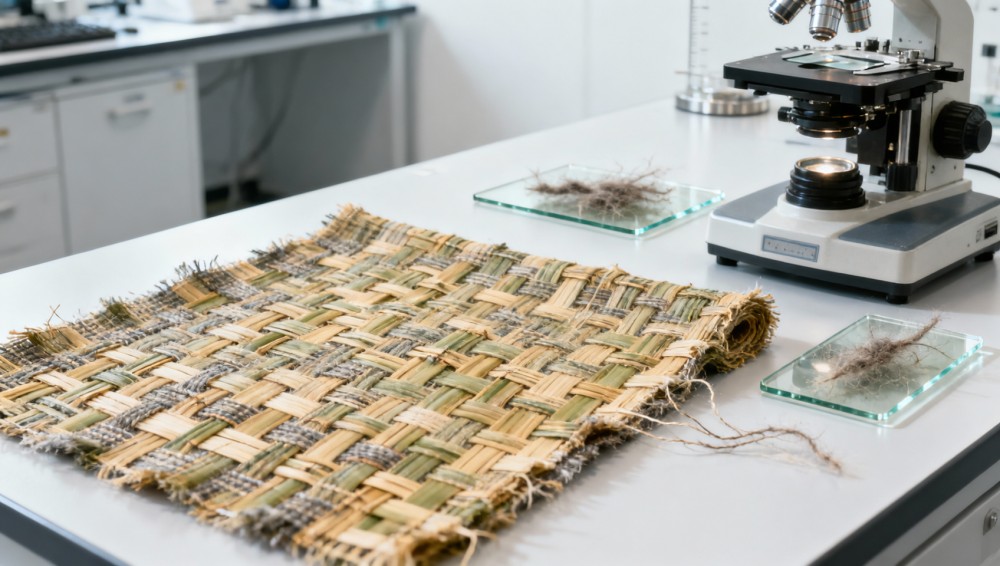
Microscopy is particularly useful when distinguishing cotton from regenerated cellulose because their structures differ. It can also support examination of a claimed natural bamboo fiber, although plant-fiber identification may require specialist interpretation. Finishing, damage, and heavy processing can reduce the visibility of diagnostic features.
Infrared spectroscopy helps answer a different question: what chemical material is present? It can support identification of polyester alongside cellulose, but similar spectra from cellulosic materials limit its ability to distinguish their botanical sources.
Burn tests are unsuitable for confirming a declared blend percentage. Several cellulosic fibers burn similarly, while dyes and finishes can change the observed behavior. Such screening should not become the basis for accepting a shipment or authorizing a composition label.
Choose quantitative analysis for the actual fiber combination
Many quantitative textile methods use selective dissolution. A reagent removes one component, the remaining material is recovered and weighed, and the proportions are calculated using the procedure’s specified corrections. Other constructions may permit mechanical separation before weighing or further analysis.
The method must match the identified fibers. A procedure suitable for cellulose and polyester cannot simply be transferred to a cotton–viscose mixture. Both cotton and viscose are cellulose, so separating them requires a method that exploits differences beyond their basic chemical identity.
Ask the laboratory to select an applicable standardized method, such as one from the relevant ISO or AATCC textile-analysis framework, and state its scope. The report should identify the procedure actually used rather than referring vaguely to “chemical analysis.” If the mixture falls outside a standard method’s scope, the laboratory should explain the validated approach and its limitations.
Finishes and additional fibers can change the calculation
Oils, sizing agents, coatings, and other non-fibrous material can affect measured mass. Appropriate pretreatment may be necessary, but it must follow the selected procedure: uncontrolled cleaning can remove material unevenly or damage a component.
Request the reporting basis, including how non-fibrous matter and moisture were handled. Results expressed on different mass bases are not automatically comparable. Correction factors also matter because a reagent may affect the supposedly retained fiber to some extent.
A three-component fabric needs a suitable analysis sequence. If elastane is present alongside viscose and polyester, treating the sample as a two-fiber blend can assign mass incorrectly. This is another reason to establish fiber identity before choosing the quantitative procedure.
Closely related regenerated fibers may need a narrower conclusion
Mixtures of regenerated cellulosic fibers can be harder to quantify than combinations of chemically distinct fibers. Viscose and lyocell, for example, share cellulose chemistry. The laboratory may need complementary identification techniques or a specialized method, and it may not be able to report each component independently with the required confidence.
A result expressed as total regenerated cellulose can still be useful, but it does not demonstrate an exact split between individual regenerated fiber types. The requested claim and the method’s resolving capability must align.
Verify bamboo origin through a separate evidence chain
Regeneration removes much of the original plant structure. Consequently, identifying viscose in a finished fabric does not usually reveal whether its cellulose came from bamboo, wood, or another source. A result consistent with viscose supports fiber identity; it does not establish botanical origin.
For a bamboo-derived feedstock claim, follow the material records upstream. Useful evidence connects the finished fabric to yarn production, regenerated-fiber production, and the relevant pulp supply. The records should show continuity between these stages rather than merely repeat the word “bamboo.”
Look for gaps where material could have been substituted or mixed. A pulp declaration disconnected from the yarn batch is weaker than records linking production and deliveries through the supply chain. If a certification scheme is presented, examine what its scope covers and how its traceability model relates to the claim on the finished fabric.
Specialist origin techniques should be assessed against the processed material and the specific claim. A technique capable of examining raw plant material may not work reliably after dissolution and regeneration. Do not commission an “origin test” without establishing what conclusion it can support.
Read the laboratory report before deciding conformity
A useful report should identify the submitted sample, fibers detected, quantitative method, composition results, reporting basis, and relevant limitations. Select a laboratory whose accredited scope covers the required textile analysis; general laboratory accreditation alone does not establish competence for every fiber mixture.
Compare results against an acceptance rule agreed before testing. That rule should distinguish the contractual composition requirement, any applicable labeling provisions, and the treatment of measurement uncertainty. There is no single tolerance that can be assumed for every blend, market, and circumstance.
A small difference from the declared percentage needs interpretation. Consider the method’s uncertainty, sample representation, and reporting basis before classifying it as substitution. Conversely, an unexpected fiber is a distinct finding that cannot be resolved merely by applying a percentage tolerance.
If results conflict with the declaration, hold the affected material while investigating sample identity, production records, and the analysis method. Retest retained or newly selected representative samples when that investigation identifies a reason to do so. Repeatedly testing convenient swatches until one passes does not resolve the discrepancy.
Keep composition approval separate from performance and safety claims
Verified fiber content supports composition decisions, but it does not establish chemical safety, antimicrobial performance, flammability behavior, or durability. Those questions require their own specifications and appropriate tests. Bamboo-derived viscose should not receive automatic approval for such claims because of its feedstock description.
Close the verification process with three clearly recorded decisions: whether the fiber identities match the specification, whether the measured proportions meet the agreed acceptance rule, and whether the bamboo-origin claim has adequate traceability support. If the laboratory confirms viscose but the sourcing records do not establish bamboo origin, the evidence supports viscose content alone. Product descriptions and release decisions should stay within that demonstrated scope.
Recommended News
 Outdoor FurnitureHow packaging affects freight costs for wholesale wicker egg chairsExplore wicker egg chair wholesale packaging strategies to cut freight costs, improve container loading, and protect profits. Compare packing options for lower landed costs.Interior Sourcing LeadOct 19, 2026
 Supply Chain InsightsHow to use supply chain resilience metrics to assess recovery riskUse supply chain resilience metrics to compare recovery time, survival buffers, and financial exposure. Learn how to assess disruption risk and prioritize mitigation that protects service.Oct 18, 2026
 Commercial LEDHow to assess an LED street light exporter’s warranty coverageAssess an led street lights exporter beyond warranty length. Learn how to verify coverage, uncover hidden costs, and negotiate stronger terms before you buy.Commercial Tech EditorOct 17, 2026
 Carton & PlasticsWhen should you heat seal aluminum foil zipper bags for food storage?When should you heat seal aluminum foil zipper bags? Learn when stronger closures matter, how to protect dry foods, and which sealing checks help ensure reliable storage.Packaging Supply ExpertOct 16, 2026