Industry News
Curation by industry experts
Hot Articles
Popular Tags
Which grades of threaded rod are suitable for structural loads?
Which grades of threaded rod are suitable for structural loads?
ASTM F1554 Grades 36, 55, and 105 are established choices for structural anchor rods. Other specifications, including ASTM A307 Grade A, ASTM A449, and ASTM A354, may be appropriate for particular threaded connections when the governing design rules and project specifications permit them. There is no single grade that is suitable for every structural load.
The distinction matters because “threaded rod” describes a product form, not an approved structural application. A rod supporting a suspended platform, one anchoring a steel column, and one used in an equipment restraint can face very different demands. Tensile strength is only part of the decision: thread dimensions, connection geometry, corrosion exposure, ductility, and material traceability all affect whether the finished assembly can be approved.
For technical evaluation, begin with the load path and governing standard—not with the strongest rod in a supplier’s catalog.
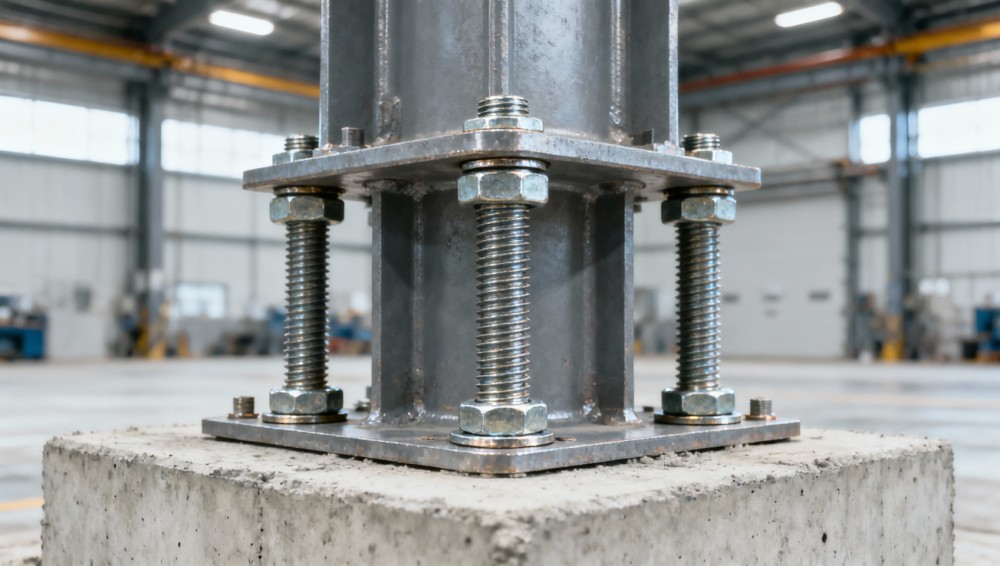
For concrete anchorage, start with ASTM F1554
ASTM F1554 covers steel anchor bolts intended to anchor structural supports to concrete. Its scope includes different anchor configurations, so a fully threaded rod can be supplied to this specification when it meets the applicable requirements. The three grades have distinct strength levels:
These are material properties, not allowable loads for an installed anchor. Verify the applicable standard edition, dimensional scope, and supplementary requirements before purchase. Design resistance still depends on the adopted code, safety factors, and the complete connection.
Grade 36 can be entirely adequate for a column base with modest anchor forces. Grade 55 offers greater steel strength without moving directly to Grade 105. Grade 105 becomes relevant where calculated steel demand warrants it, but its higher strength does not automatically solve limited embedment, small edge distances, or an undersized base plate.
Welding deserves a separate decision. Grade 55 is not automatically weldable simply because it is Grade 55; Supplement S1 provides additional weldability requirements. Grade 36 still requires an appropriate welding procedure, while welding Grade 105 should not be treated as a routine field modification. Tack-welding a nut to stop rotation can be enough to introduce an unreviewed metallurgical change.
Other grades can work, but their scope must match the connection
For threaded members outside a conventional anchor-rod detail, other ASTM specifications may be appropriate. The question is whether the specification covers the required product and whether the design method recognizes its properties—not whether the supplier describes it as “structural quality.”
ASTM A307 Grade A covers carbon-steel fasteners for general applications, with a minimum tensile strength of 60 ksi. It may be suitable for specified, lower-demand connections. However, it is not an automatic substitute for F1554 Grade 36: the latter establishes a defined yield-strength requirement and anchor-specific provisions. Similar tensile strength does not establish full equivalence.
ASTM A449 includes quenched-and-tempered steel bolts, studs, and other externally threaded fasteners. It can be relevant where higher-strength threaded components are needed, but its mechanical requirements depend on diameter. An evaluator should check the actual size rather than transfer a strength value from another catalog entry.
ASTM A354 Grades BC and BD cover quenched-and-tempered alloy-steel fasteners for applications requiring high tensile strength. They are potential options for engineered threaded assemblies, subject to connection design and fabrication requirements. Grade BD needs particular care when coatings and processing could introduce hydrogen embrittlement.
ASTM A193 Grade B7 is widely available as alloy-steel threaded rod, but its specification is associated with high-temperature or high-pressure bolting and other special-purpose applications. Availability does not make it a default structural grade. Approval requires confirmation that its properties, companion hardware, and intended use satisfy the project.
Likewise, ISO property classes such as 8.8 and 10.9 are not direct replacements for ASTM grades. A cross-border substitution needs a documented comparison of product scope, mechanical properties, threads, testing, and design acceptance.
A stronger rod may leave the governing failure unchanged
Consider a steel column base close to a concrete edge. Increasing the rod strength may improve resistance to steel rupture, yet do little for concrete breakout. In some layouts, increasing the theoretical steel capacity simply makes the concrete failure more clearly controlling.
For concrete anchorage, the design may need to assess steel failure, concrete breakout, pullout, side-face blowout, pryout, and combined tension and shear. In US projects, the adopted edition of ACI 318 Chapter 17 is commonly relevant. Steel connection checks may also involve AISC 360. The applicable rules depend on the jurisdiction and structural system.
Post-installed adhesive anchors add another restriction: the rod must meet the requirements of the evaluated anchoring system. A rod with equivalent or greater tensile strength is not necessarily an approved component if its material, diameter, coating, or installation conditions fall outside the system’s documentation.
Seismic or cyclic loading also changes the evaluation. Where ductile behavior is required, material qualification and the intended yielding mechanism matter. Do not assume that maximizing tensile strength improves that behavior. For a long exposed rod carrying compression, buckling may control well before material strength becomes decisive.
Use the thread area, not the nominal bar area
A threaded section does not have the same effective tensile area as a smooth bar of the same nominal diameter. Tensile calculations should use the appropriate tensile stress area for the specified thread. Shear checks likewise need the area and assumptions required by the governing design method, including whether threads lie in the shear plane.
Specify diameter, pitch, thread series, and fit. Then check nut strength, engagement, washers, bearing surfaces, and couplers. A high-strength rod paired with unsuitable nuts can fail by thread stripping before reaching its expected tensile capacity. An elevated leveling-nut arrangement can also introduce bending that a simple axial-load calculation misses.
Corrosion protection belongs in the grade decision
An outdoor equipment foundation, an interior dry-space support, and a coastal installation should not share a coating decision by default. Corrosion can reduce the effective section and damage threads, especially around exposed ends, crevices, and water-trapping details.
Hot-dip galvanizing is used on many anchor assemblies, but it affects thread fit and requires compatible nuts and processing. Electroplated finishes on high-strength steel deserve scrutiny for hydrogen-embrittlement risk. Specify the applicable coating requirements and confirm compatibility with the chosen material; “zinc plated” is not enough information for approval.
Stainless steel can be appropriate, but “304” or “316” alone does not establish structural capacity. Require a fastener specification with defined mechanical properties. Where ASTM A193 B8 or B8M is considered, the class matters because mechanical requirements differ. Exposure chemistry, galling, and contact with dissimilar metals also need review.
What evidence should be required before approval?
A certificate is useful only when it can be tied to the delivered material. For cut lengths supplied through distributors, that link can disappear between the original manufacturing lot, warehouse stock, and final shipment. A generic certificate stating “meets ASTM” does not resolve that problem.
For structural threaded rod, the submittal should establish:
- Specification identity: standard, grade, applicable edition, and ordered supplements.
- Material traceability: heat or lot identification connected to packaging, delivery records, and required product markings.
- Test evidence: relevant chemistry and mechanical results, including yield, tensile strength, and ductility where required.
- Finished dimensions: rod diameter, thread details, length, and configuration matching the drawing.
- Processing records: applicable heat treatment, coating certification, and any required embrittlement-control documentation.
- Assembly compatibility: specified nuts, washers, and couplers, with supporting documentation where needed.
Depending on the manufacturing route, raw steel chemistry alone may not demonstrate finished-fastener compliance. Required testing must represent the supplied product and relevant processing. Independent verification can be specified where risk warrants it, but it cannot recreate a missing traceability chain.
This is where the sourcing perspective used by Global Supply Review (GSR) becomes practical: a technically suitable grade is only useful if the supply chain preserves its identity through manufacture, coating, cutting, and delivery. Commercial availability and engineering acceptance are separate checks.
Approve the assembly, not just the grade label
For structural concrete anchors, evaluate F1554 Grades 36, 55, and 105 against the calculated demand and connection behavior. For other threaded load paths, select a specification explicitly suited to the product and accepted by the design basis. Generic commercial rod should remain unapproved until its properties and traceability are established.
If a supplier proposes a “stronger equivalent,” request a written comparison covering yield strength, tensile range, ductility, dimensions, coating, and companion hardware. Have the substitution reviewed by the responsible engineer. The suitable grade is the one supported by the complete connection design and verifiable delivery records—not the one with the highest number on the quotation.
Recommended News
 Supply Chain InsightsHow to use supply chain resilience metrics to assess recovery riskUse supply chain resilience metrics to compare recovery time, survival buffers, and financial exposure. Learn how to assess disruption risk and prioritize mitigation that protects service.Oct 18, 2026
 Commercial LEDHow to assess an LED street light exporter’s warranty coverageAssess an led street lights exporter beyond warranty length. Learn how to verify coverage, uncover hidden costs, and negotiate stronger terms before you buy.Commercial Tech EditorOct 17, 2026
 Carton & PlasticsWhen should you heat seal aluminum foil zipper bags for food storage?When should you heat seal aluminum foil zipper bags? Learn when stronger closures matter, how to protect dry foods, and which sealing checks help ensure reliable storage.Packaging Supply ExpertOct 16, 2026
 Supply Chain InsightsHow to find a custom-printed ring-pull can supplier for small ordersFind a custom printed ring pull cans supplier for small orders. Compare MOQs, printing options, samples, and delivered costs to launch confidently without excess inventory.Oct 15, 2026