Industry News
Curation by industry experts
Hot Articles
Popular Tags
How to estimate payback on an LED lighting retrofit for warehouses
A warehouse lighting proposal can show an attractive payback while leaving out lift rental, installation disruption, or the hours when lights actually run. Those omissions matter when the project competes with other capital requests: overstated savings can make an otherwise reasonable investment look stronger than it is. Estimate simple payback by dividing the net installed cost by annual net operating savings, using verified baseline consumption and a replacement design that maintains the required lighting performance.
For an LED lighting retrofit for warehouses, the calculation should include energy savings, avoidable maintenance costs, incremental operating expenses, and confirmed incentives. Keep uncertain benefits separate. A defensible approval package shows the calculation, the evidence behind each input, and how the recovery period changes when operating hours, electricity costs, or controls performance fall below expectations.
Set up the calculation before reviewing fixture prices
Simple payback in years = net installed project cost ÷ annual net operating savings.
Net installed project cost is the complete one-time investment less confirmed incentives. Annual net operating savings are the recurring expenses avoided by the retrofit, minus any new recurring costs. Both sides need the same project boundary: a proposal covering high-bay lighting should not claim savings from office or exterior fixtures unless those fixtures are also included.
Use a consistent currency and tax treatment throughout. Recoverable taxes generally should not be treated as permanent project costs. Where incentives arrive after installation, show their payment timing in the cash-flow schedule rather than implying they reduce the initial funding requirement.
Build a baseline that reflects warehouse operations
The baseline determines how much electricity the project can actually save. Start with a fixture inventory grouped by lighting zone, fixture type, input power, and operating schedule. Receiving docks, picking aisles, bulk storage, packing areas, and cold rooms may have different usage patterns; one building-wide assumption can hide those differences.
Record total fixture input wattage, including ballast or driver losses where applicable. A lamp’s nominal wattage is not necessarily the power drawn by the complete existing fixture. Use reliable equipment documentation or appropriate measurement when the installed configuration is unclear.
For each zone:
Annual baseline energy, kWh = fixture quantity × input watts ÷ 1,000 × annual energized hours.
Annual energized hours should come from schedules, switching records, building-management data, or temporary logging where practical. Staffed hours are not automatically lighting hours: lights may remain on during cleaning, security rounds, or unoccupied periods. Conversely, shutdowns and seasonal operations can reduce runtime below a vendor’s assumption.
Count existing occupancy sensors, daylight controls, and manual switching behavior. Their savings already belong in the baseline. Claiming the full benefit of new controls against an assumed always-on baseline would overstate the improvement where controls already operate effectively.
Utility bills provide a useful reasonableness check, but total warehouse electricity also includes equipment such as conveyors, chargers, refrigeration, and ventilation. Do not attribute a change in the whole-building bill entirely to lighting without separating these loads or accounting for operational changes.
Calculate replacement consumption without compromising the task
A lower-wattage proposal is only comparable if it delivers suitable illumination for the work. Check the lighting layout against mounting height, rack geometry, aisle arrangement, task requirements, glare, and emergency-lighting provisions. Poor distribution can force additional fixtures or higher output after installation, changing both capital cost and savings.
Require a lighting design and a fixture schedule with actual proposed input power. Fixture count may change during a retrofit, so compare total system consumption rather than assuming a one-for-one replacement. Include drivers, control devices, and standby consumption where material.
Without new controls, proposed annual energy uses the same zone-level calculation as the baseline. With dimming or occupancy control, divide operating time into identifiable states:
Proposed annual energy, kWh = sum of each operating state’s fixture quantity × input watts at that state ÷ 1,000 × hours in that state.
For example, a zone might operate at full output during picking, reduced output during low activity, and a standby level when vacant. These are calculation categories, not assumed savings results. Obtain power at dimmed settings from suitable technical information; a percentage light-output setting does not necessarily produce an identical percentage reduction in electrical input.
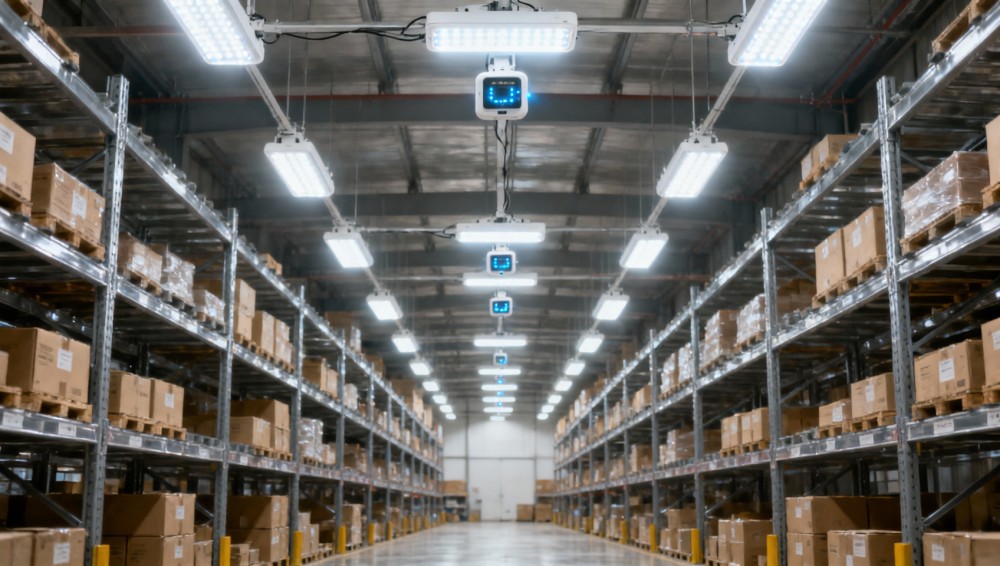
Control assumptions need particular scrutiny in warehouse aisles. Frequent forklift movements, sensor coverage across rack bays, timeout settings, and safety requirements can keep lights at higher output than anticipated. Daylight savings also depend on usable daylight reaching the relevant zone, not simply on the presence of rooflights.
Evaluate controls as a separate investment where possible. Compare their additional installed cost with their additional annual net savings over an LED-only option. This prevents strong fixture-replacement economics from concealing weak control economics.
Convert energy reductions into avoidable electricity costs
Annual energy-cost savings = baseline annual electricity cost − proposed annual electricity cost.
For a straightforward tariff, multiply the reduction in kWh by the applicable avoidable energy rate. Avoid automatically using total bill cost divided by total kWh: that average may include fixed charges that remain after the retrofit.
Time-of-use tariffs require savings to be allocated to the relevant rate periods. Lighting reductions during higher-priced operating hours may be worth more than equivalent reductions overnight. Use the warehouse’s actual schedule and tariff structure rather than a generic electricity price.
Demand charges need a separate calculation. Lower connected lighting power does not automatically translate into an equal reduction in billed peak demand. The lights must be operating during the relevant peak, and tariff provisions such as demand ratchets can limit the near-term benefit. Claim demand savings only where interval data and billing rules support them.
Heating and cooling interactions may also affect operating costs. Reduced lighting heat can lower cooling demand but increase heating requirements. Keep these effects outside the core estimate unless the building conditions and analysis support a credible calculation. Do not apply an unsupported cooling bonus to every warehouse.
Separate maintenance savings from reliability claims
Warehouse maintenance can involve more than purchasing replacement lamps. Access equipment, technician time, escort requirements, and working around active inventory can be substantial cost drivers. Use maintenance records to estimate avoidable spending rather than multiplying fixture count by an assumed annual replacement cost.
- Materials: lamps, ballasts, drivers, and other components that would otherwise need replacement.
- Labor and access: contracted labor, lift hire, and internal work that creates a genuinely avoidable expense.
- Remaining LED maintenance: expected failures, cleaning, control troubleshooting, and access costs that continue after installation.
Internal labor time saved is not always a cash saving. If staffing costs remain unchanged, show released maintenance capacity separately unless there is a documented reduction in overtime, contractor use, or another expense. The same distinction applies to reduced disruption: operational value can support a decision without belonging in the cash-payback denominator.
Do not treat rated LED life as a maintenance-free guarantee. Driver failures, environmental conditions, and warranty exclusions affect ownership cost. Check whether warranty coverage includes labor and access, not just replacement hardware. Where maintenance spending is irregular, use a multiyear schedule instead of assuming identical savings every year.
Capture the full installation commitment
Fixture prices alone rarely describe the amount requiring approval. Request a quotation that distinguishes equipment, labor, controls, access, electrical modifications, disposal, and commissioning. Confirm who pays for removal of old equipment and any applicable waste-handling requirements.
Warehouse access is a cost variable, not an administrative detail. Restricted aisle availability, rack obstructions, phased installation, and work outside operating hours may affect labor and equipment costs. Document shutdown windows and any necessary inventory movements before accepting a fixed installation allowance.
Include justified internal costs and an appropriate allowance for unresolved scope. Avoid counting the same risk in both the contractor’s price and the project contingency. Optional work should be visible as an alternative rather than silently included or excluded.
Incentives require their own approval trail. Check equipment eligibility, preapproval rules, deadlines, inspection requirements, and who receives the payment. An estimated rebate should not be treated as confirmed funding. When eligibility or payment remains uncertain, show payback both with and without it.
Test the estimate against the approval threshold
Build at least a supported base case and a downside case. The base case should use the most defensible inputs, not the most attractive ones. The downside case should reflect plausible operating changes, installation uncertainty, and weaker controls performance.
For an internal maximum payback period, reverse the formula:
Minimum required annual net savings = net installed cost ÷ maximum acceptable payback years.
This gives reviewers a practical threshold. Compare required savings with the verified energy and maintenance estimate, then identify which assumptions could push the project below that threshold. Do not combine unrelated worst cases indiscriminately; distinguish a plausible downside scenario from an extreme stress test.
Simple payback ignores the time value of money and savings after the recovery date. For a substantial investment, add discounted cash flow or net present value using the organization’s approved discount rate and evaluation period. Include replacement costs and recurring fees. Keep loan repayments and financing costs separate from the underlying project payback, then assess funding affordability alongside it.
Make savings verification part of the purchase
Before placing the order, agree on the installed fixture schedule, control settings, commissioning records, and measurement approach. Preserve baseline measurements and operating schedules so the comparison does not depend on reconstructing conditions later.
Post-installation verification should check input power, energized hours, sensor behavior, and lighting performance in representative zones. Changes in shifts or warehouse use must be accounted for when comparing consumption. Assign responsibility for correcting control settings and resolving performance gaps within a defined acceptance process.
The approval submission should therefore contain more than a single payback number: an itemized capital requirement, traceable savings calculations, incentive status, sensitivity results, and a verification plan. When the downside case misses the approval threshold, the next step is specific—resolve uncertain runtime, firm up installation scope, validate controls, or revise the investment—not simply accept a more optimistic projection.
Recommended News
 Commercial LEDHow to assess an LED street light exporter’s warranty coverageAssess an led street lights exporter beyond warranty length. Learn how to verify coverage, uncover hidden costs, and negotiate stronger terms before you buy.Commercial Tech EditorOct 17, 2026
 Carton & PlasticsWhen should you heat seal aluminum foil zipper bags for food storage?When should you heat seal aluminum foil zipper bags? Learn when stronger closures matter, how to protect dry foods, and which sealing checks help ensure reliable storage.Packaging Supply ExpertOct 16, 2026
 Supply Chain InsightsHow to find a custom-printed ring-pull can supplier for small ordersFind a custom printed ring pull cans supplier for small orders. Compare MOQs, printing options, samples, and delivered costs to launch confidently without excess inventory.Oct 15, 2026
 Fabrics & YarnsWhich Sustainable Fabrics Are Most Accepted by EU Apparel Brands?Which sustainable fabrics are most accepted by EU apparel brands? Explore top materials, certification requirements, and sourcing tips to build a buyer-ready fabric shortlist.Textile Industry AnalystOct 14, 2026