Industry News
Curation by industry experts
Hot Articles
Popular Tags
How to evaluate a canopy lights factory before placing a bulk order
Price Is Only the Starting Point
A bulk canopy-lighting order can look straightforward on a quotation sheet: wattage, quantity, unit price, delivery term. In practice, the difficult part begins after the quote is accepted. Canopy fixtures are commonly installed at fuel stations, loading bays, drive-through lanes, parking structures, transit shelters, and building entrances—locations where poor lighting is noticed immediately and access for replacement can be expensive.
That is why evaluating a canopy lights factory should go beyond comparing catalog specifications. A lower initial price may be reasonable if the factory has disciplined component control, a stable production schedule, and transparent test records. It becomes risky when the price is achieved by changing drivers, LEDs, housing material, sealing methods, or inspection standards without making those changes visible to the buyer.
For procurement teams, the useful question is not simply, “Can this supplier make canopy lights?” It is, “Can this supplier repeatedly deliver the exact approved configuration, in the required quantity, with documents and support that remain usable after shipment?” That distinction separates a workable vendor from a dependable manufacturing partner.
Define the Application Before Comparing Factories
A canopy light used beneath a petrol station canopy does not face the same conditions as one fitted in a covered warehouse dock. The first may be exposed to vehicle exhaust, humidity, wind-driven rain at the canopy edge, and a demand for even illumination that supports safe payment and fueling activity. The second may need to withstand dust, vibration, long operating hours, or frequent switching through sensors and controls.
Send factories a project brief that is more useful than “LED canopy light, 100 W.” It should identify the mounting method, input voltage and frequency, expected operating environment, desired light distribution, dimming or sensor requirements, housing color if relevant, target color temperature, and any local approval requirement. If the project involves a retrofit, include photographs and dimensions of the existing cutout or junction arrangement. A fixture that performs well in a laboratory may still be awkward to install if its mounting plate, conduit access, or wiring layout does not match the site.
This early discipline also exposes whether a canopy lights factory is engaging with the real application. A capable technical team will ask about installation height, spacing, glare concerns, ambient temperature, surge exposure, and the control system. A supplier that immediately offers a universal model without clarifying these basics may be selling from stock rather than engineering for the job.
Read the Specification Sheet Like a Risk Document
Catalogues often contain attractive claims, but a buyer needs to know what is actually being supplied. Request a controlled product specification for the quoted model, preferably tied to a revision date or drawing number. It should state the key electrical, optical, mechanical, and environmental characteristics rather than relying on broad marketing language.
Pay particular attention to the LED package, driver brand or approved driver alternatives, heat-sink construction, lens or diffuser material, gasket arrangement, cable and connector details, and surface treatment. These are not minor details. Driver selection affects field reliability and dimming compatibility; thermal design influences light output retention; the enclosure and seals determine whether moisture reaches internal components over time.
Where photometric performance matters, ask for the relevant lighting data file and confirm that it belongs to the exact fixture configuration under review. A light distribution generated for one optic cannot be assumed to represent another. Similarly, do not treat nominal wattage as a direct proxy for delivered illumination. Fixture efficacy, optical losses, mounting height, and beam pattern all affect the result on the ground.
Treat Compliance Documents as Product-Specific Evidence
Certification is often discussed too loosely in lighting sourcing. A factory may possess test reports, quality-system certificates, or declarations relevant to parts of its product range. That does not automatically mean the precise canopy fixture, driver combination, voltage version, and market destination are covered.
Ask for documents that can be matched to the offered model and the intended country or region. Check model numbers, report dates, issuing organization, electrical ratings, and any conditions or exclusions. If a local authority, project consultant, or insurer has a specific requirement, send it to the supplier before the purchase order is finalized—not after containers are booked.
There is also a commercial reason to do this carefully. If goods are held because documentation is incomplete or inconsistent, the cost is rarely limited to paperwork. Delayed opening dates, emergency replacement sourcing, storage charges, and installation rescheduling can quickly outweigh a modest saving on fixture price.
A serious factory should be able to explain what it can support directly and what requires third-party testing, product adaptation, or extra lead time. A vague promise that “all certificates are available” is not enough for a bulk project.
Look Beyond Factory Size: Examine Process Control
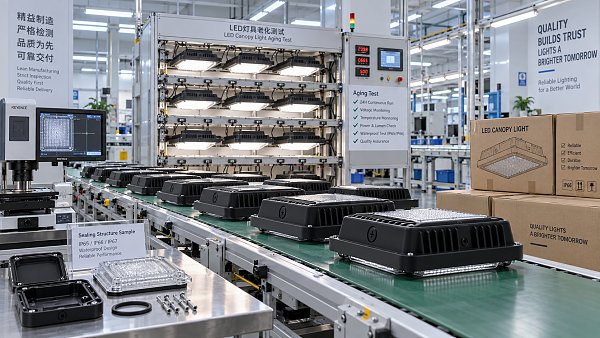
Factory visits are valuable, but floor area and a row of assembly lines do not prove consistency. When an in-person audit is impractical, a structured video review can still reveal a great deal. Ask to see incoming-material storage, driver and LED identification, assembly stations, aging or burn-in procedures where applicable, electrical testing, packaging inspection, and finished-goods labeling.
The most revealing question is often about traceability. If a shipment develops a recurring fault months later, can the manufacturer identify the production batch, driver lot, LED lot, and test record? A factory does not need an elaborate digital system to answer this well, but it should have a credible method. Labels that only show a generic model name provide limited help once product has been installed across multiple sites.
Ask how nonconforming units are handled. Are failed fixtures segregated? Can reworked goods be identified? Who signs off on final inspection? These details may sound operational, but bulk orders magnify small weaknesses. A defect rate that is manageable in a sample order becomes a costly field-service issue when fixtures are installed above forecourts or in hard-to-reach canopy cavities.
Samples Are for Verification, Not Just Appearance
A pre-production sample should be inspected against the approved specification, not merely switched on in an office. Check housing finish, mounting hardware, terminals, seals, cable length, labeling, dimensions, and packaging. Where possible, arrange a practical installation trial. Installers tend to find issues that procurement documents miss: a bracket that blocks access to a fastener, a short lead wire, a connector that does not fit the site wiring method, or a fixture profile that conflicts with an existing ceiling recess.
Keep one signed-off reference sample or create a detailed approval record with photographs and revision-controlled documents. Without that baseline, disputes over “same as sample” become unnecessarily subjective.
Test Capacity Against Your Delivery Reality
Production capacity is not just the number stated in an email. It depends on component availability, order mix, seasonal demand, current bookings, customization, packaging requirements, and the factory’s ability to run final testing without creating a bottleneck. A supplier may have enough assembly capability but still be constrained by a particular driver, optic, die-cast housing, or external finishing process.
For phased rollouts, ask whether the factory can maintain the same approved bill of materials across deliveries. If the project will extend over several months, establish a written notification procedure for component changes and confirm how long key parts can reasonably be supported. The least expensive first shipment is not necessarily the lowest-cost solution if later batches differ in color appearance, control behavior, mounting dimensions, or service parts.
The purchase order should also define practical milestones: sample approval, material readiness if relevant, production completion, inspection window, shipment release, and document handover. Treat lead time as a schedule with dependencies, not a single promise.
Calculate Landed Risk, Not Only Unit Cost
When comparing quotations, normalize them before deciding. Confirm whether prices include the same fixture configuration, driver, surge protection, mounting accessories, controls, packaging level, spare units, test reports, and delivery term. A quote can appear cheaper simply because an accessory or protection feature has been omitted.
It is worth asking what happens after a failure is reported. A warranty statement without a claims process has limited value. Clarify the evidence required, response time expectations, availability of replacement drivers or complete units, responsibility for freight, and whether technical troubleshooting can be provided remotely. In canopy installations, the labor and access equipment required to replace one failed fixture may cost more than the fixture itself. That changes the economics of a low-price offer.
Payment terms should align with verification points. Many buyers use an approved sample, pre-shipment inspection, or agreed document package as practical controls. The right arrangement depends on the supplier relationship and project risk, but releasing all leverage before the product is verifiable leaves little room to resolve deviations.
Use Questions That Reveal How the Factory Operates
The quality of a supplier’s answers matters as much as the answers themselves. Clear explanations, consistent documents, and a willingness to identify limits are usually better signs than broad assurances. During evaluation, request direct responses to questions such as:
- What are the approved LED, driver, lens, and housing options for this exact model?
- Which tests are performed on every unit, and which are conducted by batch or sampling plan?
- How are specification changes documented and approved before production?
- Can the factory provide batch identification on cartons and fixtures?
- What technical information is available to installers and maintenance teams after delivery?
- Which aspects of the order depend on outside suppliers or subcontracted processes?
These questions are not designed to trap a manufacturer. They create the shared operating record needed to manage a large order. In cross-border sourcing, assumptions travel badly; written clarity travels much better.
Make the Final Choice on Repeatability
The best canopy lights factory is rarely determined by a single feature. A factory with strong engineering but weak documentation can create approval problems. One with attractive pricing but unclear component control can turn a routine procurement exercise into a maintenance burden. Another may be technically sound but unable to support the delivery sequence required by a multi-site rollout.
A sound decision weighs product fit, compliance evidence, manufacturing discipline, commercial transparency, and serviceability together. This is the same sourcing logic applied across the lighting and displays supply chain: the goal is not to eliminate every risk, but to identify which risks are real, assign responsibility for them, and avoid discovering them after installation.
For procurement teams reviewing global suppliers, independent market intelligence and structured factory comparisons can help turn scattered quotations into a decision record. The strongest order is one where the approved sample, product documents, inspection plan, delivery schedule, and after-sales commitments all point to the same fixture—not five slightly different versions of it.
Recommended News
 Commercial LEDHow to evaluate a canopy lights factory before placing a bulk orderCanopy lights factory evaluation guide: verify specifications, compliance, quality control, capacity, and after-sales support before placing a bulk order.Commercial Tech EditorOct 02, 2026
 Commercial LEDHow to choose lighting systems that meet workplace safety needsLighting systems for workplace safety: learn how to control glare, improve visibility, meet environmental demands, and protect workers with reliable, compliant lighting choices.Commercial Tech EditorOct 01, 2026
 Fabrics & YarnsWhat fabric weight works best for reusable non woven fabric bags?Non woven fabric for bags: discover the best GSM range for durability, load capacity, print quality, and cost-effective reusable bag sourcing.Textile Industry AnalystSep 30, 2026
 Industrial FastenersWhen do zinc drop in anchors need corrosion-resistant coatings?Zinc drop in anchors need corrosion-resistant coatings in damp, outdoor, chloride-rich, or chemical environments. Learn how to select durable, approved protection.Tooling & Hardware LeadSep 29, 2026