Industry News
Curation by industry experts
Hot Articles
Popular Tags
Carton & Plastics
Sep 15, 2026
Evaluating Operational Readiness: What Buyers Overlook When Selecting Used Sheet Extrusion Lines for PP/PE/ABS/PS Applications
Packaging Supply Expert
Operational Readiness Isn’t Just About Running Hours
A project manager evaluating a used sheet extrusion line for PP, PE, ABS, or PS applications often starts with the obvious: motor hours, screw wear, and whether the line fits in the existing plant footprint. But operational readiness goes deeper — it’s the gap between “it powers on” and “it delivers consistent, specification-compliant sheet at target throughput, day after day.” That gap is where procurement decisions unravel: delayed commissioning, unplanned downtime, or rework due to dimensional instability or surface defects. These aren’t theoretical risks. They’re recurring pain points documented across mid-tier converters who prioritized upfront cost over system-level verification.
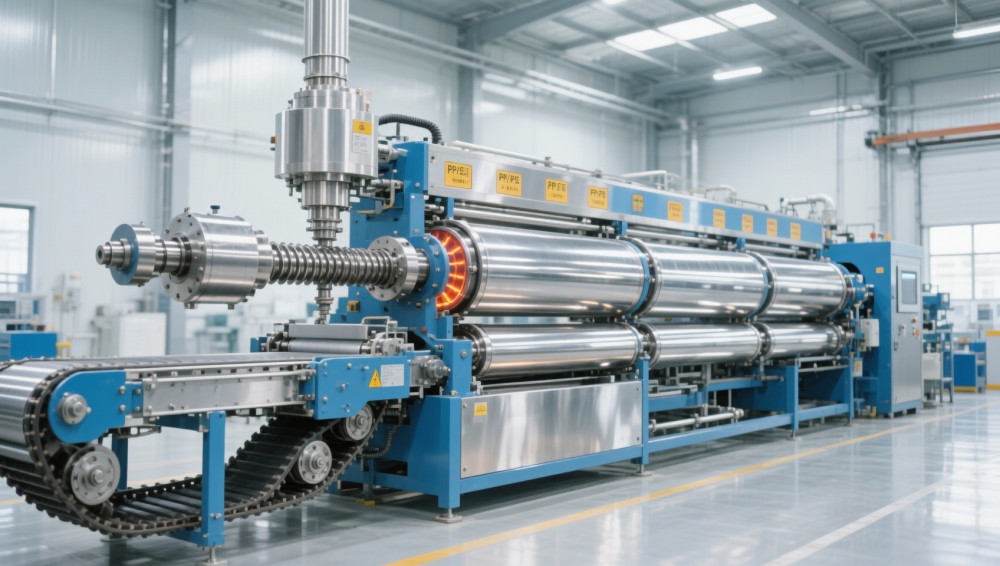
What makes this especially critical for PP, PE, ABS, and PS is material-specific behavior under thermal and mechanical stress. Polypropylene sheets require precise melt temperature control to avoid warpage; polyethylene demands uniform die lip heating to prevent gauge variation; ABS needs clean, non-oxidizing melt zones to maintain impact strength; polystyrene requires tight vacuum calibration in the calibrator to avoid blistering. A line that ran well for PVC may not translate — even if the base machine looks identical.
Three Overlooked Dimensions of Readiness
First, **thermal history and calibration traceability**. Used lines rarely come with full thermal mapping reports or documented die heater zone recalibration logs. Yet for PP and PS, even 5°C deviation across the die can shift crystallinity or cause edge curl. Buyers often accept vendor-provided temperature readouts without verifying sensor placement or calibration against NIST-traceable references. A single uncalibrated thermocouple in the melt pump can mislead operators into overcompensating elsewhere — increasing scrap rate before the first production run.
Second, **mechanical alignment integrity**, particularly in the calibrator stack and haul-off. Sheet thickness consistency depends on parallelism between rolls and flatness of the cooling plates. On older lines, frame distortion from years of thermal cycling or improper maintenance isn’t always visible — but it shows up as ±0.08 mm variation across width when targeting ±0.03 mm for medical-grade PS. Laser alignment checks pre-purchase are rare, yet they’re more predictive of long-term stability than screw wear measurements alone.
Third, **control architecture compatibility and firmware maturity**. Many used lines retain PLCs or HMI platforms discontinued for over a decade. This isn’t just about obsolescence — it affects real-time response. For example, ABS extrusion requires rapid pressure compensation during feed fluctuations. If the PID loop update interval exceeds 150 ms (common in legacy systems), the system overshoots, causing melt fracture. Modern upgrades often require hardware swaps — but those aren’t plug-and-play. I/O mapping, encoder resolution mismatch, and lack of native support for newer servo drives create integration delays that stall ramp-up.
Material-Specific Risk Triggers
PP and PE buyers tend to underestimate die swell modeling requirements. Unlike rigid PS or ABS, these semi-crystalline polymers exhibit significant post-die expansion. A line calibrated for PS will overestimate final width for PE unless the die land length, lip gap, and melt temperature profile are revalidated — not just adjusted. Without access to original design data or rheological testing records, this becomes empirical trial-and-error, consuming weeks of trial runs.
ABS introduces another layer: sensitivity to thermal degradation. Older extruders often lack segmented barrel cooling or precise melt temperature zoning. Even minor hot spots in the transition zone generate char particles that become embedded in sheet surfaces — unacceptable for automotive trim applications. Buyers inspect screw condition but rarely test barrel liner integrity or verify heater band responsiveness across zones.
PS presents optical quality challenges. Surface gloss, haze, and clarity depend on melt homogeneity and calibrator surface finish. A used line might pass mechanical inspection, yet have micro-pitting on chrome-plated calibrator rolls — invisible to the naked eye but detectable via profilometry. Without surface metrology reports, buyers assume “clean roll = ready roll.”
Verification Beyond the Walkthrough
A site visit should include three non-negotiable steps:
- **Cold-start validation**: Observe full power-up sequence, including safety interlocks, vacuum pump priming, and lubrication system pressurization. Failures here indicate neglected maintenance or undocumented modifications.
- **Material-specific dry-run**: Run a short PP or PS compound (not generic LDPE) through the entire line — extruder, die, calibrator, haul-off, cutter — while logging temperature profiles, pressure spikes, and drive current variance. This reveals hidden friction points, like worn gear pump bearings affecting melt pressure stability.
- **Documentation audit**: Request service logs covering the last 18 months — not just for major components, but for auxiliary systems: chiller flow rates, vacuum pump oil change dates, die lip heater calibration certificates. Gaps suggest reactive rather than preventive maintenance culture.
Many buyers treat documentation as secondary to visual inspection. In practice, inconsistent log entries correlate strongly with unexpected failures within six months of installation — especially for lines operating above 80% capacity.
Cost Drivers That Aren’t Listed on the Invoice
The headline price of used sheet extrusion lines reflects equipment age and brand — not readiness cost. Hidden expenses emerge during integration:
- Retrofitting outdated control systems to match plant-wide SCADA protocols can exceed 20% of purchase value.
- Calibrator roll regrinding or replacement — often needed after transport-induced misalignment — adds $15,000–$40,000 depending on width and finish spec.
- Die reconditioning for PP or ABS typically requires lip geometry verification and surface polishing beyond standard cleaning — $8,000–$12,000 minimum.
These aren’t “nice-to-have” upgrades. They’re prerequisites for stable operation at target line speed and tolerance. Buyers who skip them face extended qualification cycles — delaying customer approvals and tying up working capital.used sheet extrusion lines
When Readiness Assessment Shifts from Technical to Tactical
For project managers, operational readiness isn’t a binary pass/fail metric. It’s a risk-weighted decision framework. A line with known calibrator roll wear might be acceptable for low-tolerance PE packaging — but not for precision PS thermoforming. The key is matching verification depth to application criticality: tighter tolerances, higher-value materials, or regulated end markets demand deeper forensic evaluation.
That means defining acceptance criteria *before* bidding — not after award. Criteria should include measurable thresholds: maximum allowable gauge variation across width, minimum melt temperature stability window, maximum allowable drive current fluctuation during steady-state run. These become contractual obligations — not engineering assumptions.
Readiness also depends on supplier transparency. Sellers who provide full OEM manuals, spare parts lists, and historical maintenance summaries reduce uncertainty. Those who offer only “as-is, where-is” terms increase integration risk — not because the line is faulty, but because unknown variables multiply troubleshooting time.
Ultimately, selecting used sheet extrusion lines for PP, PE, ABS, or PS isn’t about finding the lowest price. It’s about identifying the most predictable path to first qualified meter of sheet — and knowing exactly what verification steps close the gap between delivery and output.
Recommended News
 Commercial LEDHow custom lighting for exhibition booths shapes product visibilityCustom lighting for exhibition booths enhances product visibility with strategic contrast, accurate color, glare control, and focused display design. Discover practical planning insights.Commercial Tech EditorSep 15, 2026
 Carton & PlasticsWhen do double wall corrugated boxes prevent damage in transit?Double wall corrugated boxes prevent transit damage from stacking, impact, punctures, and long-haul handling. Learn when stronger packaging delivers smarter protection.Packaging Supply ExpertSep 14, 2026
 Carton & PlasticsHow to assess a flat bottom pouch supplier’s quality controlsFlat bottom pouch supplier quality controls: assess materials, seal integrity, traceability, change management, and release processes to reduce packaging risk.Packaging Supply ExpertSep 13, 2026
 Office FurnitureHow to compare wholesale commercial carpet tiles by installed costCommercial carpet tiles wholesale: compare installed costs, freight, waste, subfloor prep, labor, and lifecycle value to make smarter procurement decisions.Interior Sourcing LeadSep 12, 2026