Industry News
Curation by industry experts
Hot Articles
Popular Tags
What fabric weight works best for reusable non woven fabric bags?
What Fabric Weight Works Best for Reusable Non Woven Fabric Bags?
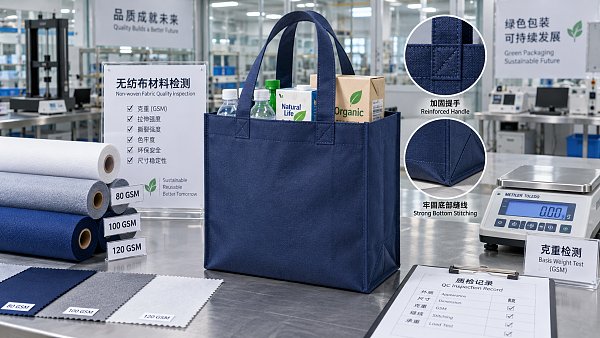
Choosing the right fabric weight is essential when sourcing reusable non woven fabric for bags. GSM influences durability, load capacity, print quality, unit cost, and retail suitability.
For most reusable shopping and promotional bags, 80 to 100 GSM is the practical starting range. Heavier weights suit repeated use, larger loads, and premium branding.
Procurement teams should not treat GSM as an isolated quality indicator. Bag construction, fiber composition, handle reinforcement, dimensions, and intended use determine whether a specification performs reliably.
This guide helps buyers compare non-woven bag specifications, question supplier claims, align material weight with applications, and balance purchase price against usable service life.
Start With the Application, Not the Lowest GSM Quote
The best fabric weight depends first on what the bag must carry and how often it will be reused. A trade-show giveaway has different requirements than grocery packaging.
Buyers sourcing non woven fabric for bags should define the use case before requesting quotations. Otherwise, suppliers may quote lighter material that meets appearance expectations but fails operationally.
For one-time promotional distribution, 60 to 70 GSM may be commercially acceptable. These bags are inexpensive, light, and suitable for brochures, samples, or lightweight merchandise.
However, 60 GSM bags can feel thin and may wrinkle easily. They offer limited resistance to sharp product edges, overloaded contents, and repeated carrying cycles.
For standard reusable retail bags, 80 GSM is commonly regarded as an entry-level functional specification. It provides noticeably better body, opacity, and print presentation than lighter grades.
For grocery, pharmacy, apparel, and general merchandise programs, 90 to 100 GSM usually provides a stronger balance between durability, appearance, and material consumption.
When bags must support bulky products or reflect a premium brand position, 110 to 120 GSM can be appropriate. Beyond that range, buyers should verify whether added weight creates measurable value.
How GSM Relates to Real Bag Performance
GSM means grams per square meter and describes the mass of non-woven material over a defined area. It is useful, but it does not directly guarantee strength.
A higher GSM normally means more fiber in the sheet, producing a thicker and more substantial feel. Yet manufacturing quality can cause similar-weight fabrics to perform differently.
Polypropylene spunbond non-woven material is the most common choice for reusable bags. Its performance depends on filament bonding, fiber distribution, thickness consistency, and finishing treatment.
A poorly bonded 100 GSM fabric may tear more easily than a well-made 80 GSM fabric. Procurement decisions should therefore include physical samples and testing requirements.
Fabric weight also affects stiffness. A 70 GSM bag tends to collapse when empty, while a 100 GSM bag generally holds its shape better on shelves.
Load capacity depends heavily on seam design and handle attachment. Stronger fabric will not compensate for weak ultrasonic welding, narrow handles, or inadequate reinforcement at stress points.
Ask suppliers for test data covering tensile strength, seam strength, tear resistance, and carrying performance. These measures provide a more defensible basis than GSM alone.
Recommended GSM Ranges by Reusable Bag Type
Small non-woven drawstring bags for cosmetics, accessories, event kits, or product packaging commonly use 60 to 80 GSM. Their compact dimensions reduce stress on the material.
Standard die-cut handle bags for brochures, clothing, and light retail purchases often perform well at 70 to 90 GSM. Larger dimensions may require a higher weight.
W-cut and D-cut shopping bags generally benefit from 80 to 100 GSM fabric. Their construction supports routine retail use while maintaining a reasonable unit price.
Box bags with bottom gussets are frequently specified at 90 to 120 GSM. The structured format encourages buyers to place heavier or irregularly shaped goods inside.
Laminated non-woven tote bags often use a base fabric between 80 and 120 GSM. Lamination improves surface appearance but should not be mistaken for structural reinforcement.
Reusable grocery totes, promotional bags intended for long-term use, and bags carrying bottles commonly require 100 to 120 GSM plus reinforced handles and base seams.
For very heavy products, consider construction changes before simply increasing GSM. Wider handles, stitched seams, cardboard inserts, and stronger gusset designs may deliver better results.
Why Handle Design Can Matter More Than Fabric Weight
Many bag failures occur at the handles rather than across the body fabric. Procurement specifications should clearly identify handle type, material, width, length, and attachment method.
Integrated die-cut handles are economical but create concentrated stress around the opening. Reinforced die-cut designs are preferable when users may carry heavier retail goods.
Non-woven sewn handles distribute force across a wider area and can support more repeated use. They are suitable for grocery totes, corporate gifts, and premium retail bags.
Cross-stitched handles offer stronger anchoring than simple edge stitching. Buyers should request photographs or pre-production samples showing the actual stitching pattern and reinforcement details.
Ultrasonic welded handles can be effective for lightweight applications when settings are properly controlled. For heavy-duty programs, validate weld integrity through practical load testing.
A 100 GSM bag with basic die-cut handles may underperform an 80 GSM sewn-handle tote. Product engineering must be evaluated as a complete system.
Define a target working load and an expected reuse cycle count. Suppliers can then propose material, handles, seams, and dimensions against a clear performance requirement.
Match Fabric Weight With Print and Brand Requirements
Fabric weight affects how a bag looks after printing. Lighter non-woven material can show uneven texture, reduced color density, and visible contents beneath large printed areas.
At 80 GSM and above, bags generally provide a more opaque background and a more substantial branded feel. This matters for retail presentation and corporate campaigns.
Screen printing works well on standard polypropylene non-woven surfaces, particularly for simple logos and limited colors. Fabric smoothness and color consistency should be checked before approval.
Laminated bags allow sharper photographic graphics and more complex artwork. Their visual benefits may justify the additional cost for long-running campaigns or consumer-facing retail programs.
Do not choose a heavier fabric solely to improve print quality. A suitable lamination, coating, print method, or bag color may address visual concerns more efficiently.
Request a production-standard print sample, not only a digital artwork proof. It should show actual fabric texture, ink coverage, registration, and color matching under normal lighting.
For international procurement, define acceptable color variation and logo placement tolerances in the purchase specification. Subjective approval criteria create avoidable disputes during final inspection.
Calculate Cost by Usable Performance, Not Material Price Alone
Higher GSM increases fabric consumption and normally raises the bag’s unit cost. The real purchasing question is whether that increase delivers a proportionate improvement in performance.
A lighter bag may appear attractive in a quotation comparison, but it can create replacement costs, customer complaints, damaged products, and weaker sustainability claims after distribution.
Procurement teams should compare total delivered cost against expected reuse. A bag used twenty times usually offers better practical value than a cheaper bag discarded after two uses.
Bag size has a major effect on material consumption. A large 80 GSM tote may use more total fabric than a small 100 GSM bag, despite its lower weight.
Ask suppliers to state finished bag dimensions, gusset dimensions, fabric GSM, bag weight, handle specification, and packaging quantity. This creates a consistent quote comparison basis.
Finished bag weight is especially useful as a cross-check. If the stated GSM and bag dimensions do not reasonably match the finished weight, investigate the discrepancy.
Freight also matters because heavier bags increase shipment weight. For low-margin promotional programs, optimize fabric weight alongside pack density, container utilization, and destination logistics costs.
How to Verify Supplier Claims Before Placing an Order
Material weight variation is a common sourcing risk with non-woven bags. A supplier may provide compliant approval samples but use lighter fabric during mass production.
Include GSM tolerance in the contract rather than specifying only a nominal number. A practical tolerance should be agreed based on bag application and inspection method.
Request fabric test reports from an independent laboratory or establish third-party inspection requirements. Inspectors can cut samples, measure area, and calculate actual GSM before shipment.
Pre-production samples should use the same material source, printing process, handles, and seams planned for mass production. Prototype samples made from substitute materials offer limited assurance.
For critical retail programs, approve a sealed golden sample. This gives quality teams a documented reference for color, dimensions, workmanship, fabric feel, and construction quality.
During production, inspectors should review random bags for seam defects, loose threads, handle alignment, contamination, printing defects, and dimensional consistency alongside material weight checks.
Load testing should reflect realistic customer behavior. Test the bag with the intended product weight, then repeat carrying cycles rather than relying only on a single static load.
Consider Sustainability Claims Carefully
Reusable polypropylene non-woven bags may reduce demand for disposable bags when they are genuinely reused. Their environmental value depends on durability, reuse behavior, and end-of-life systems.
Increasing GSM can improve durability, but more material also increases resource use per bag. The appropriate weight is therefore the lowest specification that reliably supports intended reuse.
Buyers should avoid unsupported claims such as eco-friendly or sustainable without evidence. Request information on recycled content, material composition, recyclability, and applicable certification standards.
Recycled polypropylene content may support sustainability objectives, but it can affect appearance and performance. Confirm whether the supplier can maintain required strength, color, and consistency.
For regulated markets, verify labeling requirements and local restrictions on reusable bags. Packaging compliance varies by jurisdiction and may affect material selection, marking, and documentation.
Durability testing supports credible reuse messaging. A specification that targets frequent use, reinforced construction, and appropriate fabric weight is more defensible than a generic environmental statement.
When comparing alternatives, document the intended product life and disposal pathway. This helps procurement, marketing, compliance, and sustainability teams make aligned decisions.
Build a Clear RFQ Specification for Non-Woven Bags
An effective request for quotation should state the bag’s intended application, target load, expected reuse frequency, finished dimensions, and required non-woven fabric weight.
Specify whether GSM applies to the main body only or also to handles, gussets, piping, and pockets. Ambiguous specifications give suppliers room for inconsistent interpretation.
Include material composition, color, fabric finish, printing method, artwork colors, and acceptable visual defects. These details reduce delays during sample approval and production inspection.
Describe the handle construction precisely, including width, drop length, material, stitching method, and reinforcement. For die-cut designs, specify whether the handle opening requires a patch.
State requirements for seam type, gusset shape, base board, lamination, zipper, closure, labels, and internal pockets where relevant. Each feature changes both cost and performance.
Ask suppliers to quote tooling, sampling, lead time, minimum order quantity, packaging, export carton dimensions, and compliance documentation separately from the bag unit price.
Finally, require the supplier to confirm tolerances, inspection standards, and corrective actions for nonconforming goods. Strong specifications make supplier accountability easier throughout the order cycle.
Conclusion: Choose the Lowest Weight That Meets the Job Reliably
There is no universal best GSM for reusable non woven fabric for bags. For many retail and promotional applications, 80 to 100 GSM provides the strongest overall balance.
Use 60 to 70 GSM for lightweight, short-life distribution, and consider 100 to 120 GSM for heavier loads, frequent reuse, structured bags, or premium presentation.
Make the final decision using application requirements, construction quality, testing evidence, print needs, freight implications, and expected reuse. That approach produces more reliable sourcing outcomes than price-led GSM selection.
Recommended News
 Fabrics & YarnsWhat fabric weight works best for reusable non woven fabric bags?Non woven fabric for bags: discover the best GSM range for durability, load capacity, print quality, and cost-effective reusable bag sourcing.Textile Industry AnalystSep 30, 2026
 Industrial FastenersWhen do zinc drop in anchors need corrosion-resistant coatings?Zinc drop in anchors need corrosion-resistant coatings in damp, outdoor, chloride-rich, or chemical environments. Learn how to select durable, approved protection.Tooling & Hardware LeadSep 29, 2026
 Carton & PlasticsHow to assess seam quality in 250ml aluminum beverage cansLearn how to assess seam quality in 250ml aluminum beverage cans with practical visual checks, precise measurements, teardown methods, and defect-control guidance.Packaging Supply ExpertSep 28, 2026
 Carton & PlasticsWhat drives breakage rates in bulk wine bottles wholesale orders?Bulk wine bottles wholesale buyers: discover what drives breakage rates, from glass quality and packaging to pallet loading, and reduce costly claims.Packaging Supply ExpertSep 27, 2026