Industry News
Curation by industry experts
Hot Articles
Popular Tags
When do zinc drop in anchors need corrosion-resistant coatings?
A zinc drop-in anchor can look perfectly adequate on a drawing and still become the weak point of an installation years later. The reason is simple: its zinc finish is usually intended for ordinary indoor exposure, not as a universal defense against water, salts, chemicals, or long-term condensation. For technical evaluators, the question is not merely whether an anchor is “zinc coated.” It is whether the anchor’s corrosion protection matches the actual environment around the concrete—not just the environment expected on the day of installation.
Corrosion-resistant coatings are needed when the planned service conditions can consume, undermine, or bypass the normal protection provided by standard zinc-plated drop-in anchors. That assessment should be made before the anchor is specified, because applying a coating after the fact can affect thread engagement, expansion behavior, dimensional tolerances, and the validity of the manufacturer’s published load data.
Start with the real meaning of “zinc drop-in anchors”
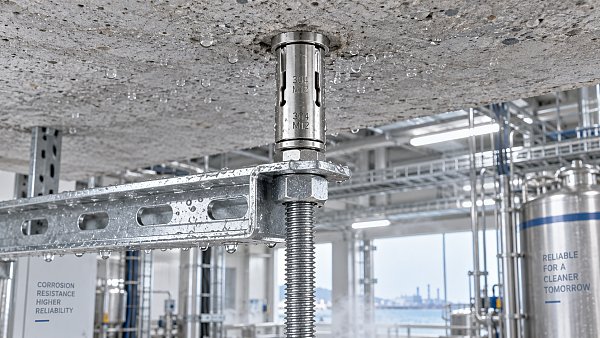
In most fastening specifications, zinc drop-in anchors are carbon-steel internally threaded expansion anchors with an electroplated zinc finish. They are installed in pre-drilled concrete holes and set with a dedicated setting tool, which expands the lower portion of the anchor against the concrete. A bolt or threaded rod is then inserted into the internal thread.
The zinc layer provides sacrificial protection: zinc corrodes preferentially to the underlying steel. In dry, conditioned interior spaces, this is often sufficient and economical. However, electroplated zinc is typically a relatively thin coating. It should not be confused with hot-dip galvanizing, zinc-flake systems, duplex coatings, or the corrosion performance of stainless steel.
That distinction matters because a drop-in anchor is not exposed in the same way as a visible bolt. Part of the anchor is embedded in concrete, part may sit near the surface, and its internal thread may be exposed whenever a fixture is removed. Water can enter through the fixture interface or the anchor opening. In some assemblies, the surface appears dry while moisture remains trapped in the drilled hole.
When standard zinc plating is generally acceptable
A conventional zinc-plated drop-in anchor may be a reasonable selection in dry, climate-controlled interior environments where corrosion drivers are limited. Typical examples include enclosed office areas, dry retail interiors, conditioned warehouses, and equipment rooms without washdown, chemical vapor, or persistent humidity.
Even then, the evaluator should look beyond the room label. A “warehouse” may contain open loading doors, seasonal condensation, fork-truck wash bays, or stored products that release corrosive vapors. A “mechanical room” may have pipe leaks, cooling equipment, chemical dosing systems, or steam. The relevant classification is the anchor’s local exposure, not the building’s general purpose.
For dry indoor work, zinc drop-in anchors are often selected because they provide a familiar installation method and a practical balance of cost and protection. But this suitability assumes the concrete itself is not unusually aggressive and that the anchor will not be repeatedly wetted during its design life.
Exposure conditions that call for corrosion-resistant protection
Corrosion-resistant coatings—or, in more severe cases, a different anchor material—should be considered whenever the installation moves beyond a reliably dry interior condition. The following triggers deserve particular attention.
Repeated moisture, condensation, or leakage
Anchors installed below grade, in parking structures, near chilled-water lines, beneath roofs prone to leakage, or in intermittently wet process areas face a much higher corrosion risk. Moisture does not need to be dramatic. Small but repeated wetting cycles can be more damaging than a single exposure because they replenish oxygen and contaminants at the metal surface.
Condensation is especially easy to miss. Fasteners supporting ducts, cable trays, piping, or suspended equipment may sit above ceilings where temperature swings occur daily. If the anchor head or connected rod repeatedly becomes damp, ordinary zinc plating may be consumed long before the surrounding structure shows visible distress.
Chlorides: marine air, de-icing salts, and contaminated concrete
Chlorides are among the strongest reasons to avoid treating a standard zinc finish as adequate. Coastal locations, splash zones, exterior canopies near sea air, tunnels, bridge-adjacent structures, and parking facilities exposed to de-icing salts all require closer scrutiny.
Salt-bearing water can enter anchor holes through cracks, joints, fixture interfaces, and capillary action. Chlorides may also already be present in aged or contaminated concrete. Once corrosion begins within the embedded zone, it can be difficult to inspect. A modest amount of red corrosion visible around the opening may represent a larger hidden problem below the concrete surface.
Exterior exposure and rain-washed assemblies
Outdoor installation does not automatically mean every anchor needs the same treatment, but it does change the baseline. Rain, ultraviolet exposure, pollutants, freeze-thaw cycles, and wet-dry movement all increase the chance of coating breakdown. Areas sheltered from direct rain can sometimes be more problematic than fully exposed surfaces because they remain damp for longer periods.
Exterior structural attachments, façade support systems, rooftop equipment restraints, signage frames, and open-air utility installations should therefore be assessed as complete assemblies. The anchor, threaded rod, washer, nut, bracket, and connected metal should have compatible corrosion resistance. A highly protected anchor paired with an unprotected rod may simply relocate the failure point.
Chemical contact and industrial atmospheres
Manufacturing plants, wastewater facilities, commercial kitchens, laboratories, swimming-pool areas, battery rooms, agricultural buildings, and chemical storage areas may all expose anchors to substances that accelerate corrosion. Acids, alkalis, cleaning agents, chloramines, sulfur compounds, fertilizers, and industrial fumes can affect zinc coatings very differently.
In these settings, “coated” is not a complete specification. The coating must be evaluated for compatibility with the specific chemicals, their concentration, temperature, frequency of exposure, and cleaning regime. An anchor that performs acceptably in occasional water exposure may deteriorate rapidly under regular alkaline washdown or acidic vapor.
Long design life and low-access installations
The consequence of replacement should influence the material choice. If anchors are hidden behind finishes, located above critical equipment, embedded in a difficult-access ceiling void, or part of a safety-related support system, the cost of a more durable corrosion solution is often modest compared with future remediation.
Long design life is not only about avoiding visible rust. Corrosion can reduce section thickness, compromise threads, impair removal and inspection, or cause expansion-related stresses in the surrounding concrete. For installations expected to remain in service for decades, a basic zinc coating may offer insufficient reserve even in an environment that appears only moderately corrosive today.
A practical way to assess coating need before specification
A useful evaluation begins with five questions rather than a generic “indoor versus outdoor” decision.
- Will moisture reach the anchor? Consider direct water, condensation, cleaning, leakage, humidity, and water trapped behind fixtures.
- What contaminants are likely to be present? Chlorides, cleaning chemicals, process fumes, and pollutants can be more important than moisture alone.
- What is the concrete condition? Cracking, carbonation, chloride contamination, poor drainage, and existing reinforcement corrosion can increase local risk.
- What is the required service period and consequence of failure? A removable light-duty fixture and a difficult-to-access overhead support should not receive the same level of conservatism.
- Has the complete fastening assembly been considered? Include the anchor, bolt or rod, washers, brackets, isolators, sealants, and any dissimilar metals.
This review is also the point to confirm whether the anchor is intended for cracked or uncracked concrete, static or seismic loading, and the applicable design standard. Corrosion resistance does not replace structural verification. A coating selection may be excellent for the environment but still unsuitable if it changes the product configuration used to establish the anchor’s design resistance.
Comparing common protection approaches
The appropriate solution depends on exposure severity, required approval status, and the manufacturer’s available product range. The options below should be treated as selection categories, not interchangeable finishes.
For severe chloride exposure, higher-alloy stainless solutions may be more appropriate than relying on a coated carbon-steel anchor. For chemical environments, material compatibility should be confirmed against the actual process conditions. There is no universal “best coating” because zinc, stainless steel, and polymeric or flake-based systems each have different vulnerabilities.
Why field-applied coatings are rarely a simple fix
A common response to corrosion concern is to install standard zinc drop-in anchors and apply paint or a protective compound afterward. This can help protect exposed hardware in some limited situations, but it is not automatically an equivalent substitute for a factory-supplied corrosion-resistant anchor.
The critical expansion zone is inside the drilled hole, where field coating may not reach consistently. Coating can also contaminate threads, interfere with bolt installation, conceal defects, or alter the friction conditions assumed in a tested fastening system. Painting the visible opening does not guarantee that water and salts will not enter around the connected fixture.
If a protective sealant or coating is proposed as part of the assembly, it should be reviewed with the anchor manufacturer and project engineer. The recommendation should identify where it is applied, how drainage is managed, whether future inspection is possible, and whether the added material affects the anchor’s qualified installation method.
Do not overlook galvanic corrosion
Corrosion can accelerate when dissimilar metals are electrically connected in the presence of an electrolyte. A stainless-steel bracket, carbon-steel zinc drop-in anchor, and wet exterior environment may create a combination that deserves review. The smaller or less noble component can become the sacrificial part of the assembly.
The risk depends on materials, exposed surface areas, electrical continuity, moisture duration, and local contaminants. Isolation washers, compatible fastener selections, drainage details, and coating continuity can reduce risk, but these measures should not be assumed to work without considering the full connection. This is particularly relevant in rooftop, façade, marine, and infrastructure projects.
Specification notes that prevent ambiguity
A good procurement description does more than state “corrosion resistant.” It identifies the anchor type, base material, coating or stainless grade, environmental exposure, required thread size, approved embedment and installation method, and any governing design or approval requirements. Where corrosion categories or project durability criteria are used, they should be stated clearly.
Technical evaluators should also request documentation that corresponds to the exact anchor finish being offered. Load values, setting instructions, and approvals for a zinc-plated version should not automatically be transferred to a galvanized, coated, or stainless alternative. Minor changes in geometry, heat treatment, or finish can matter in a small expansion anchor.
Finally, installation quality remains part of corrosion performance. Correct hole diameter and depth, thorough hole cleaning, proper setting, compatible fasteners, and avoidance of damaged threads all influence long-term reliability. A carefully selected coating cannot compensate for an anchor set in a water-filled hole, installed in deteriorated concrete, or coupled to incompatible hardware.
The decision in one sentence
Zinc drop-in anchors need corrosion-resistant coatings whenever the installation faces more than reliably dry, benign indoor conditions—or whenever the consequences and intended service life make ordinary zinc plating an unacceptable durability gamble. In damp, exterior, chloride-rich, chemically aggressive, or hard-to-maintain locations, evaluate a manufacturer-qualified enhanced coating or stainless anchor system as part of the complete connection, not as an afterthought once corrosion has already begun.
Recommended News
 Industrial FastenersWhen do zinc drop in anchors need corrosion-resistant coatings?Zinc drop in anchors need corrosion-resistant coatings in damp, outdoor, chloride-rich, or chemical environments. Learn how to select durable, approved protection.Tooling & Hardware LeadSep 29, 2026
 Carton & PlasticsHow to assess seam quality in 250ml aluminum beverage cansLearn how to assess seam quality in 250ml aluminum beverage cans with practical visual checks, precise measurements, teardown methods, and defect-control guidance.Packaging Supply ExpertSep 28, 2026
 Carton & PlasticsWhat drives breakage rates in bulk wine bottles wholesale orders?Bulk wine bottles wholesale buyers: discover what drives breakage rates, from glass quality and packaging to pallet loading, and reduce costly claims.Packaging Supply ExpertSep 27, 2026
 Office FurnitureHow supplier scorecards reduce risk in furniture procurementFurniture procurement supplier management becomes more resilient with supplier scorecards that track quality, delivery, compliance, and corrective actions. Learn how to reduce sourcing risk.Interior Sourcing LeadSep 26, 2026