Industry News
Curation by industry experts
Hot Articles
Popular Tags
How to Compare Lighting and Display Suppliers Across Regions
Comparing lighting and display suppliers across regions starts with a shared technical brief. A low quoted unit cost has little meaning when one quotation covers a decorative fixture with an integrated driver and the other covers only a housing, lamp holder, and basic wiring. The same problem appears in digital displays: one supplier may include a controller, mounting frame, power supply, calibration, and spare modules, while another may quote the cabinet alone.
Define the intended operating environment before comparing factories or regions. Record the installation type, dimensions, mounting method, electrical input, required light output or screen brightness, control protocol, ambient temperature, moisture exposure, cleaning method, operating hours, service access, packaging constraints, and destination-market documentation. This turns regional comparison into an assessment of equivalent offers rather than a catalog exercise.
Start with a specification that can be quoted consistently
Lighting specifications should distinguish nominal performance from installed performance. For luminaires, state the required beam distribution, correlated color temperature range, color rendering requirement, luminous flux tolerance, glare limitation where relevant, dimming method, surge protection expectation, ingress protection level, housing finish, and driver placement. A fixture intended for a high ceiling, a refrigerated space, or a coastal exterior requires different thermal, corrosion, sealing, and maintenance assumptions.
For displays, identify whether the product is an indoor commercial screen, outdoor LED display, transparent LED installation, interactive kiosk, menu board, video wall, or specialty panel. Include pixel pitch, active viewing distance, refresh requirement, brightness range, cabinet dimensions, front or rear service access, redundant power or signal requirements, content player compatibility, network interface, and structural loading limits. Request the same test conditions for brightness and power consumption; otherwise, published figures may not be comparable.
A controlled bill of materials is useful for projects with repeated locations or custom finishes. It can specify the LED package category, optical lens material, diffuser grade, aluminum alloy or steel thickness, powder-coating system, driver family, display module configuration, receiving card, connector type, and cable jacket requirement. Allow alternatives only where they are documented and approved. Uncontrolled substitution is a frequent source of field variation between production batches.
How to compare lighting and displays suppliers across regions?
Use a comparison matrix that separates product fit, production control, delivered cost, and long-term service. Regional labels alone are weak indicators. Factories in the same country can differ substantially in engineering depth, component access, export experience, and inspection discipline. Conversely, a supplier located farther from the installation site may offer stronger documentation, more stable component sourcing, or better capability for a specialized product.
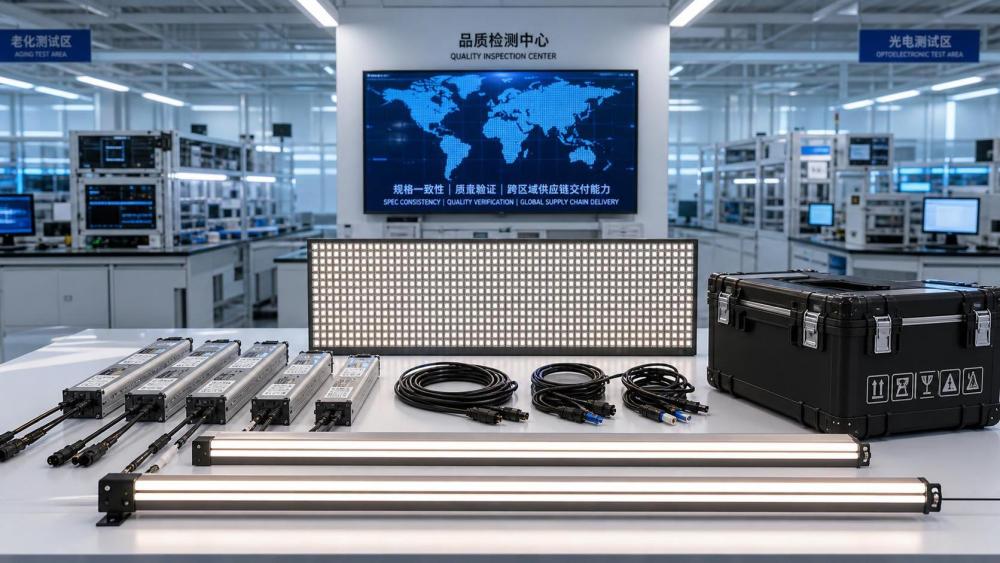
The matrix should be completed from evidence, not verbal assurances. Ask for dated drawings, test records, photographs of assembly stages, sample labels, packaging details, and a clear list of excluded items. When a response uses broad phrases such as “high brightness,” “premium driver,” or “weatherproof,” require the underlying parameter and the test method.
Read manufacturing capability through the product architecture
Lighting assembly may appear straightforward, yet reliability depends on several interfaces. Heat must move from the LED board through the thermal path and housing without compromising the optical chamber. Gaskets, cable entries, fasteners, and drainage points affect whether an outdoor fitting remains sealed in service. The driver must match the input supply, dimming system, load profile, and expected temperature. A supplier should be able to explain how these parts are selected, assembled, tested, and replaced.
Ask whether metalwork, die casting, extrusion, powder coating, lens production, printed circuit board assembly, and final assembly occur under direct control or through external workshops. Outsourcing is not automatically a risk, but it changes the verification required. Critical processes such as optical assembly, conformal coating, screen bonding, or cabinet welding need traceability between the finished product and the production batch.
Display capability has a different failure pattern. Dead pixels, inconsistent color, visible module boundaries, power imbalance, signal loss, moisture ingress, and warped cabinets can each undermine an installation. Review how modules are binned or calibrated, how cabinet flatness is controlled, whether the power and data paths are labeled, and how a damaged module can be removed without disturbing adjacent panels. For fine-pitch displays, even small differences in module revision or calibration data may be visible after installation.
Also examine engineering change control. A component shortage can trigger substitutions in LEDs, drivers, power supplies, receiving cards, integrated circuits, connectors, or adhesives. Require notice before changes that affect electrical performance, appearance, compatibility, heat behavior, or service parts. The same change-control rule should apply to accessories, including brackets, suspension hardware, waterproof glands, and communication cables.
Compare quality evidence, not certificates in isolation
Documentation should match the exact configuration offered. A report for a similar luminaire, a different wattage, or a display cabinet with another module pitch may have limited relevance. Cross-reference model numbers, component revisions, rated input, enclosure construction, and test sample description. Where destination requirements apply, verify the scope with the responsible conformity party before release.
Useful quality evidence includes incoming material criteria, in-process inspection points, final test records, serial or batch coding, nonconformance handling, and sample retention. For lighting, request records for electrical function, dimming response where applicable, visual finish, assembly torque where controlled, and aging or burn-in conditions. For displays, review pixel inspection, color calibration, brightness uniformity method, burn-in duration, signal verification, cabinet alignment, and power-on testing.
A pre-production sample should represent the proposed materials and production route. A hand-built showroom sample may prove visual intent but not repeatability. For customized projects, approve physical finish panels, lens appearance, cabinet color, bezel treatment, mounting hardware, and labeling before mass production. Keep an approved sample or signed specification reference available through final inspection.
Account for regional supply chains and logistics exposure
Regional comparison is often reduced to factory-to-port distance. That misses dependencies within the bill of materials. A lighting assembler may source drivers from another region, while a display cabinet producer may depend on imported LED modules, control systems, or specialized power components. Ask which items have long replenishment cycles, whether alternate sources have been validated, and whether a production schedule depends on a single component family.
Lead time should be divided into design confirmation, sample preparation, component procurement, fabrication, assembly, testing, packing, port handover, transit, customs clearance, and site delivery. A short factory lead time can still result in a late installation when the delivery plan omits freight booking capacity, destination inspections, or last-mile handling for oversized cabinets and fragile screens.
Packaging deserves a detailed review. Luminaires with glass, acrylic diffusers, long extrusions, or prewired drivers need protection against abrasion, impact, moisture, and cable damage. LED modules and LCD panels may require anti-static materials, rigid edge protection, desiccant where appropriate, and clear orientation markings. Confirm carton dimensions, gross weight, palletization, container loading plan, and whether replacement parts travel with the main shipment or separately.
For cross-regional projects, establish the delivery term, transfer of risk, customs-document responsibility, product classification, labeling language, and inspection point in writing. These details affect landed cost and release timing. They also determine who manages a damaged shipment, a missing accessory carton, or a discrepancy between the packing list and delivered equipment.
Price the whole installed and maintainable system
Compare quotations at the same scope. Include tooling or mold charges, engineering drawings, controls, mounting parts, cables, power supplies, protective packaging, spare parts, inspection, documentation, freight assumptions, duties where applicable, commissioning support, and replacement-part pricing. A lower fixture price can be offset by separate controls, an incomplete bracket set, or an unusable service arrangement.
For lighting, calculate installed output per circuit rather than relying only on fixture wattage. Driver compatibility, dimming hardware, emergency provision, mounting labor, access equipment, and future driver replacement can materially change the project cost. For displays, include steel structure, data distribution, media player or controller, power distribution, network requirements, protective glazing where used, cooling or ventilation provisions, and the labor needed to access rear-service cabinets.
Spare-part policy should be evaluated alongside the original quotation. Identify which parts are likely to be needed during installation and operation: drivers, LEDs or boards, lenses, gaskets, power supplies, receiving cards, LED modules, cables, fans, and mounting hardware. Confirm revision compatibility and storage conditions. A spare module from a later production run may require recalibration before it blends with an existing LED display.
Test service claims before placing a large order
After-sales support is practical only when fault reporting, diagnosis, authority, and replacement logistics are defined. Ask for an escalation path, expected documentation for a claim, remote troubleshooting method, parts identification system, and service manuals with diagrams. For smart lighting, confirm compatibility with the selected control protocol and clarify whether commissioning tools, gateways, licenses, or configuration files are included. For networked displays, determine how software access, firmware updates, content-system interfaces, and cybersecurity responsibilities are handled.
Installation manuals should reflect site reality. They need mounting loads, fixing patterns, clearance requirements, cable routing, grounding details, environmental limits, startup sequence, and maintenance access. A display that can only be serviced from the rear is unsuitable where no rear clearance exists. A luminaire with a remote driver may require an accessible enclosure; concealing it above a sealed ceiling creates an avoidable maintenance problem.
Before contract release, align the approved specification, sample record, inspection plan, production schedule, packaging plan, shipping documents, spare-parts list, and acceptance criteria. Regional comparison becomes reliable when every supplier is measured against the same operating conditions and the same evidence standard. The resulting choice can then reflect product suitability, delivery resilience, and serviceability rather than a headline quotation alone.
Recommended News
 Commercial LEDSignify Q3 2026 Earnings: €28 Million Tariff Refund Lifts ProfitExplore Signify Q3 2026 earnings: a reported €28 million tariff refund lifts profit as comparable sales fall 3.4%. Discover the implications for lighting costs and demand.Commercial Tech EditorOct 24, 2026
 Fabrics & YarnsHow to check BS 5852 test reports for fire retardant upholstery fabricChoosing fire retardant fabric for upholstery? Learn how to check BS 5852 reports, verify ignition sources and match tested constructions for confident purchasing decisions.Textile Industry AnalystOct 24, 2026
 Export UpdatesChina’s Textile and Apparel Exports Rise 21.5% in September, Up 5.1% Year to DateChina’s textile and apparel exports rose 21.5% in September and 5.1% year to date. Explore the figures and key signals to watch for sustained industry growth.Oct 23, 2026
 Hand & Power ToolsHow to choose resin-bonded cutting wheels for stainless steelChoose resin bonded cutting wheels for stainless steel with confidence. Compare abrasives, thickness, safety, and cost per cut to find the right wheel for cleaner cuts and less rework.Tooling & Hardware LeadOct 23, 2026