What Drives Breakage Rates in Bulk Wine Bottles Wholesale Orders?
Breakage rates in bulk wine bottles wholesale orders can quickly erode margins, disrupt production schedules, and create avoidable claims for buyers.
Glass weight, bottle geometry, palletization, container loading, and transit conditions all affect whether bottles arrive intact and ready for filling.
This guide helps procurement professionals compare supplier standards, identify failure points, and protect product quality alongside total landed cost.
Search Intent and What Procurement Teams Need to Evaluate
Buyers searching this topic usually want to reduce damaged deliveries, validate supplier claims, and estimate the real financial risk before placing large orders.
They are not simply looking for a generic definition of glass breakage or a list of bottle styles available from wholesalers.
Instead, procurement teams need practical criteria for comparing factories, packaging specifications, loading plans, quality controls, and contractual claim responsibilities.
The most useful answer connects physical bottle design with logistics execution, because breakage often results from several weak decisions occurring together.
This article therefore emphasizes measurable risk factors, supplier questions, acceptance thresholds, and purchasing practices that support predictable filling operations.
The Overall Rule: Breakage Is Usually a System Failure
A damaged bottle is rarely caused by one isolated issue. It usually reflects interactions between glass strength, packaging protection, handling, and transport stress.
For bulk wine bottles wholesale purchases, the lowest quoted unit price can become expensive when breakage delays bottling, creates labor waste, or triggers customer shortages.
Procurement decisions should assess delivered usability rather than factory output alone. A supplier's yield matters only when bottles remain suitable at the filling line.
Breakage risk rises whenever the chosen bottle, secondary packaging, and shipping method were designed independently instead of as one integrated shipment system.
Buyers should begin by asking where damage occurs: during manufacturing, pallet handling, domestic trucking, port transfer, ocean transit, or warehouse storage.
That distinction matters because the corrective action differs. Stronger bottles will not solve inadequate container bracing, while better pallets cannot correct annealing defects.
Glass Quality Sets the Baseline for Damage Resistance
Glass composition, furnace control, mold condition, and annealing quality establish the bottle's basic ability to tolerate impact and internal stress.
Annealing is especially important because improperly relieved thermal stress can leave bottles vulnerable even when their walls appear visually uniform and undamaged.
Ask suppliers whether they perform polarized-light stress inspection, what sampling frequency they use, and how they isolate lots with abnormal results.
Dimensional consistency also matters. Uneven wall thickness, asymmetrical finishes, and unstable base geometry can create stress concentrations that increase fracture likelihood.
Request technical drawings with tolerances for height, diameter, weight, finish dimensions, and base thickness instead of relying solely on catalog photographs.
A supplier should explain how it controls mold wear and how often molds are repaired or replaced during a sustained production program.
For high-value wine programs, buyers can request pre-shipment samples from the actual production batch, rather than approving only initial development samples.
Bottle Weight Helps, but It Is Not a Complete Strength Measure
Heavier bottles often resist impact better, but weight alone does not guarantee lower breakage because design efficiency and manufacturing consistency remain critical.
A thick decorative punt may increase nominal bottle weight without providing proportional protection at the shoulder, heel, finish, or sidewall contact points.
Conversely, a lighter bottle with controlled wall distribution and reliable annealing can outperform a poorly manufactured heavyweight premium bottle during transport.
Compare bottle weight tolerance, not only target weight. Wide variation across the same order can indicate unstable forming conditions or insufficient quality monitoring.
Weight also increases freight expense and pallet mass. Buyers should calculate whether added glass materially reduces claims enough to justify higher landed cost.
The right decision depends on wine positioning, filling-line requirements, distribution distance, and the handling severity expected after the bottle reaches the winery.
Geometry Creates Specific Weak Points During Handling
Wine bottle geometry affects how force travels through glass when bottles touch, pallets shift, or cartons experience compression during stacking.
Tall narrow bottles can be more susceptible to lateral movement, while wide-shouldered designs may concentrate impact around corners and label-panel transitions.
The heel is a common failure area because it contacts pallets, dividers, and adjacent bottles when shipments experience vibration or sudden directional movement.
The finish requires equal attention. Chips around the mouth can compromise closures, create food-safety concerns, and force expensive sorting before bottling.
Ask whether the supplier has shipped the exact bottle model internationally at similar quantities, destinations, container types, and climatic conditions.
Historical shipment experience is more valuable than broad assurances, especially when using distinctive Bordeaux, Burgundy, sparkling, or custom-molded bottle formats.
Secondary Packaging Often Determines Whether Bottles Survive
Even strong bottles can fail when secondary packaging allows repeated glass-to-glass contact, uncontrolled movement, or excessive compression from upper pallet layers.
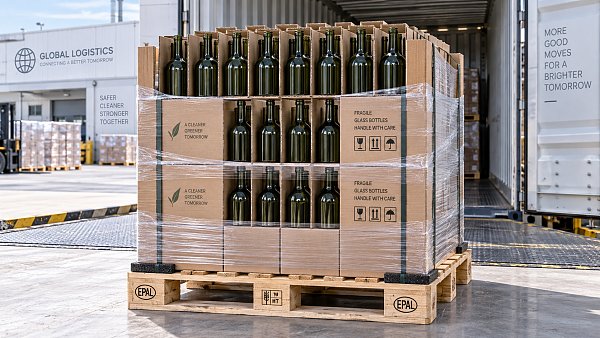
Key packaging variables include carton board grade, divider material, cell fit, tray depth, wrap tension, corner protection, and pallet edge stability.
Cartons should hold bottles securely without squeezing them excessively. Loose cells permit collision, while overly tight cells may damage finishes during unpacking.
Ask for the carton specification, including board construction, burst or edge-crush performance, moisture resistance, and maximum approved stacking configuration.
Paper dividers can be effective, but their performance changes when humidity softens the material or when bottle positions are not consistently maintained.
For demanding routes, molded pulp, corrugated inserts, reinforced trays, or other separation systems may provide better protection than minimal partition designs.
Buyers should review packed pallet photographs from multiple sides, including top layers, corner details, stretch-wrap application, and identification labels.
Pallet Design and Wrapping Control Movement Inside the Load
Pallet failures can cause widespread losses because one unstable unit load may damage hundreds or thousands of bottles during a shipment.
The pallet must match carton footprint, carry the expected weight, and remain structurally sound after forklift handling and exposure to changing humidity.
Overhang is a major concern. Cartons extending beyond pallet edges are exposed to direct impacts from forklifts, warehouse racks, and neighboring loads.
Underhang can also be inefficient when it reduces support beneath cartons or leaves gaps that permit palletized cases to shift during transit.
Stretch wrap should stabilize the load without crushing lower cartons. Excessive tension can deform packaging, while insufficient containment permits lateral movement.
Consider corner boards, top sheets, anti-slip layers, and strapping where appropriate. These components can reduce movement when properly matched to the load.
Require suppliers to specify pallet dimensions, pallet material, stack height, cases per layer, layers per pallet, and gross pallet weight before confirmation.
Container Loading Can Turn a Sound Pallet into a Claim
Ocean containers introduce vibration, acceleration, temperature variation, and route-specific handling events that suppliers cannot address through bottle design alone.
Loading plans should prevent pallets from moving longitudinally or laterally. Empty container space must be managed with suitable dunnage, bracing, or airbags.
Do not assume stretch wrap secures pallets to the container floor. It primarily stabilizes individual pallet loads rather than the entire cargo arrangement.
Floor condition matters because damaged boards, protrusions, moisture, or uneven surfaces can compromise pallet stability and increase carton compression at localized points.
Container payload limits must be respected. Heavy glass cargo can create axle, handling, and safety issues when weight distribution is poorly planned.
Ask for a container stuffing report that records seal number, pallet count, loading pattern, dunnage use, and photographs before doors are closed.
For repeat orders, review claims by shipping lane. A packaging approach that performs well regionally may require reinforcement for longer or rougher routes.
Climate and Moisture Can Quietly Increase Breakage Exposure
Glass itself is not highly moisture-sensitive, but cartons, dividers, labels, pallets, and wrapping materials can lose performance in humid shipping conditions.
When corrugated board absorbs moisture, its compression strength may decline substantially, increasing the possibility of collapsed cartons and shifting pallet layers.
Condensation inside containers can worsen the problem, particularly on long voyages involving significant temperature changes between origin, transit, and destination ports.
Buyers should discuss moisture-resistant board grades, container liners, desiccants, ventilation requirements, and warehousing conditions with suppliers and freight partners.
Climate controls are especially important when bottles will remain stored before filling, because prolonged warehouse exposure may weaken packaging after arrival.
Measure Breakage Correctly Before Comparing Suppliers
Procurement teams should define breakage rates precisely. A vague complaint about damaged bottles does not reveal whether the failure occurred before or after delivery.
Track visible breakage, chipped finishes, cracked bases, scuffed bottles, wet cartons, collapsed pallets, and unusable units found during line feeding.
Separate the damage count from the financial impact. A minor chip rate may create disproportionate cost when operators must inspect every bottle manually.
Use a standard formula: damaged or rejected bottles divided by total delivered bottles, multiplied by one hundred to create a percentage rate.
Also record damage by pallet, container location, bottle style, production lot, and delivery date. Patterns often reveal the responsible stage more clearly.
A supplier's acceptable quality level should be written into specifications, including how damage is sampled, documented, credited, and replaced.
For critical launches, define a stricter threshold for functional defects than cosmetic defects, since closure failures and glass fragments carry greater consequences.
Supplier Audits Should Focus on Evidence, Not Claims
Reliable suppliers can explain their quality process in operational terms. They should provide records rather than relying on broad statements about premium manufacturing.
Review incoming raw-material controls, furnace monitoring, mold maintenance, annealing verification, visual inspection, dimensional testing, and final packing checks.
Ask what happens when an inspection detects defects. The answer should identify containment actions, root-cause analysis, reinspection procedures, and lot traceability.
Traceability is essential for bulk wine bottles wholesale orders because a mixed pallet can otherwise make it difficult to isolate defective production runs.
Consider requesting batch-specific certificates of analysis where appropriate, especially for proprietary bottles, sensitive export markets, or tightly scheduled filling programs.
Third-party pre-shipment inspection can add value when order size, route risk, or supplier history justifies the cost of independent verification.
Contract Terms Need to Match the Actual Risk
Commercial terms should define more than price and delivery date. They should state packing requirements, inspection rights, documentation, liability, and claims timing.
Specify the required bottle model, weight tolerance, color, finish dimensions, pallet configuration, carton construction, and container loading responsibilities in writing.
Clarify the delivery term carefully. Incoterms allocate certain responsibilities, but they do not replace a detailed agreement about packaging quality and evidence.
Define how damaged goods are documented upon arrival, including photographs, pallet identifiers, counts, preservation of evidence, and notice deadlines.
Credit arrangements should account for more than replacement bottle cost when agreed. Emergency local purchases, line disruption, and freight may materially affect losses.
Procurement teams should avoid contracts that accept a supplier's standard packaging without first reviewing whether it suits the intended logistics route.
How to Balance Lower Cost Against Lower Breakage Risk
The best sourcing choice is not always the heaviest bottle or the most elaborate packaging. It is the option with the lowest expected total cost.
Calculate total landed cost using unit price, packaging cost, freight weight, insurance, anticipated damage, inspection labor, production disruption, and emergency replenishment risk.
A slightly more expensive carton or pallet configuration may be justified if it reduces damage on long-haul shipments or protects a time-sensitive bottling schedule.
Likewise, premium glass weight may be appropriate for luxury wine branding, but unnecessary for a short domestic route with proven handling controls.
Use trial shipments when changing suppliers, bottle designs, pack formats, or lanes. Small-scale evidence is usually cheaper than correcting a full-container failure.
Review performance after each shipment and update specifications when actual claim data demonstrates a recurring weakness in the supply chain.
A Practical Buying Checklist Before Placing the Order
Before issuing a purchase order, confirm the approved bottle drawing, target weight, tolerances, glass color, finish specification, and inspection standards.
Obtain written details for carton board, internal dividers, pallet dimensions, pallet stacking pattern, wrap method, corner protection, and maximum stack height.
Request photos or samples of the final packed configuration, not merely empty cartons or unwrapped bottles shown during product development.
Confirm container loading responsibilities, dunnage requirements, gross weights, stuffing photographs, transit insurance, and the escalation process for cargo damage.
Establish arrival inspection procedures before the shipment leaves origin. Warehouse and bottling teams need clear instructions for preserving claim evidence.
Finally, compare suppliers using consistent total-cost and damage-risk assumptions, rather than selecting only on quoted bottle price or nominal glass weight.
Conclusion: Build Breakage Prevention into the Sourcing Decision
Breakage in bulk wine bottles wholesale orders is best managed before production begins, through specifications that link bottle quality, packaging, and logistics conditions.
Procurement professionals should demand evidence on annealing, dimensional control, carton strength, pallet stability, and container loading rather than accepting generic assurances.
When suppliers, freight partners, and receiving teams share clear standards, buyers can reduce claims, protect bottling schedules, and improve total landed-cost predictability.
The practical objective is simple: purchase bottles that arrive consistently usable, supported by a documented system designed for the actual route and handling environment.