Industry News
Curation by industry experts
Hot Articles
Popular Tags
When do double wall corrugated boxes prevent damage in transit?
A shipment can leave the warehouse looking secure and still arrive with crushed corners, split seams, punctured panels, or product damage caused by compression inside the carton. Double wall corrugated boxes prevent this type of transit damage when a single-wall carton no longer provides enough protection against the actual distribution environment: heavy contents, repeated handling, long routes, warehouse stacking, moisture exposure, or unstable pallet loads.
The practical decision is not simply “use double wall for heavy products.” A double-wall box is justified when the risk of compression, impact, or loss of box shape is high enough that failure would create returns, rework, production delays, or rejected deliveries. Procurement teams should evaluate the product, the packing method, the shipping route, and the load placed on the carton rather than selecting board grade from product weight alone.
What double-wall construction changes
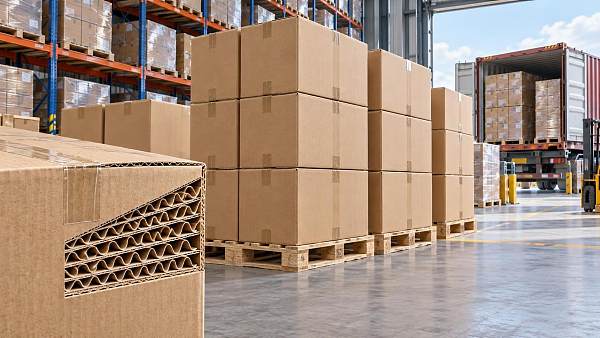
Corrugated board is made from linerboard and fluted medium. A single-wall board has one fluted layer between two liners. Double-wall corrugated board adds a second fluted layer and an additional liner, creating a five-layer structure. The added construction increases resistance to top-to-bottom compression, panel bending, puncture, and rough handling.
That extra strength is especially important after a box has already been exposed to real distribution conditions. A carton may perform well when freshly packed but lose rigidity after it has been stacked, moved through several facilities, exposed to humidity, or subjected to vibration in road, rail, air, or sea transport. Double-wall construction does not make a shipment indestructible, but it gives the box a larger performance margin when conditions are difficult or variable.
Buyers should also distinguish between board strength and box design. A stronger board cannot fully compensate for an oversized carton, weak sealing, insufficient internal support, or a pallet pattern that concentrates weight on unsupported areas. Conversely, an appropriately sized box with good internal fit may need less board strength than a poorly designed box carrying the same product.
Situations where double wall is usually warranted
The clearest trigger is a high stacking load. Cartons placed at the bottom of a pallet, in a warehouse rack, or within a floor-loaded container must carry the weight of every carton above them. As stacking height rises, lower boxes can bow outward, buckle along the vertical edges, and eventually collapse. Products may survive one or two cartons stacked above them but fail when the load is sustained for days or weeks.
Double wall is often appropriate when cartons are expected to be:
- Stored in multi-layer pallet stacks or warehouse locations with substantial vertical loads.
- Shipped in full truckloads, containers, or mixed-load consignments where other freight may press against the cartons.
- Handled through several transfer points rather than moving directly from supplier to consignee.
- Used for dense goods that place high stress on the bottom panel and hand holes, if present.
- Sent internationally, particularly where transit duration and environmental exposure are difficult to control.
- Packed with products that have sharp edges, rigid corners, metal parts, glass components, or concentrated weight points.
- Reused for internal distribution, returns, or repeated material movement.
Long-distance shipments deserve particular attention because the carton is exposed to cumulative stress rather than one isolated event. Vibration can loosen internal packing and allow products to strike one another. Repeated forklift movement can distort palletized loads. A slight loss of carton stiffness early in the route may become a major compression problem by the final delivery point.
Heavy is not the only reason cartons fail
Product mass matters, but it is only one part of the selection. A relatively light item can need a double-wall carton if it is bulky, fragile, easily punctured, or shipped in a large footprint box. Larger panels have more surface area to flex. When a broad carton is stacked, its sidewalls can bow even when the contents themselves are not especially heavy.
Likewise, a small but dense product can damage a standard carton from the inside. Hardware assemblies, ceramic items, compact appliances, machinery components, and tightly packed containers may exert concentrated force on the bottom or corners. During a drop or sudden stop, that force can break through the board. In these cases, the answer may be double wall, but it may also require a stronger inner pack, pads, corner blocks, partitions, or a different carton orientation.
Read the damage pattern before increasing board grade
When damage reports are available, the location and appearance of the failure can point to the right corrective action. Switching immediately to a heavier carton can add cost without addressing the original cause.
Crushed top panels or flattened lower cartons
This usually indicates compression loading. Check the maximum stack height, pallet storage duration, carton orientation, and whether the pallet load is aligned so that upper cartons bear on the strongest areas of the cartons below. Double wall is a sensible upgrade when the lower cartons are carrying sustained loads beyond the capability of the existing board. However, a poor pallet pattern can still cause collapse even with stronger material.
Split corners and damaged vertical edges
Corner failures often come from rough handling, insufficient edge support, oversized box dimensions, or contents that shift during transport. Double-wall corrugated boxes can improve edge rigidity, but the carton should also fit the product closely enough to prevent momentum inside the pack. Where there is unavoidable empty space, use suitable dunnage or engineered inserts rather than relying on the outer board alone.
Punctures, tears, and abrasion
Punctures may result from protruding products, sharp internal components, straps, forklift contact, or neighboring freight. A double-wall panel resists penetration better than lighter board, yet it cannot solve a sharp object pressing directly against one area. Separate sharp edges from the carton wall with pads, molded inserts, partitions, or a secondary inner carton. For external puncture risk, review pallet overhang and protective wrapping practices.
Bottom flaps opening or seams separating
Bottom failure can be caused by excess product weight, incorrect tape application, poor glue performance, insufficient flap overlap, or lifting methods that stress the base. Double wall can strengthen the panel, but closure design matters just as much. A heavy or dense pack may require reinforced taping, a different box style, or banding where appropriate for the shipping method. The carton must be evaluated as a complete system, not as board alone.
Choose flute configuration based on the risk, not just the label
Double-wall board can combine different flute profiles. The selected flute combination affects compression performance, cushioning, print surface, thickness, and resistance to crushing. A thicker structure may offer better cushioning and stacking support, while a tighter flute can improve surface stability and print quality. There is no universally best double-wall combination because the useful properties depend on product geometry and distribution conditions.
Procurement specifications should request the performance characteristics needed for the intended route. Relevant details may include board grade, flute combination, carton style, internal dimensions, allowable product weight, closure method, stacking arrangement, and whether the material may encounter humid storage or transport. Stating only “double wall” leaves too much open to interpretation. Two double-wall cartons can differ substantially in strength and suitability.
When comparing supplier proposals, confirm whether the quoted dimensions are internal or external. Internal dimensions determine product fit; external dimensions affect pallet count, freight cube, and stacking geometry. A stronger carton that increases outer dimensions may reduce units per pallet or container, changing the total logistics cost. This is one reason packaging decisions should be reviewed alongside pallet configuration rather than treated as a unit-price purchase.
Assess the carton in its actual shipping orientation
A box is strongest when it is used as intended. Changing its orientation can place load on a panel not designed to carry it. For example, a carton that stacks safely upright may be vulnerable if laid on its side to improve trailer utilization. Tall cartons are also more likely to experience sidewall deformation, while low, broad cartons may be susceptible to top-panel deflection.
Review how the product sits inside the carton. A rigid item positioned close to the top can transfer stacking force directly to the contents if the upper panel deflects. A heavy item centered in a large box can stress the bottom during vibration. Fragile products near the sidewall have little protection from side impact, regardless of board grade. Double wall works best when paired with adequate clearance, load distribution, and internal restraint.
When single wall may still be the better choice
Double wall is not automatically the most economical or sustainable answer. It uses more material, can increase carton weight, may take more storage space before conversion, and can raise freight volume if thicker board changes external dimensions. For light, stable products on short and controlled routes, a well-designed single-wall carton may provide sufficient protection.
Single wall can remain appropriate where cartons are shipped in low stacks, handled minimally, protected by a strong outer master pack, or moved within a controlled local network. It may also be suitable when the item itself provides structural support and the pack is tightly fitted. The important point is that “lighter board” should reflect a demonstrated lower-risk distribution environment, not an assumption that a product is safe because it is not heavy.
A practical buying process before issuing a specification
Start with the product and shipment conditions rather than asking suppliers for a generic double-wall option. Gather the packed product weight, dimensions, center of gravity, fragility, sharp edges, required orientation, expected storage duration, and maximum stacking scenario. Then document the route: direct shipment or multiple handoffs, palletized or floor-loaded, domestic or international, controlled warehouse or variable environment.
- Identify the primary failure risk. Decide whether compression, puncture, impact, vibration, moisture, or closure failure is the main concern.
- Review existing damage evidence. Look at damaged cartons, not only damaged products. The failure location often reveals whether the issue is structural, dimensional, or procedural.
- Define the carton and internal pack together. Specify dividers, pads, void fill, corner protection, liners, and closure requirements where they affect performance.
- Check pallet interaction. Confirm carton orientation, stack pattern, pallet deck condition, overhang limits, and stretch-wrap tension.
- Validate under representative conditions. The selected pack should be evaluated in a manner that reflects actual handling, storage, and transport exposure rather than ideal warehouse conditions.
A move to double wall is most defensible when it addresses a known compression or handling risk and is supported by a coherent carton design. When the damage source is internal movement, sharp product geometry, poor sealing, or weak palletization, the right answer may be a combined adjustment rather than simply adding heavier board. The strongest packaging choice is the one that protects the product through the real route without adding unnecessary material where a better design detail would solve the problem.
Recommended News
 Carton & PlasticsWhen do double wall corrugated boxes prevent damage in transit?Double wall corrugated boxes prevent transit damage from stacking, impact, punctures, and long-haul handling. Learn when stronger packaging delivers smarter protection.Packaging Supply ExpertSep 14, 2026
 Carton & PlasticsHow to assess a flat bottom pouch supplier’s quality controlsFlat bottom pouch supplier quality controls: assess materials, seal integrity, traceability, change management, and release processes to reduce packaging risk.Packaging Supply ExpertSep 13, 2026
 Office FurnitureHow to compare wholesale commercial carpet tiles by installed costCommercial carpet tiles wholesale: compare installed costs, freight, waste, subfloor prep, labor, and lifecycle value to make smarter procurement decisions.Interior Sourcing LeadSep 12, 2026
 Carton & PlasticsWhen is 200 gsm kraft liner board strong enough for shipping cartons?Kraft liner board gsm 200: learn when it delivers reliable carton strength, how flute, stacking, moisture, and box size affect performance.Packaging Supply ExpertSep 11, 2026