Industry News
Curation by industry experts
Hot Articles
Popular Tags
EU EPR Rule Takes Effect for Recyclable Studio Backdrops
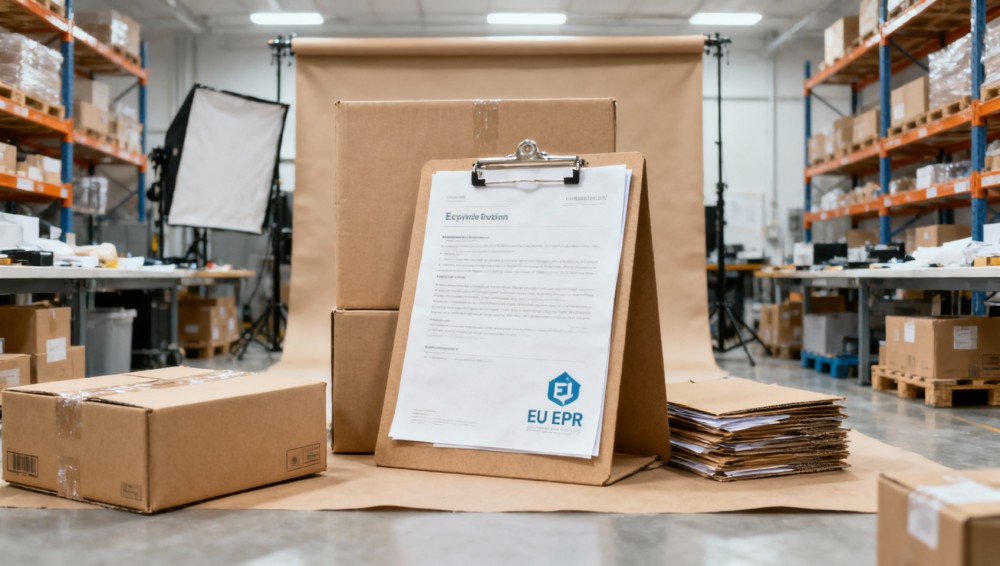
On July 1, 2026, a concrete compliance change takes effect for paper-based studio backdrop products entering the EU market: the EPR registration requirement under the Packaging and Packaging Waste Regulation (PPWR) becomes mandatory for this product scope. For exporters of wedding photography props, especially in Carton & Plastics and Eco Packaging categories, the issue is no longer just product positioning or sales access, but whether producer responsibility registration and related fee payment have been completed in the relevant member state before shipment or platform listing.
What the July 1 change confirms
The confirmed point is that, from July 1, 2026, the PPWR-linked EPR mandatory registration requirement formally applies to all paper studio set products placed on the EU market.
The information provided also confirms that Chinese exporters must complete registration with the producer responsibility organization in the relevant member state, with examples including Germany's LUCID and France's ADEME, and must pay the related eco-contribution fees.
The stated enforcement consequence is also clear in the available information: if registration and fee obligations are not completed, products may be delisted by e-commerce platforms or held by customs.
The rule change is described as directly affecting the export compliance path for wedding photography props under Carton & Plastics and Eco Packaging classifications.
Where the pressure will show up first in the trade chain
Export transactions move from product shipment to registration readiness
For direct export businesses, the immediate impact is on market-entry compliance rather than on product design alone. The core issue is that paper-based backdrop walls for studio use now carry a mandatory producer responsibility step tied to the destination member state. What deserves closer attention is whether order acceptance, listing preparation, and shipping schedules are aligned with completed PRO registration and eco-fee payment status.
Platform and channel access become part of compliance screening
For channel operators and sellers using e-commerce routes, the provided information points to a direct platform risk: products may be removed if the required registration has not been completed. From an industry perspective, this means listing continuity, SKU management, and destination-market setup may all depend on whether EPR credentials can be matched to the relevant member state requirement.
Customs exposure shifts delivery risk upstream
For supply-chain and delivery-related participants, the possibility of customs detention changes the risk profile of shipment execution. The issue is not only whether goods are ready to move, but whether supporting compliance arrangements have been completed before dispatch. In practical terms, exporters, freight coordinators, and buyers may all need closer alignment on destination-specific registration status to reduce disruption at the border.
Procurement decisions may increasingly reflect compliance capability
For buyers and sourcing teams, the rule change may affect supplier selection and order timing. Analysis shows that for paper-based wedding photography props, especially where recyclable paperboard backdrop walls are involved, supplier capability may now be assessed not only on price and delivery but also on whether the supplier can support the required registration path and related documentation for the target EU market.
What companies should review now
Check whether the product falls into the affected scope
Companies dealing in paper studio backdrop products should first verify whether the exported item belongs to the product scope described in the available information. This matters because the compliance requirement is framed around paper-based studio scene products entering the EU market.
Match each destination market with the correct registration path
The information provided identifies member-state-level PRO registration as a practical requirement, with examples such as LUCID and ADEME. Observably, businesses should pay attention to whether each destination market requires separate registration handling and whether internal trade, compliance, and sales teams are working from the same market list.
Review listing, shipping, and document workflows
Because the identified risks include platform delisting and customs detention, companies should closely review the sequence between registration completion, eco-fee handling, platform submission, and shipment release. The current information does not provide full procedural detail, so this should be treated as a compliance checkpoint requiring continued verification rather than as a fully mapped process.
Watch for further clarification in execution practice
The confirmed facts establish the requirement and the enforcement risk, but they do not provide detailed execution standards for every business scenario. From an industry perspective, companies should continue tracking official wording, platform compliance demands, and transaction-document expectations that may affect order processing, supplier qualification review, and delivery commitments.
Why this reads as an execution signal, not just a policy headline
Analysis shows that this development is better understood as a rule taking operational effect, rather than as a distant policy discussion. The reason is straightforward: the available information links the requirement to tangible consequences in market access and customs handling. At the same time, it is more appropriate to understand this as an active compliance signal that still requires observation of detailed implementation practice, especially where member-state procedures, platform checks, and documentation standards may differ in application.
How the market is likely to read this development
In neutral terms, this update signals that paper-based wedding photography backdrop products entering the EU are now more directly tied to producer responsibility compliance at the point of sale and delivery. The main industry meaning is not that all outcomes are already fixed, but that registration status, fee completion, and destination-market handling have become harder to separate from export execution. Current conditions make it more appropriate to read this as a landed compliance change with ongoing implementation details still worth monitoring.
Basis of this article and what still needs verification
This article is based on the user-provided news title, event date, and event summary. For developments of this kind, commonly relevant source types may include official regulatory notices, releases by supervisory authorities, customs or trade authority information, industry association updates, standards-related documents, and reporting by established professional media.
No specific official source link was provided in the input, so the precise official reference path still needs to be verified on an ongoing basis. What remains worth watching includes detailed policy wording, member-state implementation practice, certification or compliance interpretation, changes in tender or purchasing documents, market feedback, and how companies actually execute the requirement in trade operations.
Recommended News
 Eco PackagingWhat affects the price of kraft paper rolls bought wholesale?Kraft paper rolls wholesale pricing depends on grade, basis weight, roll size, order volume, freight, and certifications. Learn how to compare landed costs and choose reliable value.Packaging Supply ExpertOct 03, 2026
 Commercial LEDHow to evaluate a canopy lights factory before placing a bulk orderCanopy lights factory evaluation guide: verify specifications, compliance, quality control, capacity, and after-sales support before placing a bulk order.Commercial Tech EditorOct 02, 2026
 Commercial LEDHow to choose lighting systems that meet workplace safety needsLighting systems for workplace safety: learn how to control glare, improve visibility, meet environmental demands, and protect workers with reliable, compliant lighting choices.Commercial Tech EditorOct 01, 2026
 Fabrics & YarnsWhat fabric weight works best for reusable non woven fabric bags?Non woven fabric for bags: discover the best GSM range for durability, load capacity, print quality, and cost-effective reusable bag sourcing.Textile Industry AnalystSep 30, 2026