Industry News
Curation by industry experts
Hot Articles
Popular Tags
What capacity should you specify when choosing a garment washing machine manufacturer?
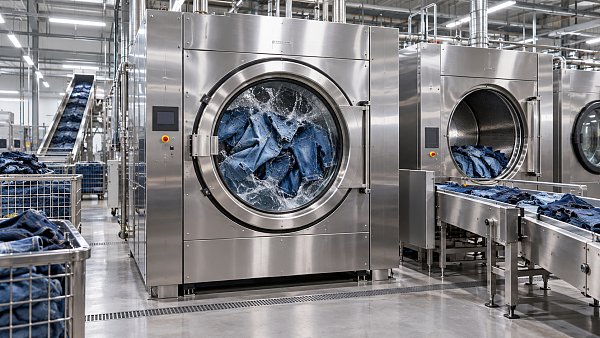
Capacity should be specified from the production requirement backward, not selected from the largest kilogram rating a supplier can offer. For most garment washing operations, the right machine is the one that can run the intended wash recipe at a stable fill ratio, complete the required number of daily batches within the available shift time, and leave enough room for rewash, maintenance, and seasonal volume changes.
A nominal 100 kg machine is not automatically suitable for a 100 kg garment batch. Denim, heavy fleece, padded outerwear, lightweight knitwear, and mixed-fashion loads occupy the drum very differently and respond differently to mechanical action. Procurement teams should therefore define capacity as a usable process capacity for a specific garment category and finish, then ask a garment washing machine manufacturer to demonstrate how that capacity was established.
Start with daily output, then calculate the batch requirement
The first question is not “How many kilograms can this washer hold?” It is “How many kilograms of garments must pass through this wash stage each day?” That figure needs to reflect finished production demand, the mix of styles, the likely rewash rate, and the actual operating schedule.
A practical calculation begins with daily washing volume and divides it by the number of batches the line can realistically complete. The result is the target dry-garment load per cycle. The word realistically matters. A theoretical cycle count based only on the main wash time will produce an undersized specification. Loading, unloading, chemical dosing, filling, draining, extraction, transfers to dryers, recipe changes, shade checks, and operator delays all consume time.
For example, a factory may plan to wash 1,200 kg of garments per day. If operations can consistently complete 12 full batches during the available shifts, the target is roughly 100 kg of dry garments per batch. But that does not automatically mean a 100 kg-rated machine should be purchased. If the process includes bulky jeans, stones, enzymes, multiple rinses, or long treatment sequences, the usable load may need to be lower. Conversely, a straightforward rinse or softener process for compact garments may support a higher fill level.
Capacity planning should also account for how production is organized. A machine sized for average daily volume can become a bottleneck when orders are concentrated into a few high-volume styles, when buyers require shorter shipment windows, or when several garment types compete for the same wash equipment. In these cases, smaller machines in parallel may provide more production control than one large machine, even when their combined nominal capacity is similar.
Nominal kilograms are only one part of usable capacity
Machine capacity is commonly stated as kilograms of dry textile load, but the rating alone does not describe the working conditions of a garment wash process. Two machines carrying the same rating can differ in drum volume, door dimensions, drum perforation, rotation control, water level flexibility, heating configuration, extraction performance, and automation. These differences affect how closely the nominal load can be approached without damaging garments or reducing finish consistency.
Procurement specifications should separate at least three capacity figures:
- Rated capacity: the manufacturer’s stated maximum dry load under its defined conditions.
- Validated production load: the dry load that can be processed for the buyer’s intended garment type and wash recipe while meeting quality requirements.
- Planning load: the lower, repeatable load used to calculate throughput, labor, utilities, and delivery commitments.
The planning load is often the most useful figure for investment decisions. It reflects the fact that washing capacity is constrained by quality, not only by physical space inside the drum. Overloading may restrict garment movement, create uneven abrasion or bleaching, reduce liquor circulation, increase crease marks, and make chemical distribution less consistent. In garment-dyeing or pigment processes, poor movement can also contribute to shade variation between pieces within the same lot.
Underloading has its own cost. A lightly filled machine may use nearly the same water, steam, electricity, and operator time as a properly loaded batch. It may also create excessive mechanical action, depending on the recipe and speed settings. The target is a load level that supports consistent garment movement and treatment, rather than the highest possible utilization figure.
Match capacity to the wash process, not just the garment weight
A garment washer is part of a process line. Its capacity must fit the process with which it will operate, especially dryers, hydro extractors, ozone systems, laser finishing, manual inspection, and packing. Selecting one oversized washer without reviewing downstream capacity can simply move the bottleneck to another station.
This is especially important where washing recipes have different cycle lengths. A basic wash may move quickly, while a multi-stage vintage effect or garment-dye process can occupy the machine for much longer. If the plant processes both, the longer recipe should influence the capacity decision unless it represents only a limited, separately scheduled product range.
Buyers should request a cycle map for each priority product family. It does not need to be a complicated engineering document. It should show the expected load, the major process stages, approximate total occupancy time, water and heating requirements, and the transfer point to the next operation. This reveals whether a capacity claim is based on a short standard program that bears little resemblance to the intended production work.
Drying deserves particular scrutiny. A washer may accept a larger batch than the dryer can process efficiently. Splitting one washed lot into two dryer loads adds handling, extends lead time, and can introduce visual variation when drying conditions influence the final hand feel or shrinkage. In some operations, choosing a washer capacity aligned with available dryer capacity produces a more stable line than maximizing washer size.
Batch traceability also influences the answer. Brands with strict color, wash, and lot-control requirements may prefer production lots that remain together from washing through finishing. A larger washer that forces multiple styles or color lots into one batch can reduce traceability and complicate corrective action when quality issues arise. The economic benefit of fewer cycles may disappear if the factory must sort, reprocess, or reject mixed production.
Do not use peak demand as the only sizing basis
Capacity should include room for growth, but capacity bought solely for an occasional peak can become expensive idle equipment. Large washers usually demand more floor space, larger utility connections, heavier foundations, greater water volume, and more consequential downtime when they are unavailable. The commercial case must compare those costs with the cost of extra shifts, temporary outsourcing, or modular expansion.
A useful approach is to define three demand bands: normal operating volume, foreseeable high volume, and exceptional peak volume. The primary machine configuration should handle normal volume comfortably and accommodate foreseeable high volume through planned scheduling. Exceptional demand may justify overtime, subcontract processing, or an additional modular unit only when the business case supports it.
For operations with volatile order profiles, two medium-capacity machines can be preferable to one large unit. This arrangement can separate dark and light colors, keep small urgent orders moving, allow recipe changes without stopping all production, and preserve partial output during maintenance. It also creates more flexibility for sample development and low-volume fashion programs. The trade-off is more labor coordination, potentially higher installation complexity, and a need to balance loads across machines.
One large machine is more attractive when the product mix is standardized, batch sizes are consistently large, utilities are designed for the load, and the operation has a strong maintenance program. There is no universally better configuration; the choice follows production variability and the cost of interruption.
Specify the conditions behind the capacity claim
When issuing an RFQ, avoid a one-line request such as “100 kg garment washing machine.” It invites suppliers to quote machines against different assumptions. A more reliable specification states the garments, the anticipated dry batch range, the principal finishes, the expected daily cycles, the shift pattern, and the utility conditions. It should also identify whether the operation will use stones, bleaching agents, enzymes, dyeing chemicals, or other materials that affect drum, piping, pump, and drain requirements.
The supplier should be asked to state its recommended working load for the specified applications rather than merely repeating the catalog rating. That recommendation should cover both the preferred normal load and the maximum load permitted without compromising process results. If the manufacturer cannot distinguish between those figures, the capacity discussion has not reached a decision-ready level.
Several technical points can materially change the usable capacity:
- Internal drum volume and diameter, which determine how freely garments can tumble and circulate.
- Programmable speed and direction control, particularly where mechanical effects must be repeatable.
- Water-level control and dosing accuracy, which affect liquor ratio and chemical consistency at different load sizes.
- Heating source, heating rate, and temperature control, because slow heating can lengthen the true batch cycle.
- Drain and filtration design, especially for stones, lint, fibers, or residues that can slow discharge and increase cleaning time.
- Door size and loading arrangement, since difficult loading can turn a nominally fast cycle into a labor bottleneck.
- Compatibility with the factory’s electrical supply, water pressure, steam or thermal system, drainage capacity, and wastewater treatment flow.
Utility capacity should be checked at the planned operating load, not only at the machine’s maximum nameplate demand. A washer may be technically installable while still creating pressure drops, insufficient hot-water recovery, overloaded drainage, or an unacceptable peak demand pattern when several units run together. Those issues become visible after installation, when they are considerably more expensive to correct.
Use trials to validate capacity before committing
For a significant purchase, capacity should be validated with representative garments and recipes. The purpose is not simply to prove that the drum can physically hold the load. The trial should compare the intended production load with the quality requirements that matter to the buyer: color appearance, abrasion effect, shrinkage, surface damage, trim integrity, hand feel, and consistency across the batch.
Where an in-person trial is impractical, the procurement team can still request a structured technical response: drum dimensions, recommended load ranges by garment category, process assumptions behind the rated capacity, cycle-time assumptions, and utility consumption conditions. Suppliers should identify which elements are machine capability and which depend on recipe development, chemical selection, garment construction, or operator practice.
It is also prudent to ask how performance changes when batches are below the preferred load. Garment factories rarely operate every machine at one perfect batch size. A machine that performs well only near maximum capacity may be poorly suited to a business handling frequent style changes or smaller replenishment orders.
Build the purchase decision around repeatable output
The best capacity specification is usually expressed as a range, not a single number. A procurement brief might require a machine rated at a certain level while expecting stable production across a defined dry-load range for named garment categories. This gives the garment washing machine manufacturer a clear basis for equipment selection and gives the buyer a measurable standard for technical evaluation.
Capacity decisions become more reliable when they are tied to the output that can be repeated shift after shift: approved garments per batch, approved batches per day, and a line flow that downstream equipment can absorb. The largest listed machine may still be the wrong purchase if it produces uneven finishes, disrupts drying capacity, or forces the factory to run oversized lots. A well-matched machine, operated within a verified working range, is more likely to protect both delivery performance and garment quality.
Recommended News
 Textile MachineryWhat capacity should you specify when choosing a garment washing machine manufacturer?Garment washing machine manufacturer guide: choose the right capacity by matching batch loads, wash recipes, daily output, utilities, and downstream line flow.Textile Industry AnalystSep 17, 2026
 Supply Chain InsightsHow to vet supplier reliability in hardware materials wholesaleHardware materials wholesale buyers can vet suppliers with practical checks for quality, capacity, compliance, pricing, and delivery reliability. Explore the full framework.Sep 16, 2026
 Commercial LEDHow custom lighting for exhibition booths shapes product visibilityCustom lighting for exhibition booths enhances product visibility with strategic contrast, accurate color, glare control, and focused display design. Discover practical planning insights.Commercial Tech EditorSep 15, 2026
 Carton & PlasticsWhen do double wall corrugated boxes prevent damage in transit?Double wall corrugated boxes prevent transit damage from stacking, impact, punctures, and long-haul handling. Learn when stronger packaging delivers smarter protection.Packaging Supply ExpertSep 14, 2026