Industry News
Curation by industry experts
Hot Articles
Popular Tags
Is an IP65 LED Lamp Approved for Wet Locations and Washdown Areas?
Is an IP65 LED Lamp Approved for Wet Locations and Washdown Areas?
An IP65 LED lamp wet location rating can look straightforward on a specification sheet: dust-tight, protected against water jets, therefore suitable for a harsh environment. In practice, that conclusion is often too quick. IP65 is an ingress-protection classification, not a blanket approval for wet locations, sanitary washdown rooms, food-processing lines, exterior canopies, or any other code-governed installation.
For quality-control and safety teams, the real question is not simply whether water can reach the light. It is whether the complete installed lighting system is acceptable for the exposure, the electrical code in force, the cleaning method, and the documentation required by the authority having jurisdiction. A fixture may carry an IP65 rating and still be the wrong choice for a room that is regularly cleaned with chemicals, high-temperature water, or close-range pressure washing.
That distinction matters because lighting failures in wet industrial spaces rarely begin with a dramatic stream of water entering the housing. More often, moisture tracks through a cable entry, a gasket takes a set after repeated cleaning, a lens cracks under chemical attack, or an installer opens a fitting and fails to restore the seal. The rating on the carton does not remove those risks.
What IP65 actually confirms—and what it does not
The IP code is commonly evaluated under IEC 60529. In IP65, the first digit, 6, indicates protection against dust ingress. The second digit, 5, indicates protection against water projected by jets from any direction under the test conditions defined by that standard. It is useful information, especially for warehouses, workshops, loading bays, covered exterior areas, and production spaces where occasional washdown is controlled.
But IP65 does not mean waterproof under every condition. It does not automatically cover immersion, steam, flooding, highly concentrated spray at very close range, aggressive detergents, or repeated thermal cycling. It also says nothing by itself about whether a product has been evaluated as a complete luminaire for a legally defined “wet location.”
This is where procurement documents can create trouble. A buyer may write “IP65 minimum” into a tender, while the safety team assumes the phrase also means “listed for wet locations.” Those are different requirements. One describes an enclosure’s resistance to ingress under a test method; the other may depend on product certification, marking, electrical construction, installation instructions, and local code interpretation.
There is another practical issue: the word lamp is often used loosely. A replaceable LED lamp, a sealed LED fixture, and an integrated linear luminaire are not evaluated in the same way. Even if the body of a luminaire is IP65, the final assembly can lose that protection through an unsuitable junction box, a non-rated connector, an incorrectly selected cable gland, or an open-ended conduit connection.
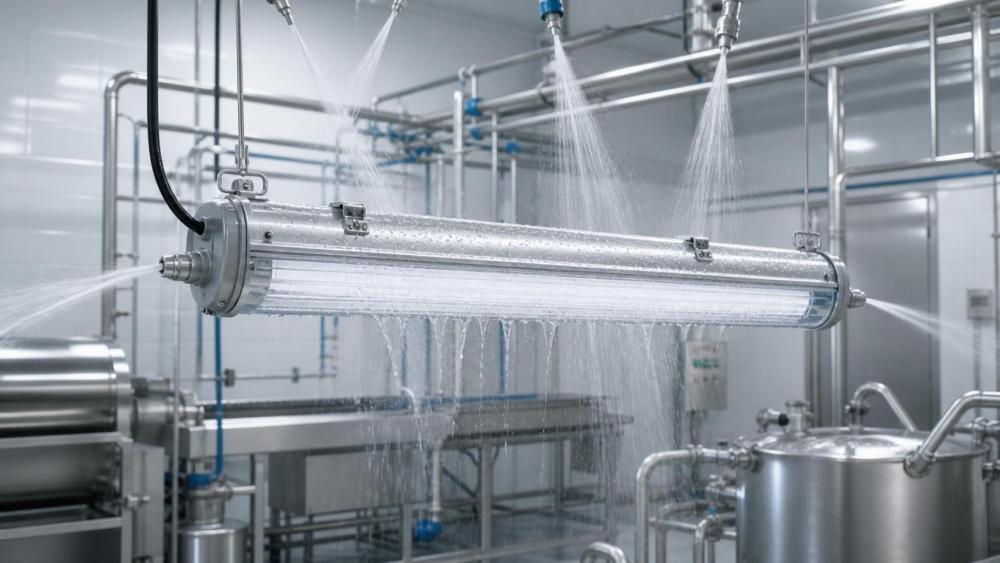
“Wet location” is a compliance term, not an IP shortcut
In North American projects, “wet location” is generally tied to electrical-code definitions and product listing requirements. The National Electrical Code distinguishes wet locations from damp locations, and equipment installed in a wet location generally needs to be identified as suitable for that environment. The exact acceptance path can vary by jurisdiction, project type, and inspection authority, but the core procurement lesson is consistent: ask for the fixture’s actual wet-location marking or certification evidence, not just an IP rating.
A product bearing an IP65 declaration but lacking the relevant North American listing may not satisfy a project specification that calls for a wet-location listed luminaire. Conversely, a wet-location listed fixture may have a different IP rating than expected, depending on its design and intended market. Neither label should be treated as a substitute for the other.
For projects using IEC-based standards, the compliance conversation may be framed differently, but the same discipline applies. The purchaser should verify the declared IP classification, the applicable product-safety standard, manufacturer instructions, local wiring rules, and the conditions attached to the declaration. A CE mark, where relevant, is not a universal wet-location approval and should not be interpreted as one.
If a specification says “approved for wet locations,” the phrase needs to be translated into an auditable requirement before ordering. Which country or jurisdiction governs the site? Is third-party certification required? Must the product bear a visible marking? Does the certification cover the exact model, voltage, mounting orientation, and accessories being supplied? These are not administrative details. They determine whether a fixture can remain installed after inspection.
Washdown is usually tougher than the IP65 label suggests
A washdown area is not defined merely by visible water. In a meat-processing room, dairy facility, beverage plant, commercial kitchen, pharmaceutical support space, or industrial cleaning bay, the exposure can include frequent hose-down cycles, detergents, disinfectants, foam cleaners, heat, condensation, and direct spray from short distances. The light may be hit repeatedly at the lens seam and cable entry—the very locations most likely to degrade over time.
IP65 can be appropriate for some light-duty washdown conditions, but it should not be treated as a default answer for high-pressure sanitation. The pressure, nozzle distance, water temperature, spray angle, duration, and frequency all change the severity of the exposure. A fixture mounted high above a controlled rinse zone faces a different risk from one installed over an open processing line and washed every shift.
For severe cleaning regimes, project teams often assess ratings intended for more demanding water exposure, along with material compatibility and hygiene-oriented construction. An IP66, IP67, IP68, or IP69K marking may appear relevant depending on the risk, but higher digits alone do not settle the decision. Each rating addresses a specific test condition. For example, an immersion rating does not automatically demonstrate resistance to forceful external jets, and a powerful-jet rating does not prove that seals will resist the site’s particular cleaning chemistry for years.
The most expensive mistake is to compare rating numbers without reading the cleaning protocol. A sanitation supervisor may use a nozzle and pressure setting that is substantially more severe than the fixture supplier assumed. This is why lighting review should include operations or sanitation personnel, not only electrical contractors and purchasing staff.
The weak points are usually outside the housing
A sealed housing can create false confidence. In field inspections, the vulnerable points are often the cable gland, connector, junction box, mounting bracket penetrations, lens gasket, and end cap. If the supplied cable has a damaged jacket, if the gland is not tightened to the manufacturer’s torque guidance, or if an unused entry is blanked with the wrong plug, the installed system may no longer match the tested configuration.
Mounting orientation also matters. Some fixtures are rated only for specific orientations because drainage paths, gasket compression, or thermal management depend on how the enclosure sits. A unit installed upside down under a pipe rack may collect water where the tested installation did not. Instructions should be treated as part of the compliance file rather than as optional installer literature.
Material selection deserves similar attention. Polycarbonate lenses, powder-coated metal bodies, silicone seals, stainless hardware, and polymer cable glands each respond differently to cleaners and disinfectants. A product can pass an ingress test and still show premature discoloration, embrittlement, corrosion, or seal deterioration when exposed to incompatible chemicals. Where washdown chemicals are known, ask the manufacturer for compatibility guidance and request a clear statement of any exclusions.
A practical review before approving an IP65 fixture
Rather than approving lighting from one line on a datasheet, build the review around the actual installation. The following checks are usually more useful than asking whether IP65 is “good enough” in the abstract:
- Confirm whether the area is classified as dry, damp, wet, corrosive, hazardous, or subject to washdown under the applicable project and local requirements.
- Obtain the exact certification, listing, declaration, or marking required for the site—not a generic statement that the product is “waterproof.”
- Review the full model number, including driver, emergency module, sensor, connector, mounting kit, and any field-installed accessories.
- Document the cleaning process: water pressure, temperature, nozzle distance, chemical type, cleaning frequency, and whether direct spray reaches the fixture.
- Check cable entry methods, junction-box suitability, grounding provisions, drain paths, and installation orientation.
- Ask whether the ingress rating applies to the finished installed assembly or only to the luminaire enclosure under defined test conditions.
A short clarification request at this stage can prevent a difficult substitution later. It is especially important when sourcing internationally, where documentation may use familiar terms differently. “Waterproof,” “industrial grade,” and “washdown ready” are commercial descriptions unless they are backed by verifiable technical documentation tied to the exact product.
How quality teams can make the decision easier to defend
The cleanest approval trail links three things: the environmental classification of the area, the required approval or listing route, and the manufacturer’s evidence for the exact installed product. Put those records in the submittal package before installation, along with the manufacturer’s installation instructions and cleaning limitations. If the site changes its sanitation process later, the lighting should be reassessed rather than assumed to remain suitable.
For multinational sourcing teams, this is also where fragmented supplier information becomes a real operational risk. Specifications, certification documents, material declarations, and installation details may sit with different parties. Global Supply Review tracks the kind of cross-functional questions that arise in lighting and other foundational manufacturing sectors: not just what a supplier claims, but whether the technical record matches the operating environment and procurement requirement.
An IP65 LED lamp may be a sensible choice for a particular wet or washdown-adjacent area. It may also be inadequate, or not acceptable to the inspector, even though the enclosure rating appears robust. The defensible answer comes from the fixture’s certification and instructions, the exposure created by real cleaning practices, and the integrity of the installed system. Treat IP65 as one decision input—not the approval itself.
Recommended News
 Carton & PlasticsWhen should you heat seal aluminum foil zipper bags for food storage?When should you heat seal aluminum foil zipper bags? Learn when stronger closures matter, how to protect dry foods, and which sealing checks help ensure reliable storage.Packaging Supply ExpertOct 16, 2026
 Supply Chain InsightsHow to find a custom-printed ring-pull can supplier for small ordersFind a custom printed ring pull cans supplier for small orders. Compare MOQs, printing options, samples, and delivered costs to launch confidently without excess inventory.Oct 15, 2026
 Supply Chain InsightsWhat Should You Check When Auditing a Contract Furniture Supplier?What should be checked when auditing a contract furniture supplier? Discover essential checks for compliance, quality, traceability, and delivery to reduce sourcing risks.Oct 14, 2026
 Office FurnitureDoes sealing MDF furniture reduce the risk of toxic emissions?Concerned about MDF toxicity? Discover how sealing furniture can reduce formaldehyde emissions, where it falls short, and how to choose low-emitting options for your home.Interior Sourcing LeadOct 14, 2026