Industry News
Curation by industry experts
Hot Articles
Popular Tags
High-Volume Apparel Labeling: Preventing Mislabels at Production Scale
High-Volume Apparel Labeling: Preventing Mislabels at Production Scale
High-volume apparel labeling leaves little room for error. A single incorrect care label, size ticket, fiber-content declaration, country-of-origin mark, or safety warning can affect thousands of units before the problem is noticed. The immediate consequence may be rework and delayed shipment. The more serious consequences can include retailer chargebacks, customs issues, consumer complaints, product withdrawal, and a loss of confidence between factory and buyer.
For quality and safety teams, the answer is not simply to add more final inspection. Final inspection can catch visible defects, but it is a weak last line of defense when labels have already been sewn into finished garments or packed into mixed cartons. Reliable high volume apparel labeling depends on controlling information as carefully as material flow: the approved data, the artwork version, the physical label stock, the bundle identity, and the verification records all need to stay aligned from pre-production through shipment.
The best systems are usually not the most complicated. They are the ones that make the correct action easy for operators and make an incorrect action difficult to complete unnoticed.
Why labeling errors multiply at scale
Mislabels rarely begin with a sewing operator making an isolated mistake. More often, the failure starts earlier: a buyer updates care instructions after samples are approved; a merchandising team changes a style code; two colorways share similar label artwork; an old carton of labels remains near the line; or production is switched without a proper clearance check. At low volumes, people may recognize the inconsistency by memory. At production scale, memory is not a control.
The risk becomes sharper when one factory handles multiple markets. A garment intended for one destination may need different fiber naming conventions, language content, importer information, warning statements, or care-label wording than the same garment sold elsewhere. Requirements can vary by product category and destination, and they change over time. Teams should therefore avoid treating a previous order as proof that a new order is compliant. The current buyer specification and applicable market requirements must be checked for the specific shipment.
High output also creates a misleading sense of stability. A line may run correctly for hours, then fail during a shift handover, replenishment, style change, repair operation, or packing transfer. These are the moments when traceability matters most, because the affected quantity is often defined by when the process stopped being controlled—not by when someone finally discovered the error.
Build one approved source of label truth
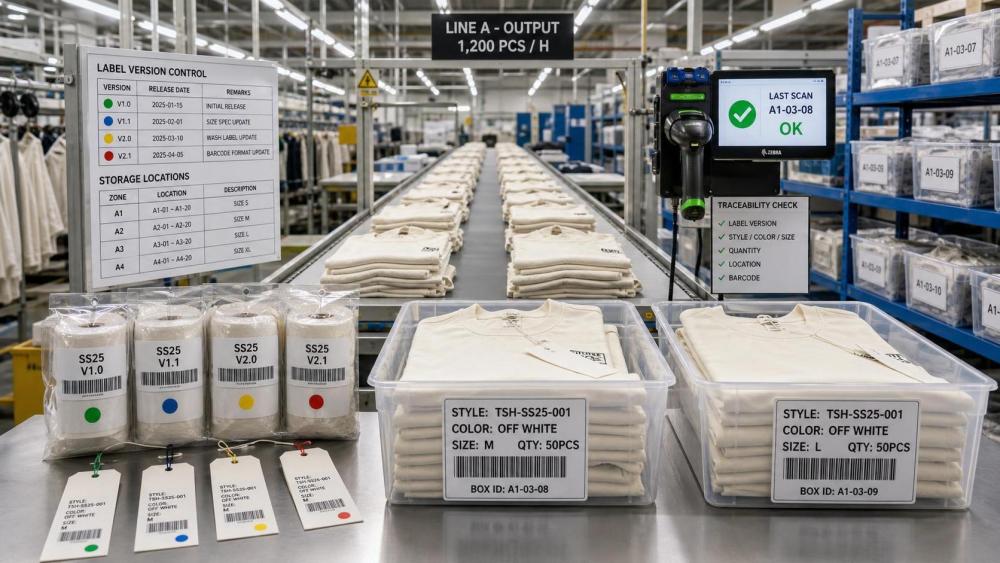
Every production order needs a controlled label specification package, not a collection of artwork files circulating in email, messaging groups, and printed notes. The package should identify each required component: main label, size label, care label, composition label, hangtag, price ticket, polybag warning, carton mark, barcode label, and any buyer-specific traceability element. It should also show where each item belongs and which versions are valid for each style, color, size range, and destination.
A useful specification does more than display artwork. It makes the production decision unambiguous. Where applicable, it should state the readable text, language order, label dimensions, fold type, placement tolerance, stitch method, barcode symbology, SKU or item reference, revision date, and approval status. For care labels, the approved symbols and wording must be treated as controlled content rather than something operators or suppliers “know from experience.”
Version control deserves special attention. An artwork filename such as “final_new2” is not a reliable document-control method. Use a revision identifier that appears both in the approval record and, where practical, on the production-facing specification. When an update occurs, the old version needs a formal disposition: removed from points of use, quarantined, returned, or clearly marked obsolete. Otherwise, old stock can quietly re-enter the process during a rush order.
Treat labels as controlled production materials
Labels are often managed less rigorously than fabric or trims because they are small, inexpensive, and easy to store. That is precisely why they are vulnerable to mix-ups. A factory may have several rolls that look almost identical but contain a different size sequence, fiber statement, language set, or barcode. Visual similarity should never be the main identification method.
Incoming label checks should compare delivered material against the approved specification before it is released. The check may include text, artwork, color, dimensions, fold direction, adhesive behavior for stickers, barcode readability, roll count, and lot identification. If a label supplier provides a production sample, it should be reviewed against the signed-off master rather than only against a digital PDF. Print quality, weave density, cutting accuracy, and scan performance can differ materially from a screen view.
Storage design matters. Segregate labels by order, style, and revision; use clearly identified bins or sealed containers; and avoid keeping multiple style labels open at the same machine. Replenishment should follow the same discipline. A runner who delivers a fresh roll without confirming the line, style, size, and revision can undo an otherwise sound quality system in seconds.
Control the handoffs where mislabels are born
The highest-risk points are usually transitions rather than routine sewing. Production managers and QA leaders should map the actual route of labels through the factory: warehouse release, line issue, sewing attachment, bundle movement, finishing, ticketing, packing, carton marking, and shipment release. The map often reveals gaps between departments that are not visible in a written procedure.
At line start, the supervisor and quality representative should verify the first approved piece against the current specification. This is more useful than a generic “start-up check” because it links the physical garment to the exact order data. The same check should be repeated after a planned style change, a label replenishment that introduces a new roll or lot, a machine stoppage involving material removal, and a shift change where responsibility passes to another team.
Line clearance is especially important. Before a new style or destination variant begins, remove unused labels, tickets, polybags, and packing marks from the prior run. Count or reconcile the residual material where feasible. The aim is not administrative perfection; it is to prevent leftover labels from becoming mixed into the next order. A signed checklist is useful only if the floor layout and storage practice make clearance physically realistic.
Bundle identity should survive every operation
When garments move in bundles, the bundle ticket or digital record should carry enough information to preserve identity through production. At a minimum, teams often need to distinguish order, style, color, size, destination, and bundle quantity. If two destinations require different labeling, they should not rely on similar bundle descriptions or operator memory. Separate routing, distinct visual identifiers, and controlled workstations are safer.
Barcode or RFID systems can strengthen traceability, but technology does not repair bad master data. A scanner can confirm that a label was scanned; it cannot confirm that the approved label data were loaded into the system correctly. Before deployment, define what the scan is supposed to prevent: wrong size ticket, wrong SKU, wrong carton assortment, duplicate serial identity, or a mismatch between garment and destination. Then test the exception path, not just the normal workflow.
Use verification that matches the failure mode
A visual inspection is appropriate for some issues, such as label placement, sewing quality, obvious text defects, or whether the correct label family is present. It is less dependable for small text differences, similar product codes, or barcode content. Verification should be selected according to the risk.
Sampling plans also need to reflect the process. A random final sample can indicate whether defects exist, but it may not reveal a short-lived mix-up that occurred on one station or within one carton range. Risk-based checks around start-up, changeover, replenishment, and packing are often more revealing than simply increasing random inspection volume.
Respond to a discovered mislabel without widening the loss
When a mislabel is found, the first task is containment. Stop the affected operation, identify the last known good verification point, isolate work in progress and finished goods produced since that point, and prevent the same label stock from being issued elsewhere. The investigation should distinguish the physical defect from the system failure that allowed it: wrong material release, unclear specification, incomplete changeover, ineffective scan rule, or inadequate training.
Traceability records determine whether the response is targeted or disruptive. If the factory can identify affected bundles, packing ranges, and label lots, it may avoid opening all finished cartons. If those links are missing, the safest decision may involve much broader inspection. That operational difference is why traceability should be treated as a quality-control capability, not merely a customer reporting requirement.
Corrective action should change the process, not just remind people to “be careful.” For example, if two nearly identical labels were stored together, the correction may be physical segregation and system-controlled issue quantities. If a revision was missed, it may be an approval gate that blocks production until the current file and physical label are reconciled. Repeated retraining without a process change usually leaves the same error path open.
What procurement and safety teams should ask before production begins
Buyer requirements are often technically correct but operationally incomplete. Before bulk production, confirm which party owns the final approval of wording, symbols, country-of-origin information, retailer tickets, and market-specific variants. Clarify whether the supplier may procure labels from an approved source, whether substitutions require written approval, and whether barcode data will be supplied as a controlled file.
It is also worth asking how the factory manages label revisions after materials have arrived, how it segregates destination-specific orders, what triggers a line clearance, and what records can be produced if an issue appears after shipment. These questions are more informative than a general assurance that “inspection is performed.” They reveal whether the supplier can control a fast-moving labeling process when conditions change.
Global Supply Review examines these operational links across textiles and apparel supply chains because labeling accuracy sits at the intersection of product compliance, packaging execution, data management, and export readiness. For factories and buyers, the practical objective is straightforward: make the approved label information traceable, make material movement visible, and verify the moments where mix-ups are most likely.
At production scale, a label is not a minor trim. It is product data attached to a physical garment. Managing it with the same discipline applied to critical components is the most dependable way to keep a small mistake from becoming a shipment-wide problem.
Recommended News
 Supply Chain InsightsHow to use supply chain resilience metrics to assess recovery riskUse supply chain resilience metrics to compare recovery time, survival buffers, and financial exposure. Learn how to assess disruption risk and prioritize mitigation that protects service.Oct 18, 2026
 Commercial LEDHow to assess an LED street light exporter’s warranty coverageAssess an led street lights exporter beyond warranty length. Learn how to verify coverage, uncover hidden costs, and negotiate stronger terms before you buy.Commercial Tech EditorOct 17, 2026
 Carton & PlasticsWhen should you heat seal aluminum foil zipper bags for food storage?When should you heat seal aluminum foil zipper bags? Learn when stronger closures matter, how to protect dry foods, and which sealing checks help ensure reliable storage.Packaging Supply ExpertOct 16, 2026
 Supply Chain InsightsHow to find a custom-printed ring-pull can supplier for small ordersFind a custom printed ring pull cans supplier for small orders. Compare MOQs, printing options, samples, and delivered costs to launch confidently without excess inventory.Oct 15, 2026