Industry News
Curation by industry experts
Hot Articles
Popular Tags
Selecting Printers and Materials for High-Volume Apparel Labeling Operations
In a high-volume apparel program, a label is rarely “just a label.” It carries care instructions that must remain readable after repeated washing, size information that must be correct at the point of sale, fiber-content declarations required by market rules, and branding that shapes the customer’s first physical impression of a garment. When output reaches hundreds of thousands or millions of units, small choices in printer type, ribbon grade, adhesive behavior, or label construction can quickly become costly operational problems.
For procurement teams, selecting printers and materials for high volume apparel labeling is therefore a total-system decision. The lowest unit price may be outweighed by reprints, line stoppages, operator intervention, rejected garments, or labels that fail during washing and create claims downstream. The more reliable approach is to evaluate the labeling operation as a connected workflow: data source, printer, consumables, application method, inspection, and final garment performance.
Start with the label’s job, not the printer catalogue
Suppliers often present printer specifications first: print speed, resolution, connectivity, and media width. Those metrics matter, but they do not define whether a labeling solution is fit for purpose. A care label sewn into a children’s garment, a removable size sticker on folded knitwear, and a heat-transfer neck label have very different demands.
Before comparing equipment, procurement should separate label requirements into practical use cases:
- Permanent care and compliance labels: Must preserve legibility through washing, drying, abrasion, and exposure to detergents.
- Brand and size labels: May be woven, printed, heat transferred, or pressure-sensitive depending on garment construction and brand direction.
- Temporary logistics labels: Used for bundles, cartons, work-in-progress tracking, and warehouse routing; speed and scan quality are often the priority.
- Retail-facing labels: Hangtag stickers, price labels, RFID labels, and country-specific retail identifiers require accurate variable data and dependable barcode performance.
A mixed apparel portfolio commonly needs more than one labeling technology. Trying to force every application through a single printer platform can appear efficient during sourcing, yet it often creates compromises in durability, throughput, or cost per label. The objective is not to own the fewest machines; it is to create the simplest reliable configuration for the actual production mix.
Match print technology to volume, variability, and durability
Three print approaches dominate most apparel labeling environments: thermal transfer, direct thermal, and digital printing. Each has a distinct place in a high-volume operation.
Thermal transfer: the workhorse for variable durable information
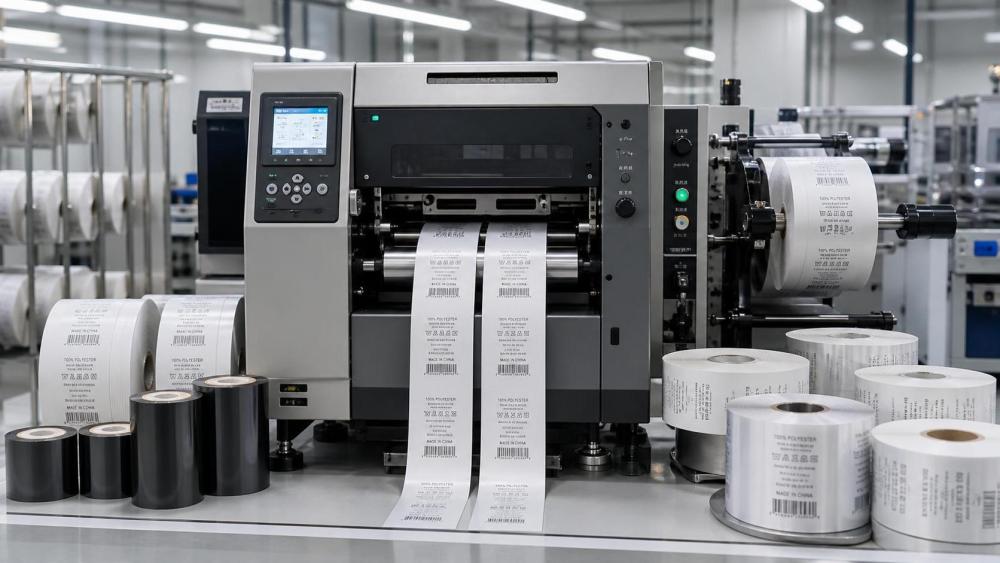
Thermal transfer printing uses a heated printhead to transfer ribbon ink onto the label substrate. For variable care labels, serialized labels, barcode labels, and compliance information, it is often the most practical choice. The printed result can be highly durable when the ribbon chemistry is matched properly to the material.
It is particularly useful where factories need to print changing SKUs, sizes, languages, lot codes, or destination-market content without waiting for preprinted stock. Industrial thermal-transfer printers also suit continuous or near-continuous production, provided they are paired with an appropriate unwind system, cutter, applicator, and preventive-maintenance plan.
The limitation is not usually the printer itself, but the combination of printhead, ribbon, substrate, and environmental conditions. A resin ribbon may be necessary for strong wash and abrasion resistance on synthetic materials, while a wax-resin grade may meet less demanding applications at lower consumable cost. Buying ribbon solely by roll price is a familiar but expensive mistake.
Direct thermal: useful, but usually not for permanent garment information
Direct thermal printing creates an image directly on heat-sensitive media and requires no ribbon. This reduces consumables and simplifies operation. It is well suited to short-life logistics labels, shipping labels, temporary bundle identification, and internal warehouse tracking.
For permanent apparel care labels, however, direct thermal is generally a poor fit. Heat, light, friction, and time can degrade the image. If the label must remain readable over the garment’s life, procurement should require wash testing rather than accepting a visually good sample from a newly printed roll.
Digital printing: stronger for design-rich or short-to-medium changing runs
Digital textile or label printing can be valuable when color graphics, frequent artwork changes, multiple language versions, or smaller production batches are involved. It may reduce the need to hold extensive inventories of preprinted branded labels. For fashion programs with frequent collections and regional variants, that inventory flexibility can be meaningful.
Its economics should be assessed carefully at very high volumes. Ink usage, finishing requirements, print speed, color consistency controls, and operator skill all affect the real cost. Digital systems can be a smart strategic fit, but they should not be selected simply because they offer attractive sample quality.
Material selection is where many hidden costs begin
Label substrates influence more than appearance. They affect print quality, garment comfort, sewing performance, conversion waste, and compliance outcomes. In apparel, the choice often comes down to a balance between soft hand feel, durability, opacity, print receptivity, and price.
Polyester satin is widely used for care labels because it offers a soft feel and refined appearance. It can suit intimate apparel, premium garments, and products where skin contact matters. Yet satin can be more demanding during printing and sewing than a stiffer alternative, and material quality varies substantially between suppliers.
Polyester taffeta is often selected for its strength, clean print surface, and comparatively economical performance. It is common in workwear, outerwear, and high-volume basics, although its hand feel may be less desirable for sensitive-skin applications.
Nylon-based materials have long been used for durable care content, but buyers should consider current sustainability expectations, recycling pathways, and destination-market requirements before standardizing them. A technically familiar substrate is not automatically the best long-term sourcing choice.
For pressure-sensitive labels, facestock and adhesive must be assessed together. A label that adheres perfectly to a smooth polybag may lift from a recycled carton, leave residue on a garment bag, or fail in humid warehouse conditions. When labels are applied to textiles directly, the risk of adhesive migration or fabric marking should be treated seriously.
Ask for performance evidence that resembles real production
Sample approval is often too visual. A crisp black print on a freshly produced care label says little about what will happen after stitching, pressing, washing, packing, and transport. Procurement specifications should define measurable acceptance criteria and require suppliers to demonstrate them under relevant conditions.
For durable apparel labels, testing may include home-laundering cycles, tumble-drying exposure, dry-cleaning resistance where relevant, rub resistance, heat exposure, and legibility of small characters. Barcode labels should be checked for print contrast and scanning performance at the actual scanner settings used on the line or in the warehouse. Heat transfers need assessment after stretch and repeated wash cycles, not merely after first application.
It is equally important to inspect the information itself. A label may survive washing but still fail if multilingual care symbols, fiber percentages, country-of-origin statements, or font sizes are incorrect. In high volume apparel labeling, data governance is as important as ink adhesion. A controlled artwork and variable-data approval process can prevent thousands of units from being labeled with obsolete or noncompliant information.
Throughput depends on the workflow around the printer
A printer rated for high speed can still become a bottleneck if operators must frequently reload media, manually peel labels, clear static-related jams, or wait for data files. Buyers should map the entire label path before committing to a solution.
Questions worth asking include:
- What is the required labels-per-minute rate during peak production, not average output?
- How many label formats, widths, and languages will run on the same line?
- Will labels be cut, rewound, dispensed, sewn, heat applied, or automatically applied to packaging?
- Can the printer integrate with ERP, PLM, WMS, barcode, or RFID data systems?
- What happens if a network connection drops or a variable-data file contains an error?
- How quickly can operators change ribbons, media rolls, and printheads without disrupting production?
Automation can be justified when label application is repetitive and stable. Print-and-apply systems, automatic cutters, rewinders, vision inspection, and RFID verification can reduce handling and mislabeling. But a highly automated setup is not automatically better for a factory producing many small runs with frequent format changes. In that environment, changeover time and operator usability may matter more than maximum line speed.
Compare total cost of ownership, not just equipment and label prices
The purchase price of a printer is only one line in the business case. A useful total-cost model should include equipment depreciation or leasing, printheads, ribbons or inks, substrate cost, maintenance, electricity, spare parts, downtime exposure, operator labor, waste, quality inspection, and inventory carrying costs for preprinted labels.
For example, a lower-cost ribbon that causes poor edge definition may generate barcode scan failures. A cheaper substrate with inconsistent coating may increase printhead wear or require more frequent calibration. Conversely, a more expensive durable label stock may reduce rework and support a cleaner sewing process. The right comparison is cost per accepted, correctly applied label—not cost per blank roll.
Procurement teams should also model risk concentration. If one proprietary printer, ribbon, or label construction is available from only a single source, disruption can halt a production line. Where possible, specify performance requirements that allow qualified alternatives, while maintaining strict control over approved material combinations.
Sustainability needs a practical specification
Apparel brands increasingly ask for recycled content, reduced packaging, lower-impact inks, and improved end-of-life compatibility. These goals are legitimate, but vague sustainability language can create confusion at the sourcing stage. “Eco-friendly label” is not a technical specification.
A better approach is to identify the actual priority: reduced virgin material, recycled polyester content, responsible forestry inputs for paper labels, lower chemical impact, material reduction, or improved recyclability within the garment system. Then assess whether the proposed label can still meet wash durability, comfort, and regulatory needs.
For textile labels, material compatibility matters. A label made from a different polymer than the garment can complicate recycling, even if the label itself contains recycled content. In some cases, reducing label size, consolidating information, or shifting selected content to a digital product passport may deliver a more meaningful material reduction than changing substrate alone. Such decisions should still account for market-specific mandatory labeling rules.
A disciplined sourcing process prevents expensive surprises
The strongest purchasing decisions usually begin with a short, clear specification pack rather than a broad request for quotation. It should state label application, garment category, expected annual and peak volumes, artwork and variable-data requirements, substrate preference, wash or abrasion requirements, compliance markets, approved color targets, roll configuration, acceptable defect levels, and required system interfaces.
Then run a controlled trial using representative garments and real production data. Test more than print appearance: observe loading time, operator behavior, stitching or heat-application performance, reject rates, scan quality, and the condition of labels after finishing. A supplier that can explain limitations openly is often more valuable than one that promises universal suitability.
Global Supply Review’s sourcing perspective is especially relevant here: labeling choices sit at the intersection of textiles, printing technology, packaging workflows, and international compliance. Procurement teams gain more leverage when they involve quality, production engineering, compliance, and sustainability stakeholders before a purchase order is issued—not after a labeling failure reaches a retail market.
The procurement decision in one sentence
For high-volume apparel labeling, select the printer and material combination that delivers the required information accurately, survives the garment’s intended use, fits the factory’s real operating rhythm, and produces the lowest cost per accepted label over time. That standard is more demanding than comparing catalog specifications, but it is the one that protects both production continuity and brand trust.
Recommended News
 Supply Chain InsightsHow to use supply chain resilience metrics to assess recovery riskUse supply chain resilience metrics to compare recovery time, survival buffers, and financial exposure. Learn how to assess disruption risk and prioritize mitigation that protects service.Oct 18, 2026
 Commercial LEDHow to assess an LED street light exporter’s warranty coverageAssess an led street lights exporter beyond warranty length. Learn how to verify coverage, uncover hidden costs, and negotiate stronger terms before you buy.Commercial Tech EditorOct 17, 2026
 Carton & PlasticsWhen should you heat seal aluminum foil zipper bags for food storage?When should you heat seal aluminum foil zipper bags? Learn when stronger closures matter, how to protect dry foods, and which sealing checks help ensure reliable storage.Packaging Supply ExpertOct 16, 2026
 Supply Chain InsightsHow to find a custom-printed ring-pull can supplier for small ordersFind a custom printed ring pull cans supplier for small orders. Compare MOQs, printing options, samples, and delivered costs to launch confidently without excess inventory.Oct 15, 2026