Industry News
Curation by industry experts
Hot Articles
Popular Tags
US Emergency Lighting Market: Demand Drivers, Codes, and Growth Segments
When a building loses normal power, emergency lighting becomes visible in a way few other building systems do. Exit signs, corridor fixtures, stairwell luminaires, and backup lighting must work immediately—often in smoke, confusion, or a crowded evacuation. That simple operational requirement is helping reshape the US emergency lighting market, where procurement decisions are increasingly tied to code compliance, retrofit timing, energy performance, testing labor, and long-term facility risk.
For business evaluators, this is not a market defined only by fixture sales. It sits at the intersection of life-safety regulation, commercial construction activity, deferred maintenance, and the modernization of aging building portfolios. A low initial product price may be attractive, but it can quickly lose its appeal if a unit complicates testing, fails prematurely, lacks clear documentation, or does not align with the authority having jurisdiction (AHJ) in the project location.
The strongest demand is emerging where compliance pressure and operational disruption overlap: healthcare facilities, schools, multifamily properties, warehouses, hospitality venues, offices, public buildings, and mixed-use developments. Across these environments, LED technology and self-testing systems are changing what buyers expect from emergency lighting suppliers.
Why the US Emergency Lighting Market Is Moving Beyond Basic Replacement
Emergency lighting has traditionally been viewed as a necessary but relatively routine category. Many facility owners replaced battery packs, exit signs, or remote heads only when units failed a test or a renovation forced an upgrade. That approach is becoming less workable.
Older commercial buildings carry a large installed base of legacy fluorescent, incandescent, halogen, and early-generation LED products. These systems can create a difficult mix of declining battery performance, inconsistent illumination, harder-to-source components, and labor-intensive inspection routines. At the same time, facilities are under greater pressure to demonstrate that life-safety systems are maintained—not merely installed.
LED emergency luminaires have changed the replacement equation. Their lower energy draw can support longer runtime from compact battery systems, while longer-rated light sources reduce routine relamping needs. In a new construction project, these benefits are usually built into the specification. In retrofit work, the appeal is different: fewer maintenance visits, more consistent visual appearance, and an opportunity to standardize products across a portfolio.
However, buyers should avoid treating LED as a complete answer by itself. Battery chemistry, charge circuitry, ambient temperature exposure, fixture placement, photometric performance, and diagnostics all affect real-world reliability. A bright-looking emergency light in a product catalog does not automatically prove that it will deliver required illumination along an actual egress path.
Codes Are the Market’s Most Durable Demand Driver
Life-safety codes create the baseline demand for emergency lighting, but the regulatory landscape is not controlled by one document alone. Project teams commonly navigate requirements drawn from adopted editions of the International Building Code (IBC), International Fire Code (IFC), NFPA 101: Life Safety Code, and NFPA 70: National Electrical Code. Occupational Safety and Health Administration (OSHA) rules may also apply in workplace settings. Local and state amendments, along with AHJ interpretation, ultimately determine what is accepted on site.
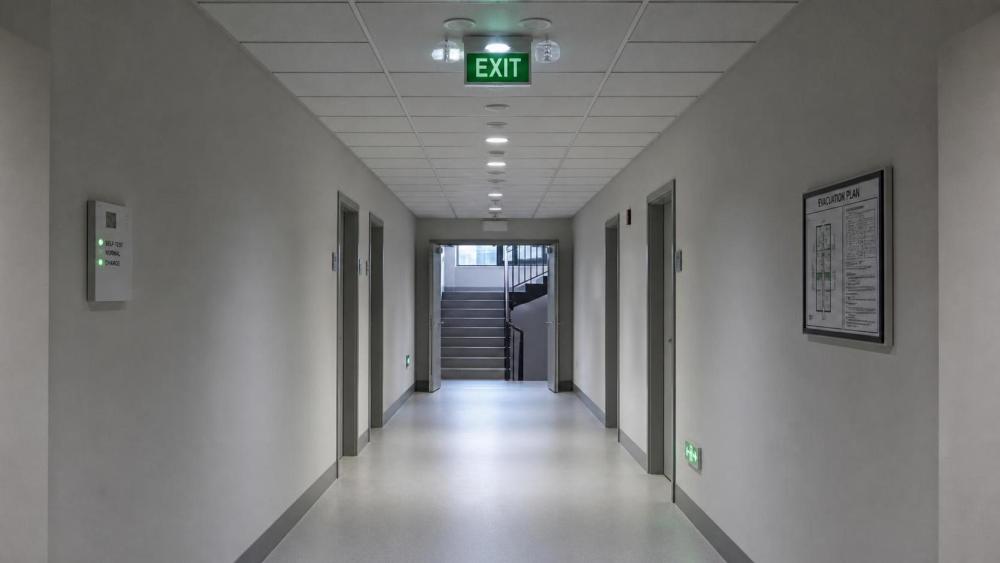
In broad terms, these requirements address the illumination of means of egress when normal lighting fails. Stairways, exit access corridors, aisles, ramps, passageways, and exit discharge areas are frequent focus points. Emergency power arrangements, operating duration, testing, wiring methods, and exit marking requirements may vary by occupancy, building type, and governing code edition.
For evaluators comparing suppliers, two distinctions matter:
- Product listing versus project compliance: A listed product is an important starting point, but fixture selection and installation must still meet the conditions of the particular building and code pathway.
- Centralized versus unit equipment systems: Battery-backed unit equipment, central inverter systems, generator-supported emergency circuits, and other architectures bring different installation, maintenance, and resilience considerations.
UL 924 is a central product standard in this category, covering emergency lighting and power equipment. Procurement teams should confirm applicable listings, labeling, electrical ratings, battery configuration, and documentation rather than relying on generic claims of “code compliant.” The final approval authority remains the local inspector or AHJ, especially where renovations involve existing conditions that do not fit a simple new-build template.
For multi-state owners, code variation can be an expensive blind spot. A national product strategy may be efficient, yet installation rules, testing expectations, seismic requirements, accessibility considerations, and local amendments can differ. The better sourcing model combines portfolio-level standardization with a local compliance review before release to site.
Where Growth Is Concentrating
The US emergency lighting market is broad, but not all segments are expanding for the same reason. Some are driven by construction, others by aging infrastructure, occupancy risk, or operating complexity.
Healthcare and senior living
Hospitals, outpatient centers, rehabilitation facilities, and senior living communities place a particularly high value on continuity and dependable wayfinding. Evacuation may be slower, patients may be mobility-limited, and parts of the facility may operate around the clock. These environments favor carefully planned lighting layouts, durable housings, dependable battery performance, and maintenance systems that reduce the chance of a missed failure.
Healthcare buyers also tend to examine cleanability, infection-control concerns, low-glare performance, and compatibility with broader facility electrical infrastructure. The result is a market segment where basic fixture cost is rarely the only decision factor.
Education and public-sector facilities
School districts, universities, municipal buildings, transit-adjacent facilities, and public assembly spaces often manage large portfolios with mixed building ages. Budget cycles can delay upgrades, allowing small deficiencies to accumulate over time. When capital work finally begins, procurement teams may seek standardized exit and emergency lighting families that simplify spare parts, staff training, and future replacements.
For these buyers, contractor availability and installation speed can be nearly as important as product design. Retrofit-friendly units, clear wiring instructions, field-replaceable components where appropriate, and dependable supply availability can influence an award decision.
Warehouses, logistics, and light industrial sites
Distribution centers have become a notable source of demand as logistics networks expand and older facilities are adapted for higher throughput. Long travel distances, high ceilings, rack layouts, cold-storage zones, loading areas, and changing floor plans complicate emergency lighting design. A fixture that works well in a standard corridor may not be suitable for a dusty production area or a high-bay aisle.
Industrial and warehouse applications often require closer attention to environmental ratings, mounting method, emergency remote-head capability, temperature range, and the practical accessibility of units during testing or service. In facilities that cannot easily pause operations, a reliable, low-maintenance design has direct operational value.
Multifamily, hospitality, and mixed-use properties
Apartment buildings, hotels, student housing, and mixed-use developments create steady demand through both new construction and renovation. Owners must balance safety expectations with visual integration in common areas such as lobbies, corridors, stairwells, garages, amenity floors, and exterior exit routes.
This segment is also sensitive to property management realities. A failed exit sign or emergency fixture may seem minor until it becomes a cited deficiency before a lease-up, inspection, refinancing event, or property sale. Products that support quick inspection, consistent appearance, and easy replacement across multiple sites are especially relevant here.
Self-Testing and Connected Systems: A Shift in the Value Proposition
Manual monthly and annual testing is one of the less visible costs in emergency lighting ownership. Facility staff may need to activate test functions, verify operation, document results, identify failures, schedule repairs, and retain records for review. In a small building, this burden may be manageable. Across a campus or national portfolio, it becomes a recurring compliance task with room for human error.
Self-testing emergency lighting products can automate portions of functional testing and indicate faults through visual status signals or diagnostic outputs. Networked systems may offer more centralized monitoring, although they introduce additional considerations around system compatibility, commissioning, cybersecurity, data ownership, and service support.
These technologies are not automatically the right choice for every site. A simple battery-backed unit may remain the most sensible option in a small, low-complexity property. But in larger portfolios, buyers increasingly evaluate emergency lighting through a total-cost-of-ownership lens: How many labor hours can testing require? How quickly can a failed device be located? Is documentation available when an inspection occurs? What happens when a product family is discontinued?
The practical market trend is therefore not “smart everything.” It is a more selective use of diagnostics where maintenance complexity justifies the investment.
What Business Evaluators Should Look for in Supplier Assessments
Emergency lighting procurement should not be reduced to a catalog comparison. A more useful assessment asks whether a supplier can support the lifecycle of a life-safety category.
One common mistake is to assume that all emergency luminaires are interchangeable once their basic voltage and runtime specifications appear similar. In reality, housing material, ingress protection, operating temperature, optics, mounting configuration, battery design, and emergency output can materially change suitability. Harsh industrial environments, damp locations, architectural interiors, and remote egress routes each create different requirements.
Retrofit Activity Will Remain a Major Opportunity
New construction supports demand, but retrofit cycles are likely to remain central to the US emergency lighting market. Commercial real estate owners continue to invest selectively in modernization, tenant improvements, energy upgrades, safety corrections, and repositioning projects. Emergency lighting is often included because ceilings are open, electrical work is already underway, or inspections have identified deficiencies.
Retrofit decisions are rarely isolated. An owner upgrading general lighting to LED may reconsider emergency coverage. A warehouse converting storage areas to active picking zones may need a different egress layout. A hotel renovation may require emergency fixtures that better fit the interior design while preserving life-safety performance. These situations reward suppliers and sourcing teams that can translate product features into site-specific decisions.
There is also a growing need to plan around obsolescence. Facilities with many legacy fixtures should identify which models are approaching end of support, which batteries are difficult to replace, and where inconsistent product families increase maintenance burden. A phased replacement plan can be less disruptive than reacting to failures one building at a time.
A Market Where Reliability Is the Real Differentiator
The outlook for the US emergency lighting market is supported by forces that are unlikely to disappear: mandatory life-safety obligations, aging building stock, LED conversion, increasingly complex facilities, and a preference for maintenance-efficient systems. Demand may fluctuate with construction cycles, but the need to keep egress routes illuminated remains fundamental.
For business evaluators, the most credible opportunities are not always found in the lowest-cost fixture category. They are found where product reliability, clear compliance evidence, service continuity, and operational fit come together. A well-chosen emergency lighting program protects more than a project budget. It helps a building remain ready for the moment when ordinary lighting is no longer there.
For procurement teams following lighting and display supply chains, ongoing review of code adoption, LED platform changes, diagnostic capabilities, and supplier documentation practices will be essential. In a category built around emergency readiness, the strongest sourcing decisions are made long before an emergency occurs.
Recommended News
 Supply Chain InsightsHow to find a custom-printed ring-pull can supplier for small ordersFind a custom printed ring pull cans supplier for small orders. Compare MOQs, printing options, samples, and delivered costs to launch confidently without excess inventory.Oct 15, 2026
 Home DecorHow order size affects wholesale prices for round linen tableclothsBuying round linen tablecloths wholesale? Discover how order size, freight, and inventory costs affect pricing—and choose the right quantity to maximize real savings.Interior Sourcing LeadOct 14, 2026
 Outdoor FurnitureHow to verify outdoor furniture manufacturers' production capacityCan outdoor furniture manufacturers deliver on time? Learn how to verify production capacity, uncover bottlenecks, and validate supplier commitments before placing your next order.Interior Sourcing LeadOct 13, 2026
 Commercial DisplaysWhat makes an outdoor digital signage display manufacturer reliable?Discover how to choose a reliable outdoor digital signage display manufacturer with proven weather protection, quality control, smart visibility, and responsive after-sales support.Commercial Tech EditorOct 12, 2026