Industry News
Curation by industry experts
Hot Articles
Popular Tags
Bamboo Cotton Blend vs. Pure Cotton: Choosing Fabrics for Summer Basics
For procurement teams sourcing summer basics, the choice between a bamboo cotton blend and pure cotton reaches beyond a fabric hand-feel decision. It influences the garment’s comfort story, production consistency, care expectations, retail positioning, and the credibility of sustainability messaging. A T-shirt that feels cool and smooth on a hanger may perform very differently after repeated washing, dyeing, packing, and shipment through a humid supply chain.
Pure cotton remains the familiar benchmark for essentials such as tees, underwear, sleepwear, jersey dresses, and lightweight loungewear. Bamboo-derived regenerated cellulosic fiber, commonly sold as bamboo viscose or bamboo rayon depending on the market and labeling rules, adds softness and moisture-management appeal when blended with cotton. Yet it also introduces questions around fiber traceability, processing chemistry, pilling, shrinkage control, and claim substantiation.
The right choice is rarely “bamboo cotton blend is better” or “cotton is safer.” It depends on the product brief, target price, intended wear cycle, climate, brand promise, and supplier capability. Buyers who treat fabric selection as an early-stage risk-management exercise are more likely to avoid costly quality adjustments later in development.
Start with the summer-basic use case, not the fiber trend
Summer basics serve different consumer needs. A heavyweight logo tee for a streetwear collection needs body, opacity, and shape retention. A close-fitting camisole may need softness, stretch recovery, and reduced cling. A men’s undershirt must cope with perspiration, repeated laundering, and possible deodorant residue. These are not interchangeable fabric problems.
Pure cotton often works well where familiarity, natural-fiber positioning, print performance, and rugged wash behavior are central to the program. A bamboo cotton blend is more compelling when the product is designed around a notably soft touch, a fluid drape, or a next-to-skin comfort message. The blend can help an otherwise ordinary basic feel more elevated, particularly in fine jersey, rib, interlock, and sleepwear constructions.
Before requesting lab dips or sample yardage, a sourcing team should translate the consumer promise into measurable fabric requirements:
- Target fabric weight, opacity, and silhouette stability
- Required stretch and recovery, including the role of elastane if used
- Expected wash frequency and acceptable shrinkage range
- Desired moisture behavior during warm-weather wear
- Print, embroidery, garment-dye, or finish requirements
- Market-specific labeling and sustainability-claim requirements
- Target landed cost and acceptable supply-chain complexity
This brief prevents a common mistake: selecting a fiber blend based on a swatch, then trying to engineer durability, recoverability, and compliance into the garment afterward.
How bamboo cotton blend and pure cotton differ in wear
Pure cotton is a natural cellulosic fiber with a well-understood performance profile. Its absorbency, breathability, and comfort have made it a default for warm-weather apparel for generations. Cotton can feel crisp, dry, lofty, compact, or soft depending on staple length, yarn count, knit structure, finishing, and garment wash. In other words, “100% cotton” says less about final quality than many buying teams assume.
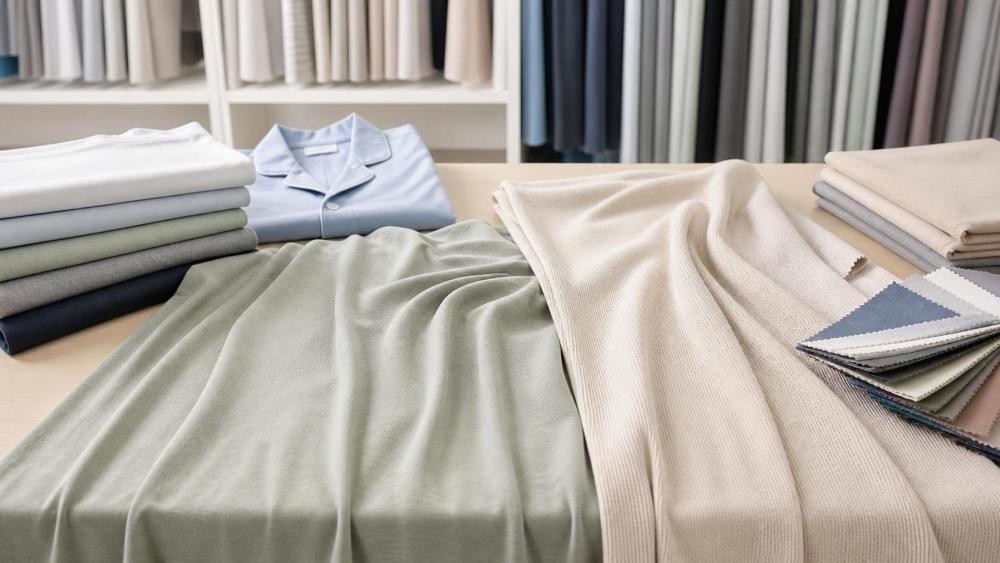
A bamboo cotton blend combines cotton with regenerated cellulosic fibers produced from bamboo feedstock. The bamboo component generally contributes a smoother, silkier surface and more fluid drape. In a fine knit, this can create a cool-to-the-touch sensation that consumers often associate with premium comfort. Cotton contributes a more familiar dry hand, structure, and resilience to the blend.
For summer basics, the practical distinction lies in how these attributes work together. Bamboo-derived fiber can absorb moisture efficiently and may feel less rough when damp. Cotton also absorbs moisture well, but a garment can feel heavier once saturated. Neither fiber should be confused with a high-performance synthetic moisture-wicking system: both are hydrophilic fibers that take up moisture. Garment construction, fabric weight, finish, fit, and airflow determine how comfortable the wearer actually feels in heat.
The softness advantage has a commercial trade-off
The most persuasive argument for a bamboo cotton blend is tactile differentiation. In crowded basic-apparel categories, touch can be a meaningful conversion driver. A buyer evaluating samples at a line review may immediately notice the smoothness of a bamboo-rich jersey against a standard cotton alternative. That sensory advantage can support a more refined product narrative without relying on elaborate design details.
However, a softer hand is not automatically a stronger commercial fabric. Bamboo-rich blends may have less surface robustness than a well-engineered cotton jersey, particularly when yarn quality, twist, knitting tension, and finishing are not tightly managed. Pilling, skewing, bagging at stress points, and excessive shrinkage can become visible after several wash cycles. These risks are especially relevant for dark shades, lightweight fabrics, and body-hugging silhouettes.
For procurement teams, the key is to distinguish between initial sample softness and retained softness after use. Request washed panels, not only unwashed hanger swatches. Compare specimens after the same laundering protocol. Examine the surface under normal retail lighting, then review it under closer inspection for fuzzing and color change. A fabric that wins the first touch test but loses its clean appearance after three washes can create a costly returns problem.
Composition percentages matter, but construction matters more
There is no universal ideal ratio for bamboo and cotton. A modest bamboo content may soften a cotton-led fabric while retaining much of cotton’s familiar structure. A bamboo-dominant blend can deliver a more luxurious drape but may need more disciplined technical development. The final result changes again when elastane, polyester, modal, or recycled fibers enter the blend.
Buyers should therefore evaluate composition together with yarn type, fabric construction, weight, and finish. A compact-spun cotton jersey and an open-end cotton jersey can behave very differently despite both being labeled 100% cotton. Similarly, two fabrics with the same bamboo-cotton ratio may vary in pilling resistance and shrinkage because of yarn twist, knitting gauge, enzyme treatment, silicone softening, or heat-setting processes.
For a stable core tee, a cotton-forward single jersey may be the safer route. For women’s lounge separates or premium underwear, a finer bamboo cotton blend in rib or interlock can be appropriate, provided stretch recovery and wash durability are validated. A lightweight summer top may benefit from the blend’s drape, while a structured boxy tee may lose its intended silhouette if the fabric is too fluid.
Do not treat “bamboo” as a sustainability shortcut
Sustainability is where fabric discussions can become misleading. Bamboo grows quickly in many regions and is often presented as a renewable raw material. But most bamboo fibers used in apparel are regenerated cellulosic fibers. Their environmental profile depends not only on the feedstock but also on the chemical conversion process, water management, energy sources, wastewater controls, and chain-of-custody documentation.
That does not disqualify bamboo-derived fiber from responsible sourcing. It means buyers should ask better questions. What is the fiber’s technical and legal name in the destination market? Is the supplier using traceable raw material? What manufacturing route is involved? Which transaction documents support the stated composition? Are environmental claims limited to what can be substantiated?
Pure cotton also requires careful scrutiny. Conventional cotton can involve substantial agricultural inputs, while preferred cotton programs may offer stronger traceability or improved farming frameworks. But procurement teams should not assume that any cotton claim is automatically comparable across regions, suppliers, or certification schemes.
A credible product page or packaging statement should be specific and restrained. Claims such as “made with bamboo-derived regenerated cellulosic fiber” may be more accurate than broad, unqualified environmental language. Legal review is particularly important for products sold across North America, Europe, and other markets with different textile labeling and green-claim rules.
Supplier evaluation: the questions that reveal execution capability
Fabric selection should be paired with supplier assessment early, especially for repeat programs. A mill’s ability to make a beautiful development sample is not the same as its ability to maintain shade, width, weight, and hand feel across production lots.
When reviewing a bamboo cotton blend supplier, ask for clarity on the fiber source, spinning route, knitting or weaving setup, finishing sequence, and internal testing procedures. Request lot-to-lot records where available. For both blend and pure-cotton programs, the most useful discussion is often not about generic fiber advantages but about control points: How are shrinkage and spirality managed? How is shade continuity monitored? What is the standard approach to pilling tests? Are fabric lots relaxed before cutting? Who approves bulk hand feel against the signed standard?
For apparel buyers, a practical pre-production testing plan should typically consider:
- Fiber composition verification and labeling accuracy
- Fabric weight, usable width, and dimensional stability after laundering
- Colorfastness to washing, perspiration, rubbing, and light as relevant
- Pilling and abrasion performance for the intended end use
- Spirality, skew, and garment torque in knitted constructions
- Stretch and recovery where rib or elastane is included
- Restricted-substance and chemical-management requirements
Test standards and acceptance levels should be aligned with the product category and market rather than copied indiscriminately from another program. Underwear, children’s apparel, fashion tees, and workwear basics carry different real-world risks.
Cost should be assessed as a program cost, not a fabric-price comparison
A bamboo cotton blend may carry a higher fabric cost than a comparable conventional cotton option, though the gap varies by composition, origin, yarn quality, and order volume. Looking only at price per kilogram can obscure the commercial picture. Fabric yield, cutting waste, garment weight, rework rates, packing requirements, and anticipated retail positioning all affect the final decision.
For example, a softer blend may justify a higher retail tier in sleepwear or intimate basics, where comfort is easy for shoppers to understand. In contrast, a value-focused promotional T-shirt may benefit more from dependable cotton availability, simple decoration, and predictable replenishment. If the product cannot command a differentiated shelf story, the additional sourcing complexity may not create enough value.
Lead time also deserves attention. Cotton is broadly available through established global supply networks, while bamboo-derived fiber availability can depend on approved source channels and mill relationships. Procurement teams managing seasonal launches should confirm fiber booking, dyehouse capacity, and bulk approval timing before committing to a blend-led collection.
A practical choice framework for summer basics
Choose pure cotton when the program needs broad consumer familiarity, a more structured casual look, dependable printing performance, straightforward replenishment, or a clearly natural-fiber product position. It is particularly suitable for classic crew-neck tees, polos, children’s basics, utility jerseys, and garments expected to take repeated abrasion.
Choose a bamboo cotton blend when sensory comfort is a central part of the product proposition and the garment benefits from a softer, smoother, more draped character. It can be a strong option for premium loungewear, lightweight sleepwear, base layers, underwear, fitted tees, and soft summer separates. The decision should be supported by wash testing, accurate labeling, and a supplier that can control bulk consistency.
In many assortments, the strongest strategy is not to replace cotton across the board. It is to assign each fabric to a clear role. Cotton can anchor reliable, high-volume core styles. Bamboo cotton blends can create an elevated comfort tier where the touch, drape, and shopper story are visible enough to matter.
That approach gives buyers room to balance commercial discipline with product distinction. In summer basics, the best fabric is not simply the one with the most appealing claim or the lowest quoted cost. It is the one that still feels right after wear, washing, transport, retail handling, and the consumer’s second purchase.
Recommended News
 Supply Chain InsightsHow to find a custom-printed ring-pull can supplier for small ordersFind a custom printed ring pull cans supplier for small orders. Compare MOQs, printing options, samples, and delivered costs to launch confidently without excess inventory.Oct 15, 2026
 Home DecorHow order size affects wholesale prices for round linen tableclothsBuying round linen tablecloths wholesale? Discover how order size, freight, and inventory costs affect pricing—and choose the right quantity to maximize real savings.Interior Sourcing LeadOct 14, 2026
 Outdoor FurnitureHow to verify outdoor furniture manufacturers' production capacityCan outdoor furniture manufacturers deliver on time? Learn how to verify production capacity, uncover bottlenecks, and validate supplier commitments before placing your next order.Interior Sourcing LeadOct 13, 2026
 Commercial DisplaysWhat makes an outdoor digital signage display manufacturer reliable?Discover how to choose a reliable outdoor digital signage display manufacturer with proven weather protection, quality control, smart visibility, and responsive after-sales support.Commercial Tech EditorOct 12, 2026