Industry News
Curation by industry experts
Hot Articles
Popular Tags
How Bamboo Blend Fabrics Perform in Knitwear, Bedding, and Activewear
How Bamboo Blend Fabrics Perform in Knitwear, Bedding, and Activewear
For technical evaluators, a bamboo blend is not a single material specification. It is a performance variable shaped by fiber ratio, yarn structure, knit or woven construction, fabric weight, dyeing route, and finishing. Two fabrics sold under the same broad description can behave very differently in wear, washing, pilling, drying time, and dimensional stability.
That distinction matters because bamboo-derived regenerated cellulosic fibers are often selected for their soft hand, moisture affinity, and smooth surface. Those qualities can be useful, but they do not automatically make a fabric suitable for every end use. A soft bamboo blend jersey may be excellent for a next-to-skin sleep top yet underperform in a high-abrasion training garment. A bamboo blend sheet may feel luxurious out of the package but need better yarn selection and finishing control to retain its appearance after repeated laundering.
The practical question is not whether bamboo blend fabrics are “good.” It is whether a particular construction is good enough for the intended product, care conditions, price tier, and expected service life.
Start With What “Bamboo Blend” Actually Means
In most apparel and home-textile supply discussions, bamboo refers to a regenerated cellulose fiber made from bamboo feedstock rather than mechanically extracted bamboo bast fiber. The fiber may be blended with cotton, polyester, nylon, wool, elastane, or other cellulosic fibers. From a performance standpoint, the companion fiber often determines whether the final fabric holds its shape, withstands abrasion, dries quickly, or feels warmer in use.
A bamboo-cotton blend usually aims for a balance of softness and familiar cotton handling. Bamboo-polyester constructions generally target improved strength, drying behavior, and shape retention. Bamboo-elastane fabrics are commonly used where stretch and body-hugging comfort are priorities. In knitwear, a bamboo-wool or bamboo-cotton yarn may be used to reduce the dry, scratchy perception sometimes associated with coarser natural-fiber blends.
The name on a fabric swatch is therefore only a starting point. Before approving a sample, evaluators should request the nominal blend ratio, yarn count or yarn system, fabric construction, finished weight, width, care recommendation, and available test reports. A supplier that can describe the yarn and finishing route clearly is generally easier to work with than one relying only on generic “eco-soft” claims.
Why the Fiber Feels Soft but Can Still Create Development Issues
Bamboo-derived regenerated cellulose typically has a smooth surface and a fluid drape. In lightweight jersey, rib, and interlock, this can produce a noticeably supple hand with less surface harshness than many conventional cotton constructions. For sleepwear, intimate apparel, base layers, and bedding, that hand feel is often the commercial reason the blend enters the specification in the first place.
The trade-off is that softness and drape are not the same as resilience. A fabric that hangs beautifully may show more growth at stress points if the knit structure is loose or if recovery has not been engineered into the blend. In practical terms, this can appear as bagging at knees and elbows, stretched necklines, hem distortion, or a mattress sheet that looks less crisp after laundering.
Pilling is another area where broad material claims can be misleading. Pilling risk is influenced by fiber strength, staple length, yarn hairiness, twist level, construction density, brushing, and use conditions. Adding polyester may improve durability in one fabric but can also make pills more persistent once they form, because stronger synthetic fibers anchor them to the surface. A compact-spun yarn, tighter construction, and sensible finishing choices may matter more than simply changing the blend percentage.
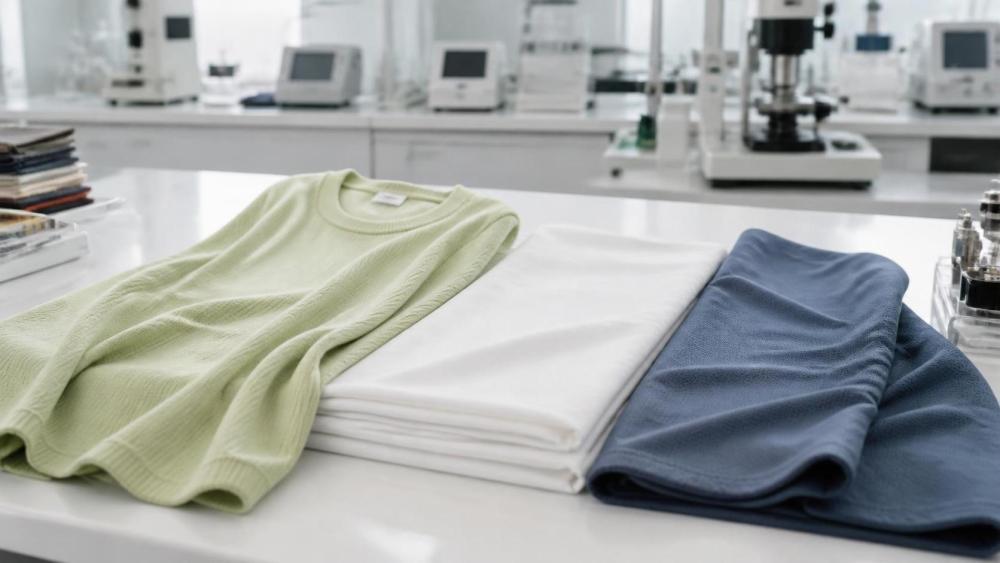
Knitwear: Drape Is an Advantage, Recovery Needs Deliberate Engineering
In knitwear, bamboo blend yarns are often valued for a soft, relaxed appearance. Fine-gauge sweaters, cardigans, lightweight pullovers, and transitional-season tops can benefit from the fiber’s fluidity. A bamboo-cotton or bamboo-wool blend may also make a garment feel more approachable for consumers who dislike the dry hand of some traditional knitwear.
However, knitwear is where structure becomes especially important. A loose plain knit made with a low-twist yarn may look elegant on the sample table but grow noticeably during wear. This is particularly relevant for long cardigans, wide-neck pullovers, garments with patch pockets, and products sold on hangers. The issue may not be visible until a wash-and-wear trial, which is why lab-only evaluation is not enough for a drapey knit.
For shape-sensitive styles, development teams commonly look at a more stable stitch structure, reinforced rib edges, compatible elastane content, or a yarn blend that provides more elastic memory. The right solution depends on the silhouette. A fitted rib top needs recovery; an oversized summer knit may accept more relaxation if its visual concept is intentionally soft and casual.
Color is another practical consideration. Regenerated cellulosic fibers can deliver rich coloration, but shade consistency should be reviewed across lots, especially where bamboo-derived fiber is blended with fibers that take dye differently. Heather effects, deep shades, and contrast trims deserve early strike-off approval. It is much cheaper to identify tonal mismatch before bulk knitting than after garment assembly.
Bedding: Comfort Is Easy to Sell; Wash Durability Is the Real Test
Bamboo blend bedding is usually positioned around softness, smoothness, and perceived coolness. These benefits can be real in a well-made fabric, especially when the construction supports close skin contact and the finish does not create an overly stiff surface. Moisture absorption can also improve the initial comfort experience compared with a fabric that feels plasticky or traps humidity at the skin interface.
But bedding is a laundering-intensive application. Sheets, pillowcases, duvet covers, and mattress protectors are exposed to repeated washing, detergent residues, friction in domestic machines, and sometimes high-temperature drying. A bedding fabric should not be approved solely because it feels exceptionally soft in its first presentation.
For this category, technical review should focus on dimensional change, seam slippage where relevant, colorfastness under the stated care regime, surface appearance after repeated wash cycles, and fitted-sheet elastic performance. Construction density and yarn quality are often more important to long-term satisfaction than marketing language around fiber origin. A very lightweight fabric may be appropriate for a value-oriented summer sheet set, but it may not meet the expectations attached to a premium hotel, retail, or direct-to-consumer positioning.
Bamboo blends can also be useful in knitted bedding products such as jersey sheets, pillow protectors, and mattress textiles. Here, stretch offers a functional advantage, particularly for fitted applications. Yet the same stretch can complicate cutting, sewing, and dimensional control. Technical teams should examine both fabric relaxation before cutting and finished-product measurements after washing. A pattern that works for cotton jersey cannot always be transferred unchanged to a softer, more extensible bamboo blend.
Activewear: Moisture Comfort Does Not Equal High-Performance Moisture Management
Bamboo blend fabrics are frequently considered for yoga wear, studio apparel, athleisure, lounge-active hybrids, and low-to-moderate intensity training products. In these uses, a soft hand, quiet surface, and moisture-absorbing feel can be more valuable than rapid evaporation alone. A bamboo blend legging or tee can feel comfortable during everyday movement because the fabric is pleasant against skin and less overtly synthetic in character.
The performance requirement changes when the garment is intended for running, cycling, field training, or high-sweat gym use. Cellulosic fibers can absorb moisture, but absorption is not identical to fast drying. A fabric may take in perspiration readily and still remain wet longer than a carefully engineered polyester or nylon performance knit. For endurance or high-output sportswear, this difference can affect perceived weight, cling, thermal comfort, and post-exercise drying time.
That does not rule out bamboo blends. It means the blend should be built around the activity. Polyester or nylon can provide structural durability and drying support, while elastane supplies stretch and recovery. The bamboo-derived component can soften the hand and improve next-to-skin comfort. Fabric mapping may also be worth considering: a softer bamboo blend for low-friction body panels and a more technical synthetic knit in zones exposed to high sweat, pack abrasion, or repeated mechanical stress.
Be cautious with unsupported antimicrobial claims. Buyers may associate bamboo with odor control, but finished-garment odor performance depends on the complete textile system, use conditions, laundering, and any verified treatment applied. Claims should match test evidence and local labeling requirements, not assumptions about the feedstock.
A Practical Evaluation Matrix Before Bulk Approval
Questions That Prevent Costly Misalignment
A useful sourcing conversation goes beyond asking for a bamboo blend swatch book. Ask what proportion of the fabric is bamboo-derived regenerated cellulose, what fibers complete the blend, and whether the stated composition is based on finished fabric weight. Ask whether the fabric is open-width or tubular, whether it is compacted or pre-shrunk, and how much variation may occur between production lots. These questions are not administrative detail; they reveal whether the supplier understands the product as a controlled textile system.
It is also worth separating aesthetic approval from performance approval. A hand-feel sample can be accepted early, but bulk commitment should follow an agreed specification that covers weight tolerance, width, shade standard, dimensional change, stretch requirements where applicable, and the test methods both parties will use. The right methods depend on the destination market, customer requirements, and product category, so they should be confirmed at project level rather than copied from an unrelated fabric program.
For buyers managing several categories, this is where a cross-functional review becomes useful. Design may prioritize drape, merchandising may focus on the consumer story, quality teams may flag wash results, and sourcing may be watching capacity and lead time. None of those perspectives is wrong. Problems arise when one of them becomes the entire specification.
The Better Decision Is Usually Application-Specific
Bamboo blend fabrics perform best when their role is clearly defined. In knitwear, they can deliver softness and drape, provided recovery and structural stability are designed into the garment. In bedding, they can create an inviting sleep surface, but laundry durability must be validated before premium claims are made. In activewear, they are often strongest in comfort-led categories and mixed-intensity use, while demanding performance sportswear generally needs support from more durable, faster-drying fibers and carefully engineered constructions.
For global sourcing teams, the reliable route is to evaluate the whole chain: fiber disclosure, yarn choice, knitting or weaving, wet processing, garment construction, care expectations, and repeatability at bulk scale. Global Supply Review follows this kind of category-led approach because material decisions rarely sit in isolation; they affect quality control, claims substantiation, supplier communication, and the long-term commercial outcome of the finished product.
A bamboo blend should earn its place in the specification through the product it helps create, not through the appeal of its name alone.
Recommended News
 Home DecorHow order size affects wholesale prices for round linen tableclothsBuying round linen tablecloths wholesale? Discover how order size, freight, and inventory costs affect pricing—and choose the right quantity to maximize real savings.Interior Sourcing LeadOct 14, 2026
 Outdoor FurnitureHow to verify outdoor furniture manufacturers' production capacityCan outdoor furniture manufacturers deliver on time? Learn how to verify production capacity, uncover bottlenecks, and validate supplier commitments before placing your next order.Interior Sourcing LeadOct 13, 2026
 Commercial DisplaysWhat makes an outdoor digital signage display manufacturer reliable?Discover how to choose a reliable outdoor digital signage display manufacturer with proven weather protection, quality control, smart visibility, and responsive after-sales support.Commercial Tech EditorOct 12, 2026
 Garment MfgWhen do bulk embroidered hoodies offer better value than printed ones?Bulk embroidered hoodies deliver lasting value for uniforms and premium branding. Compare durability, design, comfort, and cost to choose the right decoration.Textile Industry AnalystOct 11, 2026